Citation Analysis
What this is for, in one sentence: Citation Analysis shows whether AI platforms actually credit your site when they answer questions in your space: how often you win the citation, how often a competitor wins it instead, and which domains AI trusts most.
When to come here:
- To answer the publisher’s core question: when AI talks about our beat, do we get the citation, or does a competitor?
- Before a licensing, syndication, or partnership conversation, to bring a real number: how often AI already treats your site as a source in this category.
- When a specific competitor keeps winning the citation on questions you cover too, and you want to see exactly which domain, and how often.
Nadia Rahman’s problem at GreenGrid Media isn’t whether AI answers solar questions, it’s who gets the credit when it does. Every citation that goes to SunReport or VoltDaily instead of GreenGrid is attribution GreenGrid’s reporting earned and didn’t collect. This screen turns that from a hunch into three numbers and a ranked list of who is actually winning.
The headline: three numbers on one scope
Section titled “The headline: three numbers on one scope”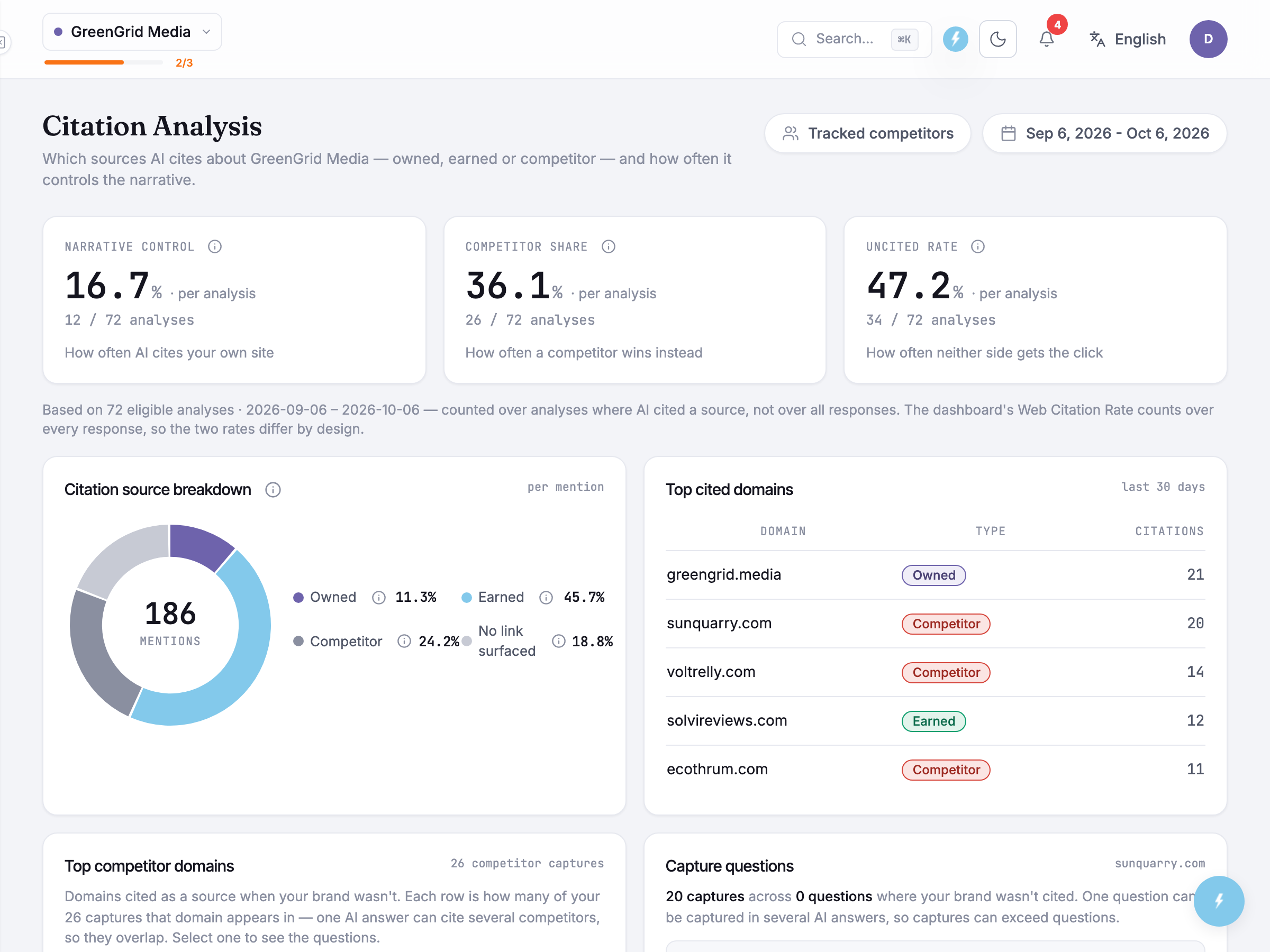
Next to the date range sits a Tracked competitors link, through to Competitive AI Performance, the head-to-head table of GreenGrid against the rivals configured in its own brand profile, not every competitor AI happens to cite.
Three cards split this period’s 72 eligible analyses by who got the citation:
Narrative Control: 16.7%. How often AI cites your own site. In 12 of the 72, AI cites greengrid.media directly.
Competitor Share: 36.1%. How often a competitor wins instead. In 26 of the 72, GreenGrid isn’t cited but a rival is: SunReport, VoltDaily, or EcoWire.
Uncited Rate: 47.2%. How often neither side gets the click. The remaining 34 answers credit nobody at all.
The line underneath the cards states the scope for all three: 72 eligible analyses, meaning analyses where AI cited a source at all, not every response GreenGrid tracks. That’s a narrower, deliberately different base than the Web Citation Rate on the AI Visibility Report dashboard, which counts over every response. The two figures answer different questions, so don’t expect them to match.
Where the citations go: source mix and the trust list
Section titled “Where the citations go: source mix and the trust list”Below the cards, Citation source breakdown turns the same period into a per-mention mix, so a domain that gets named without a link still counts. The donut splits the period’s 186 mentions four ways, shown as shares: owned pages 11.3%, earned coverage 45.7%, competitor domains 24.2%, and 18.8% where a source was named but no link surfaced. Competitor domains alone out-cite GreenGrid’s own by more than two to one.
Beside it, Top cited domains ranks the domains AI leans on most in this category by citation count, with its own range note in the panel header, roughly the last 30 days, independent of the date range set above. GreenGrid sits at the top with 21 citations, marked Owned, but sunreport.com is one behind at 20, and two more rivals make the list: voltdaily.com at 14 and ecowire.com at 11. solarreviewshub.com (12) is the one non-brand earned domain to break in. This panel itself doesn’t expand: it’s a flat, five-row ranking with no per-domain drill-down into which page, prompt, or engine earned a given citation. For that level of detail, see the full domain list further down the page, described next.
Further down the page: the full domain list, with evidence
Section titled “Further down the page: the full domain list, with evidence”Below the four panels above, past what the screenshot captures, the same screen carries a second, larger domain table: every domain AI has cited for GreenGrid, not just the top five, with Search domain… to filter it by name and pills for All, Owned, Earned, and Competitor (each with its own count) to filter it by type. Selecting Earned opens a second row of category pills to narrow further: All earned, Social, App store, Directory, Forum, and Press & other.
Each row lists the Domain, its Classification, its Citations count, and an Action column. Domains are matched to your brand automatically; some may belong to unrelated companies with similar names.
The Action column’s Reclassify control lets you move a domain between Owned, Earned, and Competitor by hand when the automatic classification looks wrong: the row shows Updating while the request is in flight, and the domain re-sorts into its new bucket once the change saves, or you’ll see a failure message if it doesn’t.
When one of your own domains doesn’t actually match your registered website, a hide-unverified toggle appears above the table so you can filter those flagged rows out while you sort out the mismatch.
Click any row and it expands into that domain’s evidence: the cited URL, its source type, the prompt that surfaced it, when it was answered, and a link to view the full answer. The rows cover every domain in range, not just the top five, but the evidence under each one is a sample from the latest prompts pulled, not a complete list of every citation; some domains show none at all even though their count above is real.
Competitors in the mix: who’s winning, and on what
Section titled “Competitors in the mix: who’s winning, and on what”Top competitor domains lists every domain that got the citation instead of GreenGrid, ranked by how many of the period’s competitor-won analyses it appears in. One AI answer can cite more than one competitor, so the rows overlap and won’t sum to the 26 total. This period it’s sunreport.com (20), voltdaily.com (14), and ecowire.com (11).
Selecting one of those domains fills Capture questions with the specific prompts it captured, so you can see exactly which questions GreenGrid is losing and open the full AI answer from there. Until you pick one, it just prompts you: Select a competitor to see the questions it captured.
Honest guidance: a citation is not a click. This screen measures credit inside AI answers; whether cited links convert into visits is Site Traffic’s job. The two together are your before and after: citations are the leading indicator, traffic the proof.
Honest guidance: the uncited rate doesn’t say why. 47.2% of analyses credit no one, but this screen doesn’t split that into “used your reporting without credit” versus “a generic answer nobody needed a source for.” If you want to know whether a specific flagged answer is leaning on GreenGrid’s own reporting, you’ll need to read that answer against your coverage yourself; for a structural view of where AI has nothing to cite at all, check Key Topics Analysis for the same topic’s demand-versus-presence gap.
Honest guidance: the composition-change trap. All three headline percentages share the same 72-analysis denominator. Add or remove tracked prompts and every number moves without anything changing in the world. Compare like periods.
What to do with each bucket
Section titled “What to do with each bucket”- Grow the 16.7%: GreenGrid’s cited pages are proof AI already trusts the site’s structure; keep publishing and refreshing the same way, and make sure AI can read all of it (Site Audit).
- Attack the 36.1%: sunreport.com, voltdaily.com, and ecowire.com are the names to watch. Open Competitive AI Performance to see how each one compares to GreenGrid overall, then commission or upgrade GreenGrid’s answer to the questions they’re winning (Key Topics Analysis, Take Action → Content Generator).
- Watch the 47.2%: there’s no reason code attached to it here, so treat a rising uncited rate as a prompt to check Key Topics Analysis for demand AI can’t fill from anyone yet, not as proof of anything on its own.
Common questions
Section titled “Common questions”Why does a rival get cited on a topic we cover better? AI cites what it can read, parse, and trust: recency, structure, and machine-readability often beat editorial quality. Compare the rival’s likely page structure against your own equivalent in Site Audit: the gap is usually technical, not journalistic.
What does the no-link share in the breakdown mean? A mention where AI named a source but attached no link to it. It still counts as a citation for the mix, because the credit was given, but it produced nothing a reader could click. Watch your owned share for direct credit and the earned share for third-party authority; the no-link share is the part of the conversation nobody can follow home.
We’re cited but traffic didn’t move. Is it worth anything? Citation share is the leading indicator; it builds the authority loop that compounds into presence and, over time, referral traffic. Verify the traffic side in Site Traffic; if citations rise for months with zero referral movement, the issue is usually which pages get cited, deep guides versus clickable news.
Can we see exactly which of our pages got cited, or on which prompt? For the URL and the prompt, yes: expand a domain’s row in the full domain list further down the page, and you get a sample of its citations, cited URL, type, prompt, when it was answered, and a link to the full answer, though it’s a non-exhaustive sample from the latest prompts, not every citation behind that domain’s count. What you don’t get is the AI engine behind each one; that isn’t shown here.
How often should I check this? Watch the three headline numbers each period, using whichever date range the screen is set to, and re-check Top competitor domains whenever Competitor Share moves, since that’s where a specific rival’s gain or loss shows up.
What to do next
Section titled “What to do next”- Competitive AI Performance: the head-to-head table behind every name in Top competitor domains.
- Key Topics Analysis: the demand map this screen’s credit map sits under.
- Site Audit: if AI can’t parse your pages, rivals win citations on structure alone.
- Site Traffic: the click side of the citation story.
- Take Action: turn a citation gap into a content or schema fix with Content Generator, Content Optimizer, or Schema Generator.