Prove your earned work moved the AI answer.
When a journalist, analyst, or buyer asks ChatGPT, Gemini, Perplexity, Google AI Overviews, or Google AI Mode about your client, the coverage you earned is either shaping that answer or it isn’t. Zicy measures which, and shows you which sources to earn next.
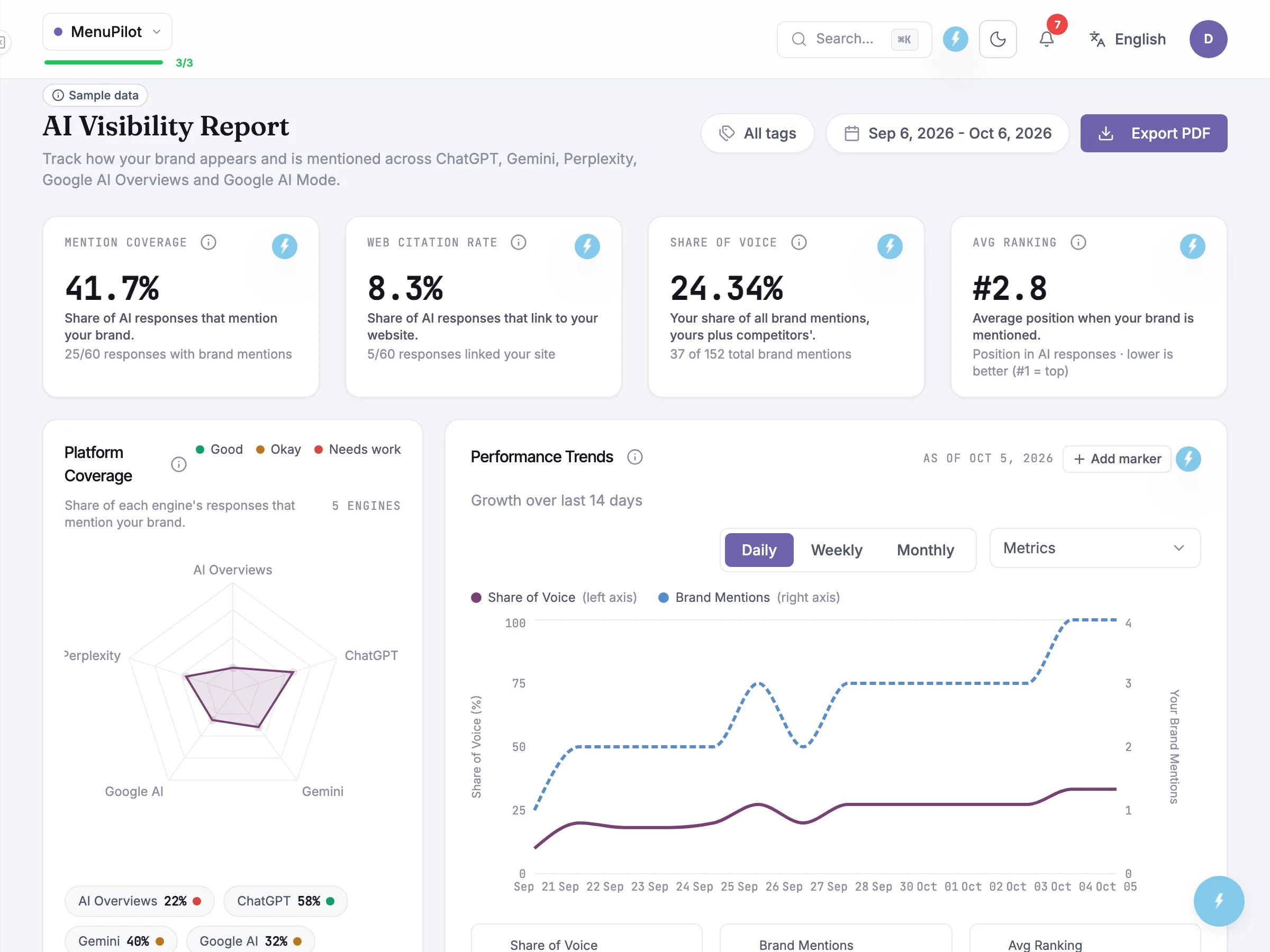
At a glance
- Zicy connects earned coverage to AI outcomes, showing which publications and sources AI actually cites when it answers questions about your brand.
- It tracks brand mention coverage, citation rate, and sentiment across ChatGPT, Gemini, Perplexity, Google AI Overviews, and Google AI Mode.
- PR teams can see whether a placement moved AI visibility, not just whether it ran.
The AI answer is now a primary place your client’s reputation is formed.
It is measurable, and most comms programmes are not yet measuring it.
The audience is already there.
More than 1 billion people now use standalone generative AI tools each month.
Buyers research inside the chat.
45% of B2B buyers used generative AI to research vendors and products in a recent purchase. Earned coverage AI can't see doesn't reach them.
The cited sources aren't the ranked ones.
Only about 38% of Google AI Overviews citations come from pages ranking in the top 10, down from 76% seven months earlier. A ranking report won't tell you which sources AI trusts.
The licensing map is being redrawn.
Publishers are signing AI content deals and suing over uncompensated use at the same time. Which outlets AI actually cites in your client's category is a moving, measurable target, not a fixed media list.
The answer’s already written. Make sure your client’s in it.
We measure the narrative. You earn it.
Zicy doesn’t pitch journalists or place coverage. Your team does that, on the merits of the work. Zicy measures whether the coverage you earned changed what AI says about your client: which sources AI cites, how sentiment shifted after a campaign, and where a competitor still owns the story.
It is the proof layer earned media has never had, a replacement for advertising-value-equivalency that measures answer movement instead of column inches.
On the earning side, our guide on how PR, news releases and Wikidata entries improve AI visibility explains which off-site sources move the answer, and which on-site markup you control directly.
Eight touchpoints, in the order the work runs: measure, diagnose, act, prove.
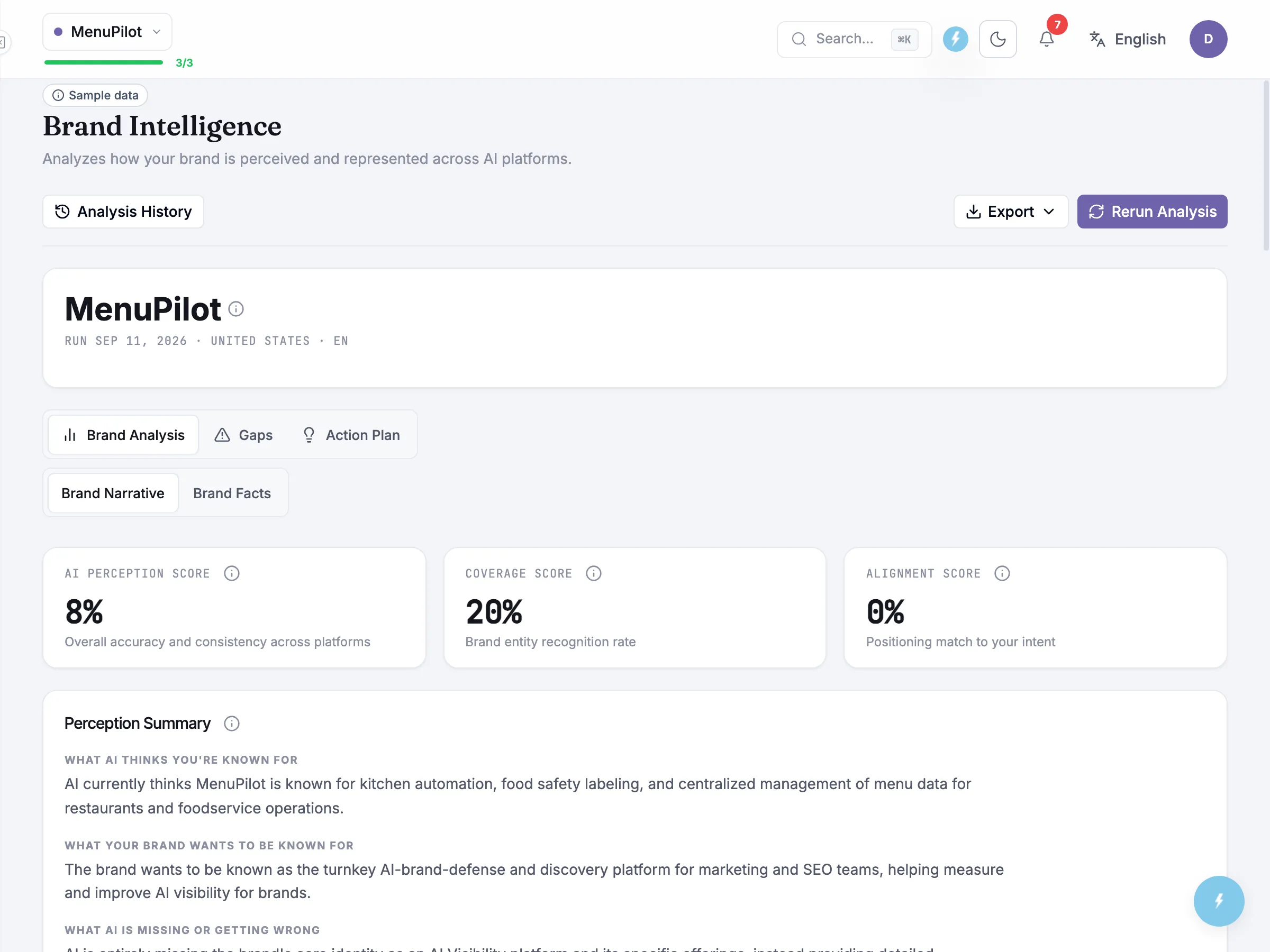
Brand Intelligence: your reputation-risk audit.
Per-engine view of misaligned sentiment, hallucinations, and not-associated signals across ChatGPT, Gemini, Google AI Overviews and Google AI Mode, in about 2 to 3 minutes; Perplexity is covered by prompt tracking. Shows where to concentrate earned media before a campaign, not after. That includes entity confusion, when AI mixes your client up with a similarly named company, flagged per engine before a journalist repeats it. Entity Audit then finds the cause on the client's own site, such as a missing sameAs link, and gives you the markup that fixes it.
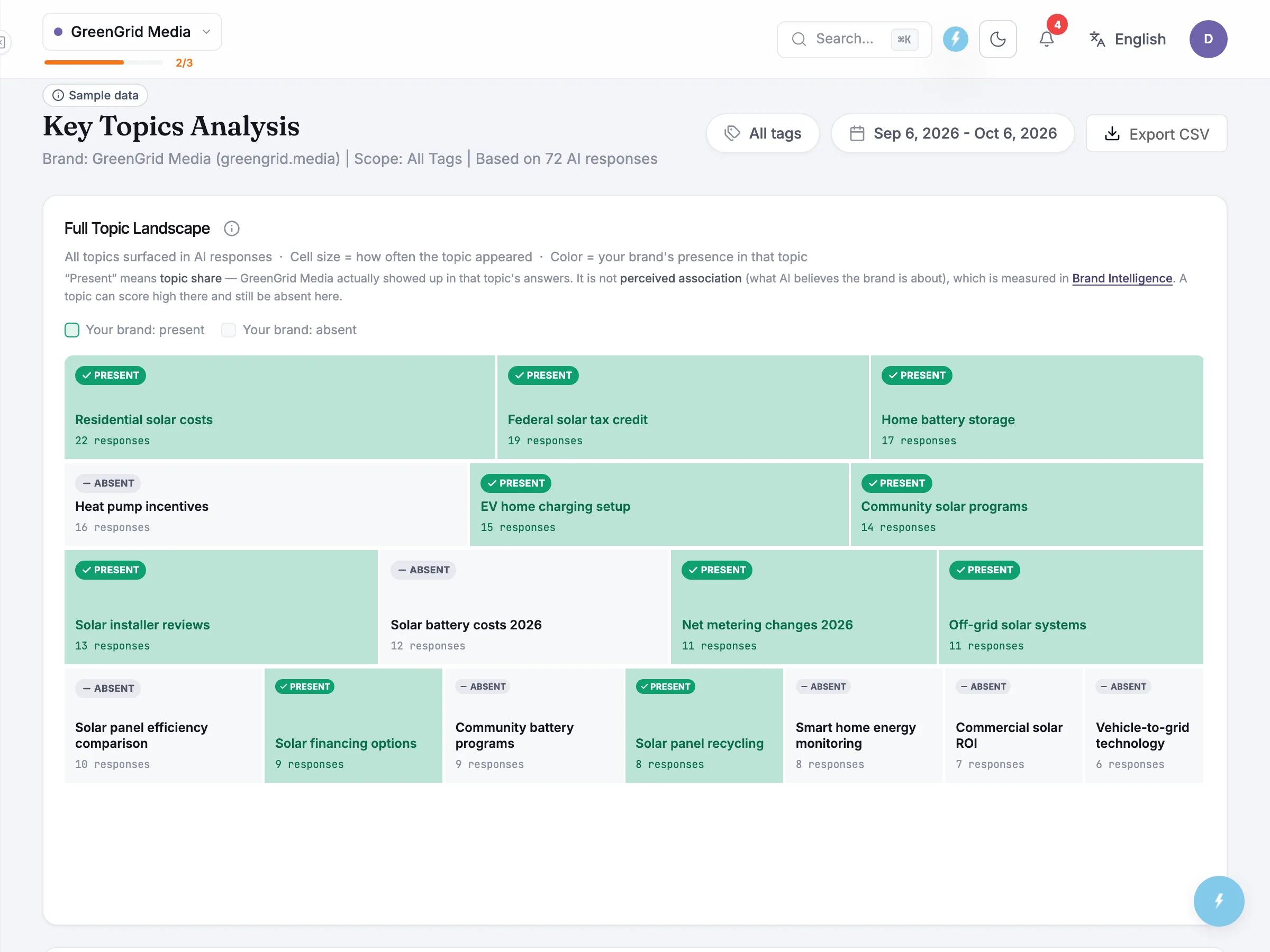
Key Topics: your narrative-control map.
Splits the category into the topics you lead, the battlegrounds worth contesting, and the blind spots you've ceded. The competitor column shows who AI credits on each story. Battlegrounds and blind spots become the earned-media pitch list you take to your media targets.
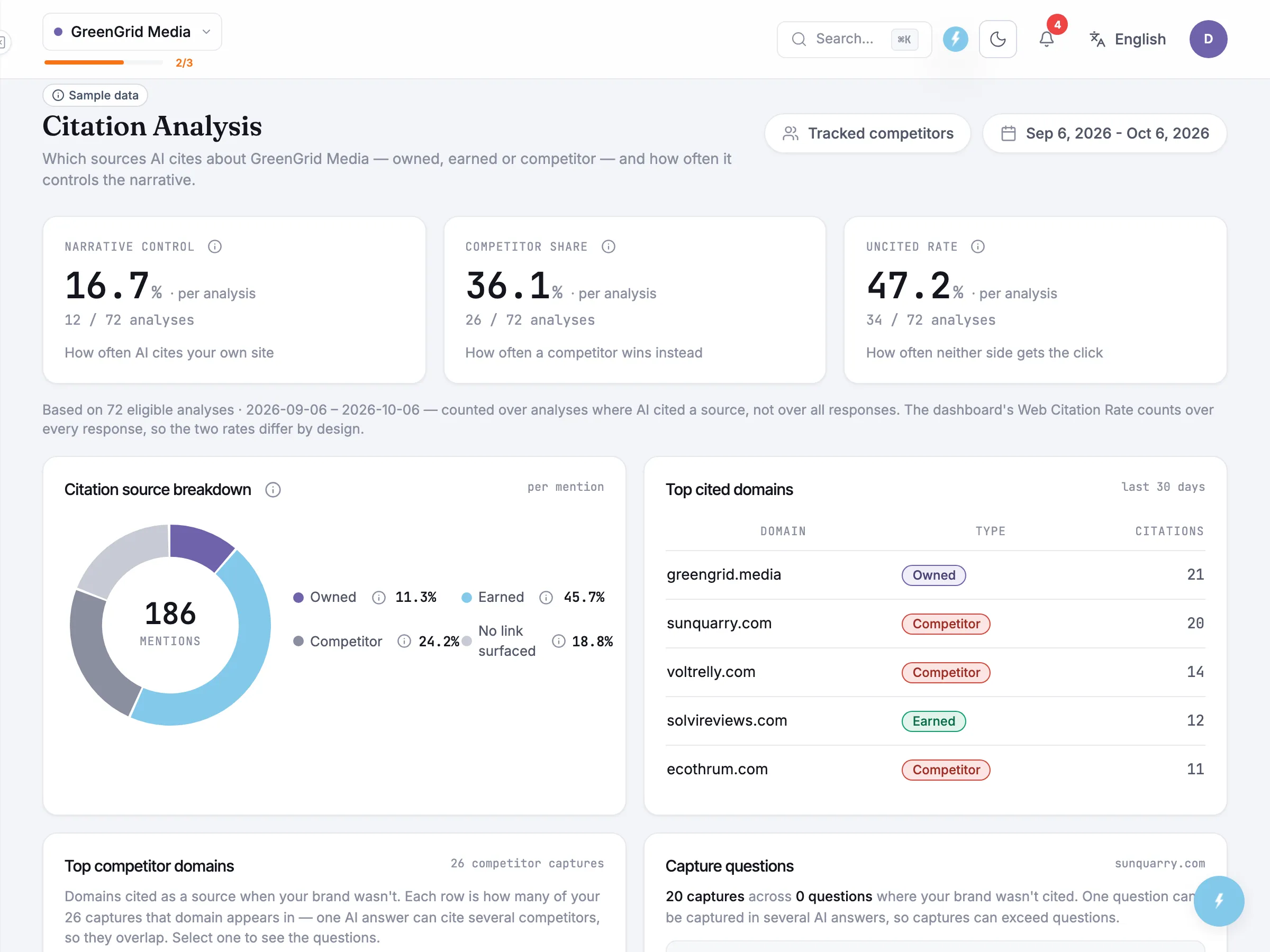
Citation Analysis: your earned-media targeting map.
Which source categories AI cites in the category, broken down owned / earned / competitor / uncited, down to the individual URL. The uncited rate flags where AI paraphrased a source without crediting it. This is where you see competitor share of the narrative and where to win it back.
Competitor Sentiment: the framing each rival is earning.
The associations AI attaches to each competing brand, and the positive / neutral / negative split. Core comms intelligence for positioning and rapid response. Down to the specific words, with how often each one appears.
Prompt Manager: per-engine reputational monitoring.
Track the exact questions that shape your client's reputation, per engine, with the full AI response and the sources it leaned on. Because weighting differs across the five engines, you can target the outlets that move a specific engine, and prove the narrative shifted after you did. Every tracked question keeps the full AI answer per engine, day by day, with every source it cited. Copy or download it as evidence for the client report, or documentation when something goes wrong. Tracking is daily on every plan, which matters most during a campaign window or a reputation incident.
Content Generator: citation-backed thought leadership, fast.
Turn approved messaging into source-grounded, on-record thought leadership with a research step that makes it genuinely pitchable. Human-reviewed and brand-tone aware; never scaled, anonymous, or fabricated content.
Impact Tracker: the coverage ran. Did the answer change?
Add a PR / campaign marker on the day coverage lands and tag it to the prompts the campaign targeted. Impact Tracker compares Citation Coverage, Brand Mention Coverage, Share of Voice and Sentiment for the week before with the latest week, flags campaigns whose windows overlap, and labels every result as change that coincided, not proven cause. That is a before and after a client can check.
Prove: earned work, answered.
Connect AI visibility to downstream branded search and on-site engagement, so you can show that an earned campaign moved the AI answer and the demand behind it. For agency-side PR teams, the client-facing PDF audit report ships under your own brand.
New to Zicy? The help centre has a step-by-step guide for PR and communications teams.
Real programmes, measured across major AI platforms. Zicy case studies, from invisible to AI-cited
Questions PR teams ask.
How is monitoring AI answers different from media monitoring or social listening?
Media monitoring tracks where you were published or mentioned; Zicy tracks whether that coverage changed what AI says about your client. Traditional tools stop at the clipping; Zicy connects the earned coverage to movement in the AI answer across all five engines.
Reputation is formed in coverage, why does the AI answer matter so much?
Because the coverage is increasingly read by a machine, then summarised to the buyer. More than 1 billion people use standalone generative AI tools every month (Meltwater & We Are Social, Digital 2026, via Similarweb), and the framing AI repeats is the framing that reaches the decision, not the original article.
My client has stopped caring about clippings and AVE. What do I report instead?
A reputation metric the C-suite already respects: AI Share of Voice, mention coverage, citation rate and sentiment, tracked daily across five engines. It's defensible, comparable to competitors, and tied to the answers buyers act on.
Can I actually prove the coverage I earned moved the answer?
Yes. That's what Citation Analysis is for. It shows which sources AI cites about your client, classified as owned, earned, competitor or uncited, so you connect the placement you landed to movement in the answer rather than asserting a link. Impact Tracker puts the campaign date on the same chart as the metrics, so the before and after is on one screen in the client review.
Can Zicy show which sources AI trusts in my client's category?
Yes, Citation Analysis shows which sources AI draws on when it answers about your client's category, classified as owned, earned, competitor or uncited. That turns an earned-media plan from a guess into a targeted list of the outlets AI actually cites, by engine.
Does Zicy do the PR, and does that threaten my role?
No. Zicy measures and proves; it does not place coverage. Your team earns the media on its merits, and Zicy shows whether it moved the answer. It makes your work measurable, not redundant.
If AI hallucinates something damaging about my client, what can we actually do?
First you see it early through the Reality Score and sentiment surveillance; then you act through legitimate channels, if the framing is inaccurate, you guide a correction with the publication or platform; if it's accurate criticism, it goes back to the client as an operational issue. The one thing Zicy will not do is manufacture or suppress sentiment.
When a rival or a hostile source starts owning the story, will I know in time?
Yes, Competitor Sentiment Profiles and Citation Analysis flag when a competitor or an unfavourable source is shaping how AI frames your client, and which sources are driving it, while there's still room to respond.
General questions about Zicy and AI visibility.
What is AI visibility?
AI visibility is how often, how accurately, and how prominently a name appears in the answers AI engines give when people ask about its category, across ChatGPT, Gemini, Perplexity, Google AI Overviews and Google AI Mode. It is distinct from search rankings: something can rank on Google's first page and still be absent from the AI answer.
What is AEO or GEO?
AEO (answer engine optimisation) and GEO (generative engine optimisation) are the practices of making a name accurately findable and citable in AI-generated answers, rather than ranked in a list of links. They address AI engines, ChatGPT, Gemini, Perplexity, Google AI Overviews and Google AI Mode, where SEO addresses traditional search results.
How is AI visibility different from SEO?
SEO optimises where pages rank in a list of links; AI visibility determines whether a name is mentioned and cited in a synthesised answer. They run on different signals, only 12% of AI-cited links also rank in Google's top 10 (Ahrefs, 15,000 prompts, 2025), so a strong SEO position does not guarantee a place in the answer.
What is AI Share of Voice?
AI Share of Voice is the percentage of AI answers in a category that mention a given name, measured against a tracked competitor set. It is the headline metric Zicy reports, because it reflects the answers people act on rather than the rankings or impressions older metrics counted.
Which AI engines does Zicy track?
Zicy tracks five engines: ChatGPT, Gemini, Perplexity, Google AI Overviews and Google AI Mode. Each weights sources differently, so coverage across all five, rather than any single one, is what gives a defensible picture.
Does Zicy check my Google Business Profile?
Yes. Once you connect your listing with a Google sign-in, GBP Audit runs nine checks. Seven read the listing: business hours, website link, phone number, business description, review volume, listed category, and whether your name, address and phone match your website, or what is on file. Two look at your website: whether the listing's link points to this location's own page, and whether your site has a page for this location. It also compares your listing with up to four of the competitors you already track. GBP Optimizer can then write a new business description and a category suggestion for you to paste into business.google.com. Zicy never edits your listing and does not reply to reviews.
How does Zicy know what the AI said, does it scrape, and is it reliable week to week?
Measurement uses legitimate API access where available and respects platform terms of service, no machine-generated rank-checking traffic. Tracking is daily on every plan, so you see meaningful shifts as soon as they happen, not a week later. The weekly and monthly views roll those daily results into a smoother trend.
How quickly does AI visibility change once you act?
AI visibility shifts gradually rather than overnight, because the engines rebuild entity understanding and retrieval over time rather than on a fixed schedule. Zicy tracks daily so you can watch movement against a baseline as fixes, content and earned coverage take effect, rather than waiting for a single before-and-after snapshot.
Could using this get us penalised by Google?
No, the approach is the opposite of manipulation. Zicy's tooling is built to current best practice and aligned with Google's May 2026 spam-policy update covering AI Overviews and AI Mode; the work is to make genuine expertise easier for AI to find, verify and trust, not to game it.
What does it cost, and what are we locked into?
Plans run from $79 a month (Starter) to $449 (Scale), with custom Enterprise; Starter and Growth include a 7-day trial, the annual plan gives thirteen months for twelve. The platform is self-serve with no lock-in.
Why a tool built in Penang rather than a US platform?
Because coverage in your markets and languages is the starting point here, not an afterthought. APAC-native coverage across all five engines and the languages your buyers actually use is built in, and Zicy operates under Malaysia Digital status.
Prove the work moved the answer.
See what AI says about your client today, across all five engines. 7-day free trial, no card required.
