How Owned, Earned and Third-Party Sources Shape AI Answers
Learn why AI tools pull from owned, earned and third-party sources when describing your business, and what to do when those sources are inaccurate or outdated.
Key Takeaways
- AI tools pull information about your business from your own website, but also from directories, review platforms, press coverage and aggregator listings you may never have visited.
- Every source that mentions your business falls into one of three categories: owned, earned, or third-party.
- Owned sources are fully within your control. Earned and third-party sources are not, but you can influence both.
- Inaccurate third-party listings are one of the most common causes of wrong AI answers about small businesses.
- Knowing which category each source belongs to tells you exactly what action to take.
- A five-step check across all three source types tells you where the gap is and where to start.
Introduction
A café owner in Kuala Lumpur types her business name into an AI assistant and reads that she serves vegan dishes. She has never offered a vegan menu. The source turns out to be a food directory listing auto-generated from an outdated aggregator that scraped a competitor’s data and attached her business name.
Most SME owners focus their effort on their own website, assuming that is the main thing AI reads. The reality is that AI tools pull from many places at once, and the sources outside your control often carry as much weight as the ones you own.
This guide explains what each source category is, how AI models use them, and what to do when any of them is feeding the wrong information about your business.
What does it actually mean when AI “reads” a source about your business?
It means the model has processed text from that source and is drawing on it to construct an answer, rather than live-fetching the page at the moment someone asks. This is different from a normal Google search.
When someone types a question about your business into an AI assistant, the tool is not crawling your website in real time. It is drawing on a broad pool of content it has already ingested, which may include things written about you years ago, by people you have never met, on platforms you have never logged into.
AI models also weigh how consistently a claim appears across multiple independent sources. A fact that appears only on your own website carries less weight than the same fact confirmed by an independent news article, a directory and three review platforms. This is precisely why the sources outside your direct control matter so much.
What is the difference between owned, earned and third-party sources?
The three categories describe who created the content and how much control you have over it.
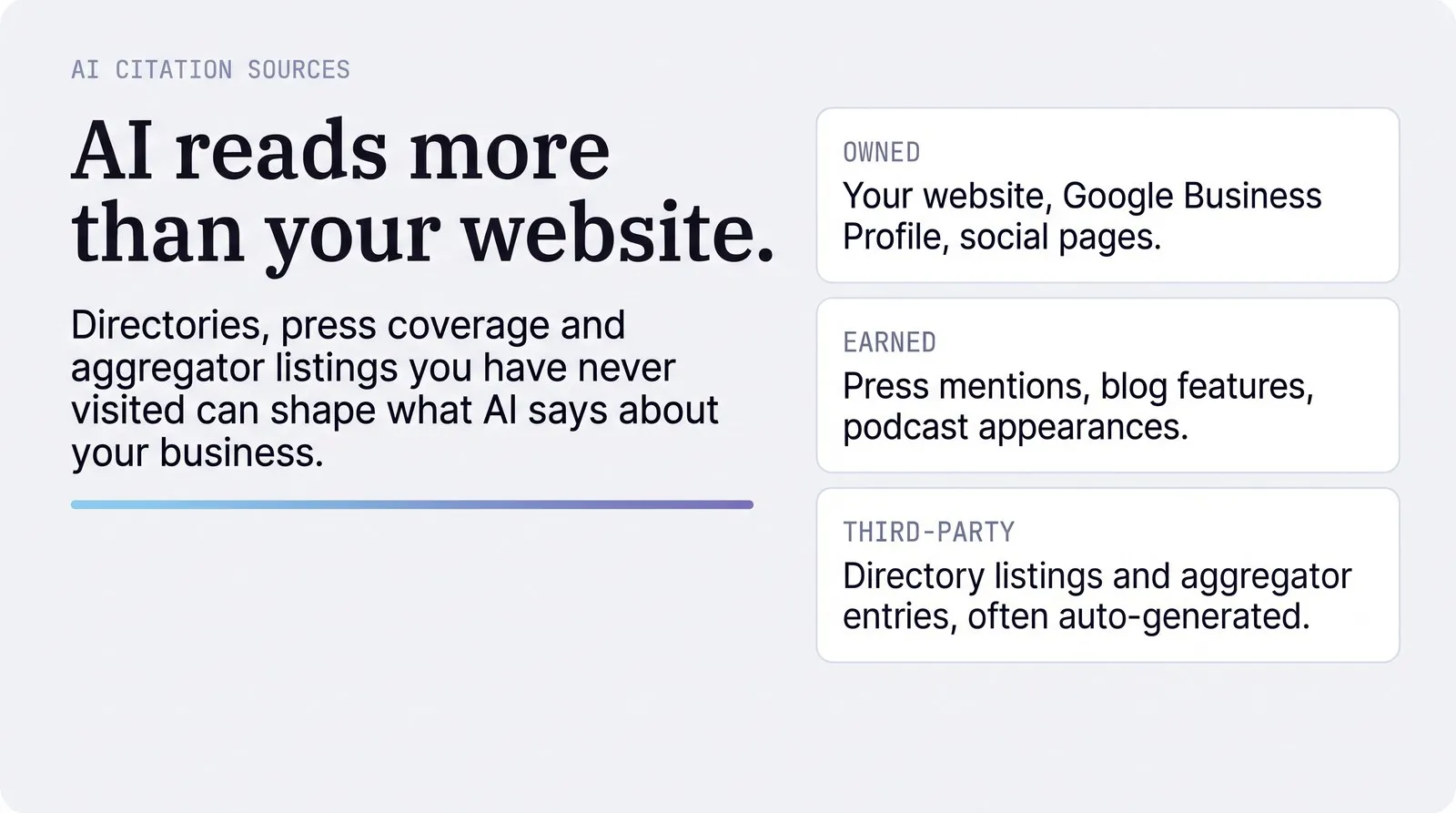
Owned sources are pages and profiles you created and manage directly. Earned sources are coverage others have written about you independently. Third-party sources are listings and directory entries where someone else has described your business, often without telling you.
| Category | What it is | Who controls it | What to do |
| Owned | Content you create and publish: your website, Google Business Profile, social media pages | You | Keep it accurate, up to date, and consistent across every channel |
| Earned | Coverage others have written independently: press mentions, journalist interviews, blog features, podcast appearances | The publisher, though corrections can be requested | Monitor for inaccuracies and contact publishers promptly if something is wrong |
| Third-party | Directory listings and aggregator entries where your business has been described by someone else, often without your knowledge | The platform, though many allow you to claim or correct the entry | Search for your business across directories regularly and claim or correct any listings that are inaccurate |
The question someone types into an AI assistant often determines which source type is most likely to shape the answer.
| When AI is asked... | Most likely source type | What to check |
| "What does [business name] do?" | Owned | Website descriptions and Google Business Profile |
| "Where is [business name] located?" | Third-party | Directory listings and address fields |
| "What do people say about [business name]?" | Third-party and earned | Review platforms and media mentions |
| "What kind of business is [business name]?" | Third-party | Category labels in aggregator directories |
| "Has [business name] been in the news?" | Earned | Published articles and press coverage |
For which pages AI actually cites in your industry, read: How to Find the Websites and Pages AI Cites in Your Industry.
Which sources do AI tools trust most?
No single category automatically wins, but consistency across all three carries enormous weight. If your website describes your business one way and five directory listings describe it another way, the model may blend or select between them in ways you cannot predict.
The more your owned, earned and third-party sources agree with each other, the cleaner and more accurate the AI answer tends to be. Think of it as a vote count: a consistent story across fifteen independent sources is far more persuasive to an AI model than a single perfectly written website that contradicts everything else out there.
This means your goal is not to make one source perfect in isolation. It is to make sure all your sources are telling the same story.
For the signals that make AI treat your sources as credible, read: How can you build digital trust signals that AI engines recognise?
Why do third-party sources cause so many problems for small businesses?
Third-party sources are the most likely to contain outdated or incorrect information, and they are the ones business owners check least often. A bakery in Johor Bahru might appear on a dozen aggregator sites it has never registered for, with an old operating address, an incorrect business category, or a list of products that no longer exist.
These listings are often auto-generated by platforms pulling data from other sources, which means an error in one place can replicate across many. AI models can and do pull from these sources, treating them as independent corroboration of a claim, even when that claim is wrong.
The challenge is that third-party sources are numerous and scattered. There is no single inbox where incorrect listings announce themselves. Finding and correcting them takes a planned, regular check.
For how to find and fix inconsistent facts across your sources, read: How to Keep Your Business Facts Consistent Across the Web So AI Can Identify You Correctly.
What should I actually check, and in what order?
Start with owned sources, because they are fully within your control and the easiest to fix. Confirm that your website, Google Business Profile and social media pages are accurate, consistent and current. Any discrepancy at this level undermines everything else.
Then move to earned sources. Search for press coverage and media features about your business and check whether the descriptions still reflect what you actually offer. If a journalist wrote a profile of your business two years ago and you have since changed your services or moved premises, that article may now be feeding incorrect information into AI answers.
Third-party sources take the most time, because there are usually more of them than you expect. Prioritise the high-traffic directories relevant to your industry first, then work outwards. Some platforms allow you to claim your listing and edit it directly. Others require a formal correction request. Document every change you make, and revisit those listings a few months later to confirm that the updates have been accepted and propagated.
Zicy's Citation Analysis maps which owned, earned and competitor sources AI is citing for your category questions, so you can see exactly where to focus.
For which competitor pages AI keeps citing for your customer questions, read: How to Find Competitor-Owned Sources That AI Keeps Citing.
How do earned media mentions affect what AI says about me?
Earned media carries more weight than many SME owners realise, because AI models treat independent coverage as a credible signal. A single well-read feature article in a Malaysian business publication can carry significant weight simply because it is seen as an external, unbiased account of your business.
This works in your favour when the article is accurate and positions you clearly. It works against you when the article is outdated: it may describe a price you no longer charge, a service you have discontinued, or a business address you moved away from years ago. The AI has no way to know the article is stale. It reads it as a current, reliable source.
If your business has been featured in any publication or media outlet, it is worth checking those articles periodically. Most publishers will make a correction if you approach them professionally and explain clearly what has changed.
For how to spot and verify outdated facts shaping AI answers, read: How to Find Wrong or Outdated Business Facts in AI Answers.
What is the most common mistake businesses make when checking their sources?
Most businesses that check their AI visibility look for one thing: does the right name appear?
When it does, they stop.
What they do not check is what comes next. AI tools do not just name a business. They describe it. They mention the category, the services, the location, the pricing tier. Each of those details comes from somewhere. And that somewhere is very often a source the business owner never knew existed.
A bakery in Petaling Jaya found that AI described it as a confectionery supplier. The description had come from a wholesale directory that auto-generated a listing because the bakery appeared in a food industry database. No one at the bakery had ever visited the directory, let alone created an account on it.
The mistake is not ignoring AI visibility. The mistake is assuming that if the name is right, everything else must be right too.
For what AI actually says about your business beyond the name, read: How To Check What AI Knows And Says About Your Business.
Where should you start if you want to check your sources today?
You do not need a large budget or a technical team to start. Five steps are enough to understand where you stand.
Step 1: Define your ground truth
Write down the three things that should be true about your business in any AI answer: your main service or product category, your location, and who you serve. This is your ground truth, the standard you measure everything else against.
Step 2: Ask AI to describe your business
Open an AI tool and ask it to describe your business by name. Read every sentence. Does it match your ground truth? Note anything that is wrong, missing, or vague.
Step 3: Check your major directory listings
Search your business name across the major directories: Google Business Profile, industry-specific directories, and any food, service, or trade databases relevant to your sector. Check the category, the description and the address on each one.
Step 4: Find sources you did not create
Look for third-party sources you did not create. These are listings that appeared automatically, mentions in aggregator sites, or business database entries you have no login for. These are the sources most likely to be inaccurate and the ones most likely to influence AI answers.
Step 5: Identify one specific gap
Write down one specific gap. One thing AI currently says about you that is not accurate. That is where you start.
Doing this manually gives you a snapshot. Keeping up with changes across five or more AI platforms, dozens of directories, and ongoing media mentions is a different task entirely.
Zicy's Brand Intelligence tracks this automatically. It shows you which sources are shaping what AI says about your business, flags gaps between what your owned sources say and what AI is reporting, and identifies where a correction is most likely to have an effect.
Frequently asked questions
Can I control what AI says about my business?
Not entirely, but you can influence it significantly. You have full control over your owned sources and partial influence over earned and third-party sources. The more consistent and accurate your sources are across all three categories, the more likely AI answers will reflect your business correctly.
How often should I audit my sources?
A thorough audit once every three to six months is a reasonable baseline for most small businesses. If you change your services, move premises or update your pricing, run a targeted check immediately rather than waiting for the next scheduled audit.
What do I do if a third-party listing is wrong?
Start by identifying whether the platform lets you claim the listing. Many directories allow you to create an account, verify ownership and edit the entry directly. For platforms that do not allow self-service edits, most have a correction request process. Document every change you make and revisit the listing after a few weeks to confirm the update was accepted.
Does my Google Business Profile count as an owned source?
Yes. Google Business Profile is one of the most important owned sources for local businesses. It is frequently used by AI tools because it is a structured, verified data source. Keeping it accurate and complete should be one of the first things you check in any source audit.
If I correct a listing, how quickly will AI answers change?
There is no fixed timeline. AI models update their knowledge on their own schedules, which vary by platform. A correction you make today may take weeks or months to appear in AI answers. This is why consistency across all sources matters: the more sources carry the corrected information, the faster and more reliably the change tends to be reflected.
Final Thoughts
AI answers about your business are built from multiple source types at once. Getting them right means checking owned, earned and third-party sources, not just the ones you created.
The practical starting point is to run a quick search: ask an AI tool to describe your business, then trace each detail back to where it came from. Start with your own pages, then look at what others have written, then find the directories you never knew existed.
If you want to see what AI says about your business today, the free AI brand audit takes five minutes and needs no account.
Zicy Brand Intelligence automates this tracking across AI platforms, directories and media mentions, so you can see exactly what is shaping your visibility and where to focus first.
See how AI answers about your brand
Zicy tracks how AI describes and cites your brand across ChatGPT, Gemini, Perplexity, Google AI Overviews and Google AI Mode.
