How can you build digital trust signals that AI engines recognise?

Trust signals are the machine-readable cues, verified authorship, transparent sources, consistent facts and secure infrastructure, that tell AI a brand is real, reliable and worth citing. AI evaluates them continuously through verifiability, consistency and completeness. Zicy tracks whether that credibility is translating into AI visibility across ChatGPT, Gemini, Perplexity, Google AI Overviews and Google AI Mode.
Trust has always been a cornerstone of marketing, but now it needs to be machine-readable. As platforms like ChatGPT, Gemini and Perplexity shape how people discover brands, credibility is not judged by human perception alone. AI engines analyse thousands of trust signals, the digital cues that tell them your brand is real, reliable and worth citing. In the AI era those signals function as validation inputs: structured evidence that helps models decide whether your content can be safely included in generated answers. This is closely tied to answer engine optimisation.
What trust signals mean in the AI era.
On the traditional web, trust came from backlinks and reviews. On the AI-driven web, trust is built through verifiable transparency: facts, context and reputation that machines can cross-check. AI engines ask three silent questions when evaluating your site:
- Can I verify this information across multiple credible sources?
- Is the author or organisation recognised elsewhere online?
- Is this information current, clear and complete?
If your digital presence answers yes to all three, you are feeding AI the same confidence humans feel when dealing with a known brand. These signals are evaluated continuously, so trust is not a one-time achievement but a dynamic state maintained over time. AI also assesses consistency: stable, repeated signals strengthen trust, while conflicting or outdated information weakens it. Trust signals are the verification layer beneath becoming an authoritative entity.
Which trust signals matter most.
AI engines prioritise signals that demonstrate factual accuracy, consistency and authority. The most influential include:
- Verified authorship: associate real experts with every piece of content, with bios, credentials and profile links.
- Transparent sources: reference data, research or case studies that can be independently validated.
- Updated content: AI favours recent, revised information, since freshness implies reliability.
- Secure infrastructure: HTTPS, structured metadata and accessible sitemaps confirm technical trustworthiness.
- Cross-platform consistency: brand details such as name, tagline, services and leadership must match across your website, press coverage and business directories.
Not all signals carry equal weight. Those tied to verifiability, sources, authorship and external validation, tend to have a stronger impact than purely technical ones, and signal alignment, where multiple signals reinforce the same narrative, increases AI confidence in your credibility. Being consistently cited is one measurable outcome, so pair this with citation coverage tracking.
AI trusts what it can verify and what others confirm, not what you claim.
- Earned beats owned: about 84% of AI citations come from third-party media, and just 0.3% from paid or advertorial (Muck Rack, 25M+ links, 2026).
- Reviews are a trust signal: 34.5% of Google AI Overviews cite a review platform, rising to 49% when the query asks for reviews, and five platforms supply 88% of those citations (SE Ranking, 30,000 keywords, 2026).
- On G2, 80% of products now get more AI citations than human pageviews (G2, 80,000+ products, 2026).
Presence on the sources AI already trusts is itself a trust signal.
How brands can actively enhance these signals.
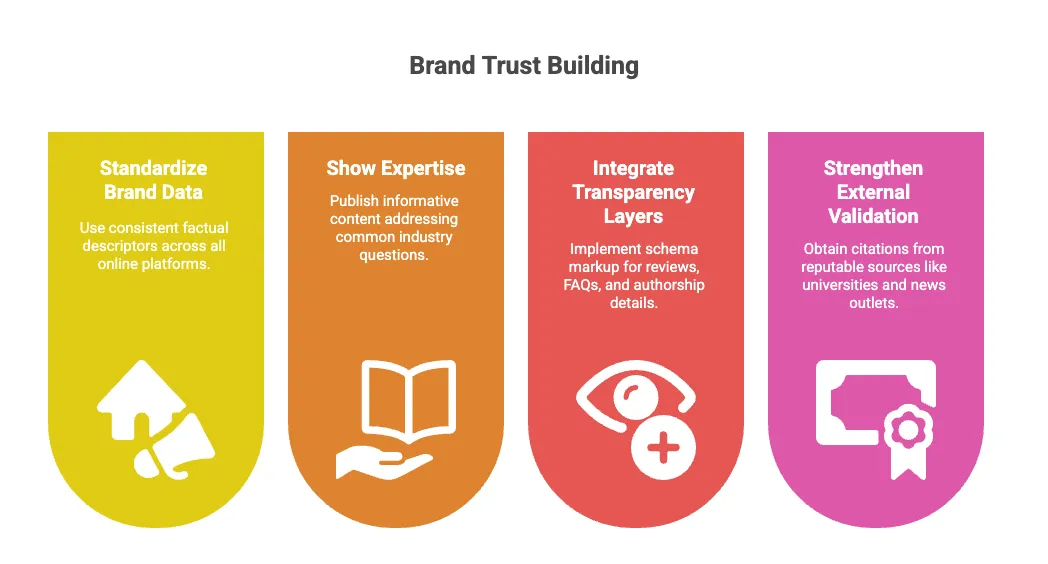
Building trust is not about perfection but coherence. To translate human credibility into machine-interpretable proof:
- Standardise brand data: use the same factual descriptors, founded date, CEO name, HQ city, everywhere online.
- Show expertise: publish authored explainers, whitepapers and guides that address core industry queries.
- Integrate transparency layers: add schema markup for reviews, FAQs and authorship.
- Strengthen external validation: earn citations from credible domains such as universities, news outlets or verified directories.
Refresh trust signals regularly rather than leaving them static, and build interlinked trust ecosystems where your content references and is referenced by other credible entities. These actions help AI models connect your digital presence to a consistent identity, reinforcing your trust graph over time. When you are ready to test the outcome, see how to get cited in ChatGPT and Perplexity.
Build signals AI can read and corroborate:
- Put named authors and real expertise on your pages; demonstrated expertise carries to AI surfaces (Google Search Central, 2026).
- Cite sources and add original data; each of citations, quotations and statistics lifted AI visibility by about 30% to 40% in a controlled study (Princeton GEO study, 10,000 queries, 2024).
- Earn coverage across many independent sources; only 2.7% of cited domains appear on all five engines, so breadth is what makes you durable (SurfacedBy, 127,198 citations, 2026).
- Keep your entity data consistent across the web so AI recognises you.
Why trust signals are the new competitive advantage.
In generative search, AI models curate answers rather than ads, so you cannot pay for placement. You must earn your spot through reliability. The brands that win are those AI systems repeatedly cite because they have proven integrity, clarity and authority in their digital footprint. This creates an environment where brands with stronger trust signals gain disproportionate visibility, since AI prefers a smaller set of highly reliable sources over a large set of uncertain ones, and as AI evolves, trust signals will increasingly influence not just citations but recommendations, comparisons and decision-making outputs. AI engines reward brands that are verifiable, transparent and consistent. Digital trust signals are not decoration; they are the currency of credibility in the generative web, and brands that build and maintain them benefit from compounding credibility as AI continues to reuse trusted sources.
This is now the only safe game. Since 15 May 2026 Google treats bought or faked citations as spam, enforced through its June 2026 update (Search Engine Land, 2026), and recovery takes months. Earned, corroborated trust is the durable moat, the Authority pillar in Growth.pro's PAVA framework.
Questions about AI trust signals.
What trust signals do AI engines like ChatGPT and Perplexity actually look for?
Verifiable, corroborated ones: named authors and expertise, cited sources and original data, earned third-party coverage, and consistent entity data. About 84% of AI citations come from third-party media rather than owned pages (Muck Rack, 25M+ links, 2026).
Do author bios and named experts (E-E-A-T) help you get cited by AI?
They help. Google states that optimising for AI search is optimising for the search experience, where demonstrated expertise matters (Google Search Central, 2026). Named authors, credentials and cited sources make your expertise verifiable to both readers and AI.
Do online reviews on G2 or Reddit affect whether AI recommends my brand?
Yes, materially. 34.5% of Google AI Overviews cite a review platform (SE Ranking, 30,000 keywords, 2026), and on G2 most products now get more AI citations than human pageviews (G2, 80,000+ products, 2026). Genuine reviews and community presence feed AI trust.
Is earned media or my own website more likely to be cited by AI?
Earned media, by a wide margin, at about 84% of AI citations versus a small share for owned sites (Muck Rack, 25M+ links, 2026). Your site still matters for accuracy, but independent coverage does most of the citing.
See whether your credibility is earning citations.
Zicy tracks how AI describes and cites your brand across ChatGPT, Gemini, Perplexity, Google AI Overviews and Google AI Mode.
