How To Check What AI Knows And Says About Your Business
Learn how to check what AI knows and says about your business, identify inaccurate or missing information, and see how Zicy helps monitor AI perception.
Key Takeaways
- Use branded questions to see how AI understands and describes your business when it is asked about you directly.
- Check whether AI has the correct information about your services, target customers, locations, category, positioning and differentiators.
- Separate inaccurate information from missing information, because both can affect how potential customers perceive your business.
- Focus on repeated patterns across multiple answers or AI engines before deciding what information needs to be clarified or updated.
Introduction
Customers may ask AI about your business before visiting your website. They may want to know what you sell, who you serve, where you operate or whether you are suitable for a particular need.
The answer may not always match how you describe your own business.
AI may use outdated information, omit an important service, confuse your company with another business or misunderstand what makes you different. Even when most of the answer is correct, one missing or inaccurate detail can affect how a potential customer understands your business.
The key question is:
How accurately does AI understand and describe my business?
This is different from testing whether AI can discover your business when the customer has not named you. Here, the purpose is to check the picture AI has already formed about your brand.
What should you ask AI about your business?
For this type of check, include your business name.
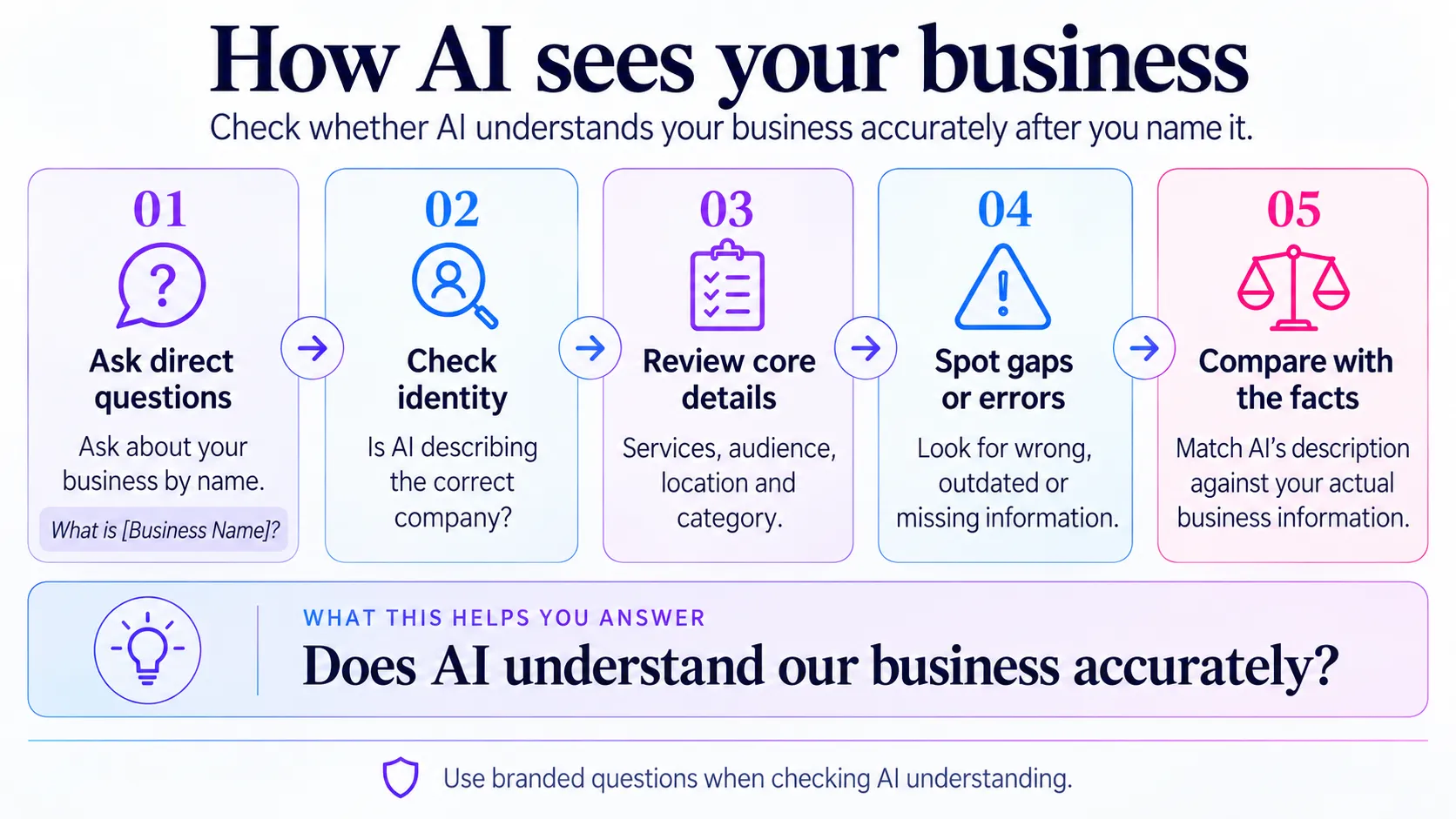
Start with simple questions that cover the information a potential customer may want to know:
- “What is [Business Name]?”
- “What products or services does [Business Name] offer?”
- “Who is [Business Name] for?”
- “Where does [Business Name] operate?”
- “What is [Business Name] known for?”
- “What makes [Business Name] different?”
- “When would you recommend [Business Name]?”
You can then ask more specific questions about important services, audiences or locations.
For example, a law firm could ask:
“Does [Business Name] provide employment law advice?”
A software company might ask:
“Is [Business Name] suitable for small retailers?”
The purpose is not to see whether your brand appears. You have already named it.
The purpose is to understand what AI believes about your business and how clearly it can explain it.
What should you look for in the answers?
Recognition alone is not enough. Compare what AI says with your current business information.
| What to check | What to look for |
|---|---|
| Business identity | Is AI describing the correct company? |
| Products and services | Does it understand your important offerings? |
| Target customers | Does it accurately describe who you serve? |
| Location | Does it understand where you operate? |
| Business category | Does it place you in the right industry? |
| Positioning | What does AI think you are known for? |
| Differentiators | Does it recognise what makes you different? |
| Accuracy and freshness | Is the information still current? |
Pay particular attention to the difference between wrong information and missing information.
Wrong information is directly inaccurate. For example, AI may state that you operate from an old location or still provide a service you have discontinued.
Missing information is different. AI may correctly explain part of your business while leaving out an important service, customer segment or area of expertise.
Both matter.
An incorrect fact can mislead a customer. Missing information can make your business appear less relevant or capable than it really is.
The goal is not to make every AI answer copy your website word for word. What matters is whether AI has a clear, current and reasonably complete understanding of your business.
Why might AI misunderstand your business?
AI-generated answers can reflect information found across different sources rather than relying only on your website.
If your business information is inconsistent, unclear or outdated across those sources, the resulting description may also become inconsistent.
For example, your website may describe you as serving both consumers and businesses, while older profiles still describe you only as a consumer brand. AI may then produce different interpretations depending on the sources available to it.
This is why an inaccurate AI answer should be treated as a signal to investigate, rather than something to fix blindly.
Should you compare more than one AI engine?
Yes, but the purpose here is to identify perception patterns, not to compare visibility or rankings.
One engine may understand your services correctly while another uses an outdated description. If the same error or omission appears repeatedly across several engines, it may indicate a broader information problem.
If an issue appears only once, it may simply be an isolated answer.
For a detailed guide to comparing where your business appears across platforms, see How To Check Your Business Across AI Answer Engines.
How should you record what AI gets wrong or misses?
Keep your record focused on the information itself.
For each finding, note:
- what AI said;
- whether it is correct, outdated or incomplete;
- what the correct information should be;
- which AI engine produced the answer; and
- whether the same issue appears elsewhere.
You could also group findings by theme, such as services, locations, target customers or positioning.
This makes it easier to identify repeated misunderstandings rather than reacting to individual answers.
What should you do if AI information looks wrong?
First, verify the information against sources you know are current, such as your website, service pages and business profiles. If you have a Google Business Profile, Zicy can check the listing itself: how Zicy audits a Google Business Profile.
Then investigate why the misunderstanding may exist.
For example, if AI describes you only as a consumer business but you also serve commercial clients, check whether that distinction is clearly explained across your main business information.
Do the same for:
- old locations;
- discontinued services;
- unclear business descriptions;
- missing specialisms; or
- conflicting information between different profiles.
Avoid changing your website or messaging because of one unusual AI response.
Look for repeated evidence first.
If several answers show the same misunderstanding, you have a much stronger reason to investigate the underlying information.
How can you compare AI perception with your actual business information?
Once you have collected several answers, compare what AI says with the information you know to be current.
Look at what AI appears to think your business is known for, then compare that with how you actually describe your services, audiences, locations and positioning.
The most useful findings usually fall into three groups:
- what AI understands correctly;
- what AI is missing; and
- what AI appears to have wrong.
A platform like Zicy can make this comparison easier by checking what AI says against the business information you provide.
It can then highlight what AI may be missing or getting wrong, while letting you review the actual responses behind each finding.
What should an SME business do first?
Start with a small set of direct questions about your business.
Check whether AI can correctly explain:
What do we offer? Who do we serve? Where do we operate? What are we known for?
Then separate what AI gets right, what is wrong, and what is missing.
Do not worry about fixing everything immediately. First identify whether the same misunderstanding appears repeatedly and confirm what the correct information should be.
That gives you a clearer starting point for deciding what business information may need to be clarified or updated.
Begin with evidence rather than assumptions.
See what AI knows and says
about your business with Zicy.
Zicy tracks brand mentions, website citations, share of voice and average AI ranking across ChatGPT, Gemini, Perplexity, Google AI Overviews and Google AI Mode.
