What Is Brand Mention Coverage and How Do You Measure It?
Discover how Brand Mention Coverage measures your presence in AI answers, and how Zicy helps you monitor prompts, platforms and visibility trends daily.
Key Takeaways
- Brand Mention Coverage shows how consistently your brand appears across AI responses to the prompts you track.
- It is a presence metric. It tells you whether your brand appeared, not how prominently it was recommended or where it ranked.
- The prompts you choose matter. Unbranded prompts are particularly useful for understanding whether AI brings up your brand before the user already knows it.
- Brand mentions can happen across ChatGPT, Claude, Gemini, Perplexity and Google's AI experiences, and the same prompt may produce different brands on each platform.
- There is no universal “good” percentage. What matters is whether you appear consistently for relevant prompts and platforms, and whether that visibility improves over time.
Introduction
A potential customer asks an AI platform to recommend products or businesses in your industry. Several names appear, including a competitor, but your brand does not.
That does not necessarily mean the platform does not know your company exists. It means your brand was not included in that answer, so the customer was given other options first.
One missing mention may not mean much. If it keeps happening across important prompts and platforms, it reveals a pattern. Brand Mention Coverage measures that pattern so you can assess AI visibility without relying on a few isolated checks.
What Is Brand Mention Coverage?
Brand Mention Coverage measures how consistently your brand appears across AI-generated responses to the prompts you track. At its simplest, it asks: Was your brand mentioned in this response?
It is a breadth or presence metric. Your brand may be the first company recommended, one name in a list or a brief mention near the end. All three count as responses in which your brand appeared.
Brand Mention Coverage answers “Were we mentioned?” rather than “Were we the strongest recommendation?” Prominence and ranking are separate measures.
An AI platform may know facts about your company without bringing it up in a broader market question. That is why this metric differs from simply checking what AI knows and says about your business. The key question is whether AI thinks to mention you when the conversation is relevant.
For a concise definition, see the AI Mention Coverage glossary entry.
Why Does Brand Mention Coverage Matter in the Age of AI Search?
People use AI to research options before deciding what to buy, which company to choose or which product to explore. Instead of opening several search results and building a shortlist, a user can receive a ready-made answer containing a handful of brands.
If your brand appears, it has an opportunity to enter the customer's consideration set. If it is repeatedly absent, other companies may receive that opportunity instead.
A mention does not guarantee a visit, enquiry or sale. But a brand cannot be considered in an AI answer if it never appears there.
Coverage also makes AI visibility less anecdotal. “I searched our category on ChatGPT and we appeared” and “I tried Gemini and could not find us” are both isolated observations. A wider set of responses reveals the pattern.
Also read: How Is AI Visibility Different From Google Rankings? and How Do AI Answers Change the Way Customers Discover Small Businesses?
What Counts as a Brand Mention and What Doesn't?
A brand mention happens when an AI-generated response clearly identifies your brand. Abbreviations, shortened names and recognised variations may also count when they clearly refer to the same business.
Branded Prompts
A branded prompt includes the company name, such as “What does Brand X offer?” A response containing Brand X counts as a mention, but it tells you less about natural discovery because the user supplied the name.
Unbranded Prompts
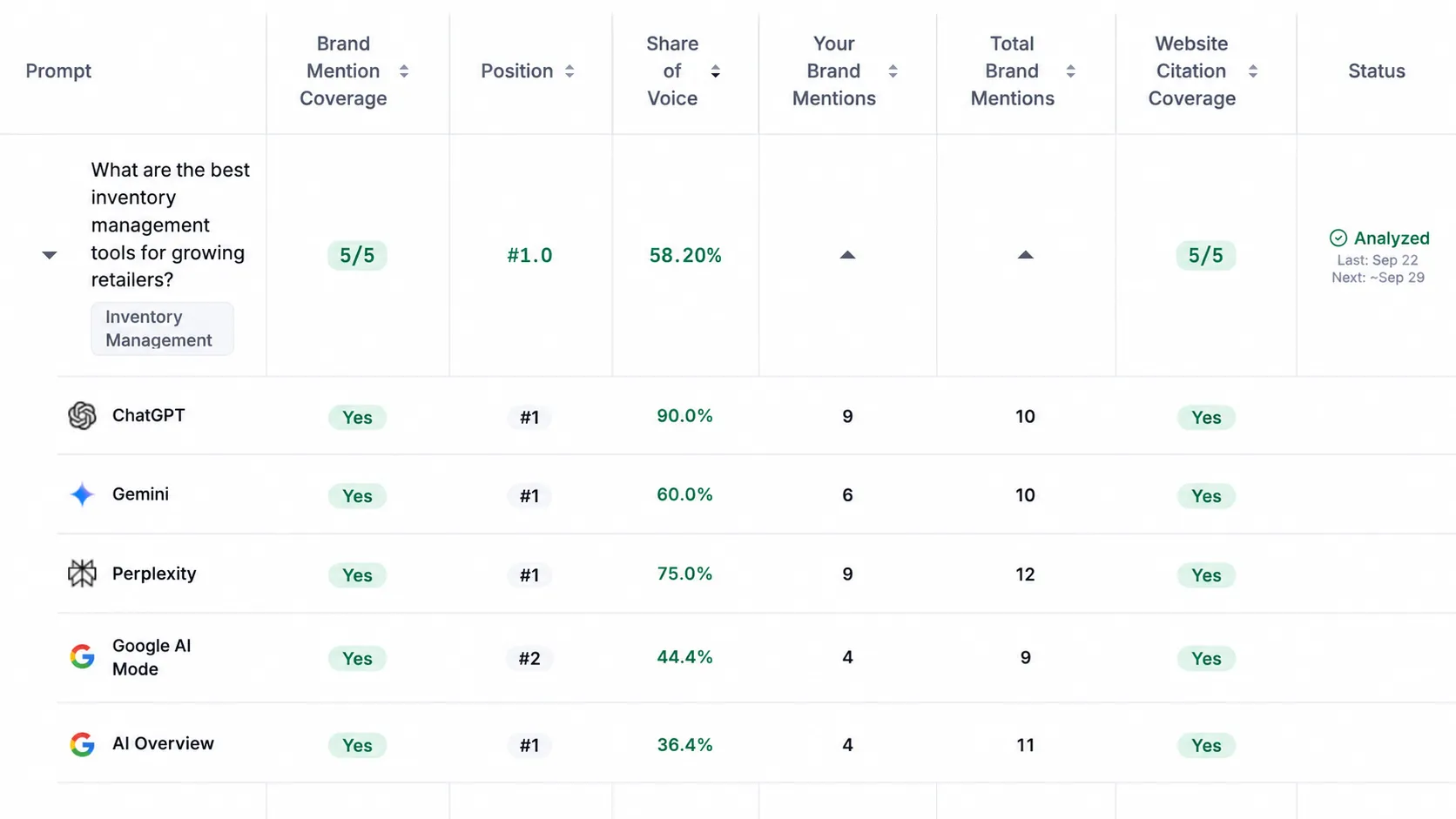
An unbranded prompt does not name a company, such as “What are the best inventory management tools for growing retailers?” Here, the AI decides which brands to surface, making the result more useful for measuring discovery.
Buyer-intent prompts are especially useful because they invite AI to compare, recommend or surface brands without telling it which company to discuss. If the answer stays generic and identifies no company, no brand mention occurred.
Read next: How to Choose Buyer-Intent Prompts That Can Actually Reveal Brand Visibility and How to Use Branded and Non-Branded Prompts Without Distorting Your AI Visibility.
Where Do Brand Mentions Happen?
Brand mentions can appear across the AI answer engines people use to research products, businesses and services, including ChatGPT, Claude, Gemini, Perplexity, AI Overviews and Google AI Mode.
Each platform generates its own response. The same prompt can therefore produce different results depending on where it is asked. A brand may appear frequently on ChatGPT but less consistently on Gemini, while Perplexity and Google's AI experiences may surface different groups of companies.
Checking only one platform gives you one part of the picture. Comparing several shows whether visibility is reasonably consistent or depends heavily on where users ask the question.
Also read: How to Check Your Business Across AI Answer Engines.
How Do You Measure Brand Mention Coverage?
1. Choose Relevant Prompts
Choose questions tied to your business, including the products or services you provide, the problems you solve, category alternatives and common buying or comparison questions. A smaller relevant set is more useful than hundreds of unrelated prompts.
Learn how to find the right AI prompts to track for your business.
2. Analyse the Prompts Across AI Platforms
Run those prompts across the platforms you want to monitor. For each response, record whether your brand appeared. The combined responses become the dataset for your coverage calculation.
3. Calculate Brand Mention Coverage
AI responses that mention your brand ÷ total AI responses analysed × 100
If your brand appears in 30 of 50 responses, the calculation is 30 ÷ 50 × 100 = 60%. Your brand was present in 60% of the responses included in that analysis.
The denominator matters. A 60% result based on relevant customer questions tells you something different from one based mainly on branded or unrelated questions.
4. Track It Consistently Over Time
AI responses can change, so repeated tracking is more useful than a one-off check. Keep a stable prompt baseline where possible and compare coverage over time. This turns isolated answers into a trend and prevents one unusually good or bad response from shaping your whole view.
Also read: How to Keep a Stable AI Prompt Baseline and Know When to Reset It.
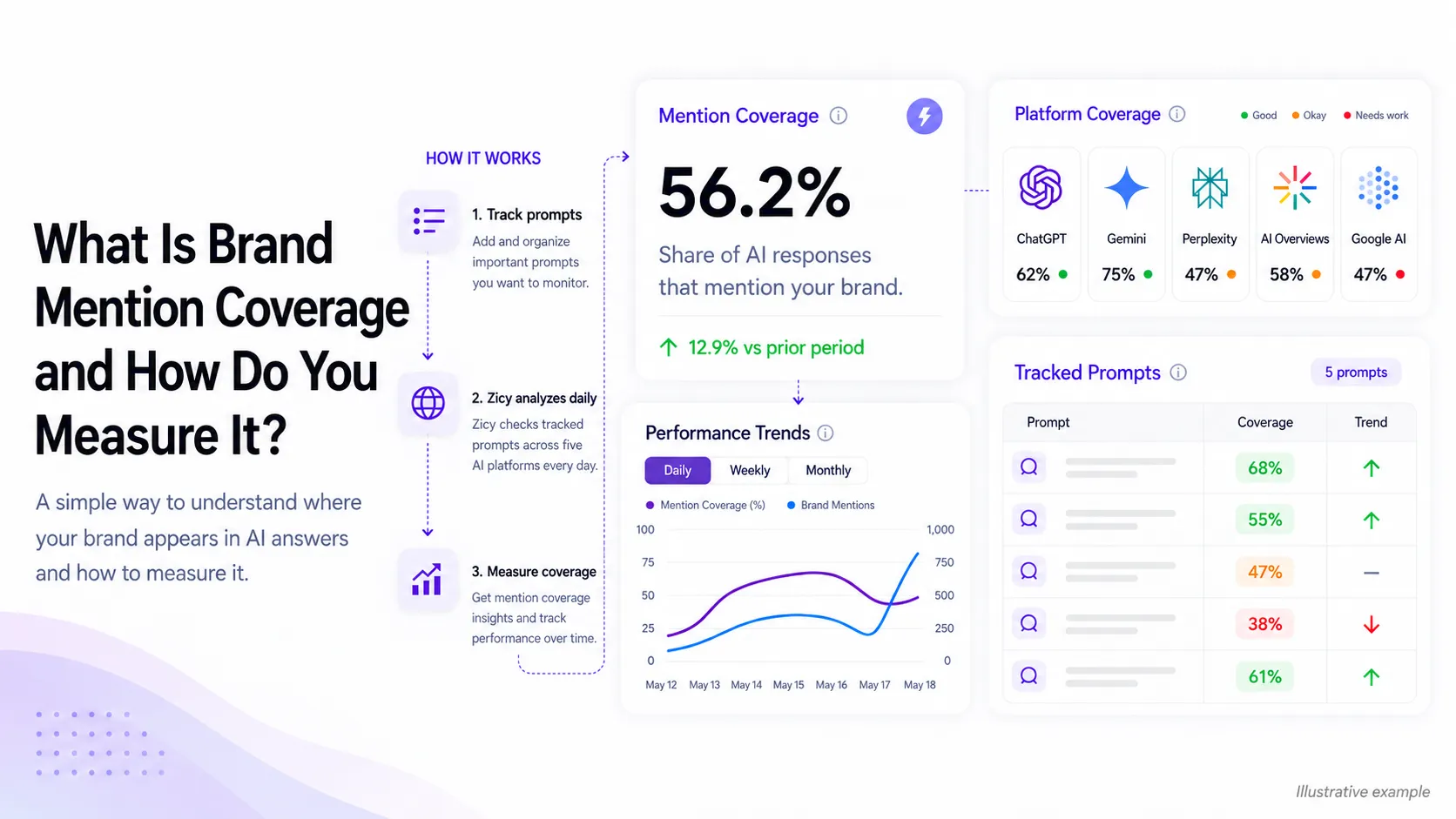
If you are tracking many prompts across several AI platforms, a platform like Zicy can automate those repeated checks and show your Brand Mention Coverage by prompt, platform and over time.
What Does Your Brand Mention Coverage Tell You?
The overall percentage gives you the headline.
The more useful insights often appear when you look at the results by prompt and platform, where you can see whether visibility is consistent or where gaps appear.
1. Consistent Visibility
Your brand appears across many relevant prompts, suggesting that AI platforms regularly connect it to the topics, products or services being discussed.
2. Prompt-Specific Gaps
You may appear for some prompts and disappear from others. The total percentage can hide these differences, so inspect individual questions.
3. Platform-Specific Gaps
Strong coverage on one platform can coexist with weak coverage on another. A healthy total can still mask an engine where your brand is rarely mentioned.
4. Improving or Declining Coverage
A rising result across a stable prompt set means your brand appears in a greater share of monitored responses. A decline means it appears less consistently. The metric shows what changed; the prompts and responses help explain why.
5. Irrelevant or Inaccurate Mentions
A response may contain your brand name but associate it with an unrelated or incorrect description. Coverage is a starting signal. The underlying answer reveals whether the presence is useful and accurate.
What Is a Good Brand Mention Coverage?
There is no universal percentage every business should consider good. A competitive category may have many brands that could appear, while a narrow category may have few. Broad prompts also behave differently from highly specific questions, and the mix of platforms changes the result.
Relevance
Are you appearing for the prompts that genuinely matter? A lower overall percentage can still include strong visibility for your most commercially important topics.
Consistency
Does your brand appear across several platforms and important prompts, or only in isolated cases?
Trend
Is coverage improving, declining or staying flat? Your own history is often more informative than a generic industry benchmark.
The goal is to understand whether your brand is consistently present in the AI conversations where it should reasonably be considered.
Measure Whether Your Brand Enters the Conversation
Brand Mention Coverage answers a simple question: when AI responds to questions relevant to your business, how often does your brand appear?
The overall percentage shows how widely your brand appears. Individual prompts show where you are present and missing. Platform results reveal whether visibility is consistent across AI experiences, and trends show whether the pattern is changing.
Most of all, Brand Mention Coverage is not about proving that an AI model knows your company exists. It measures whether AI considers bringing your brand into the conversation when someone explores the products, services or solutions you provide.
Measure whether your brand appears
in the AI conversations that matter.
Zicy helps you monitor relevant prompts, compare platforms and inspect the answers behind your Brand Mention Coverage.
