How To Find The Right AI Prompts To Track For Your Business
Learn how to choose the customer questions worth monitoring in AI, build a balanced prompt set and track the areas that matter most to your business.
Key Takeaways
- Build your prompt set around the products, services, customer groups, problems and locations that matter most commercially.
- Use real customer questions and buying situations as your starting point instead of generating a large list of generic prompts.
- Prioritise meaningful differences in customer needs rather than tracking many small wording variations of the same question.
- Keep a stable core set of prompts so changes in visibility can be compared consistently over time.
Introduction
Tracking your business in AI starts with deciding which customer questions are important enough to monitor.
These questions are commonly called prompts. They are what people may type or ask when using ChatGPT, Gemini, Perplexity or Google's AI experiences.
But there are potentially hundreds of questions related to any business.
Trying to track all of them creates noise. Tracking only a handful of obvious questions can leave important parts of your business uncovered.
The goal is to build a focused prompt set that represents the customer situations where you genuinely want your business to be visible.
A useful prompt strategy should help answer:
When customers ask AI about the products, services and problems most important to our business, where do we appear?
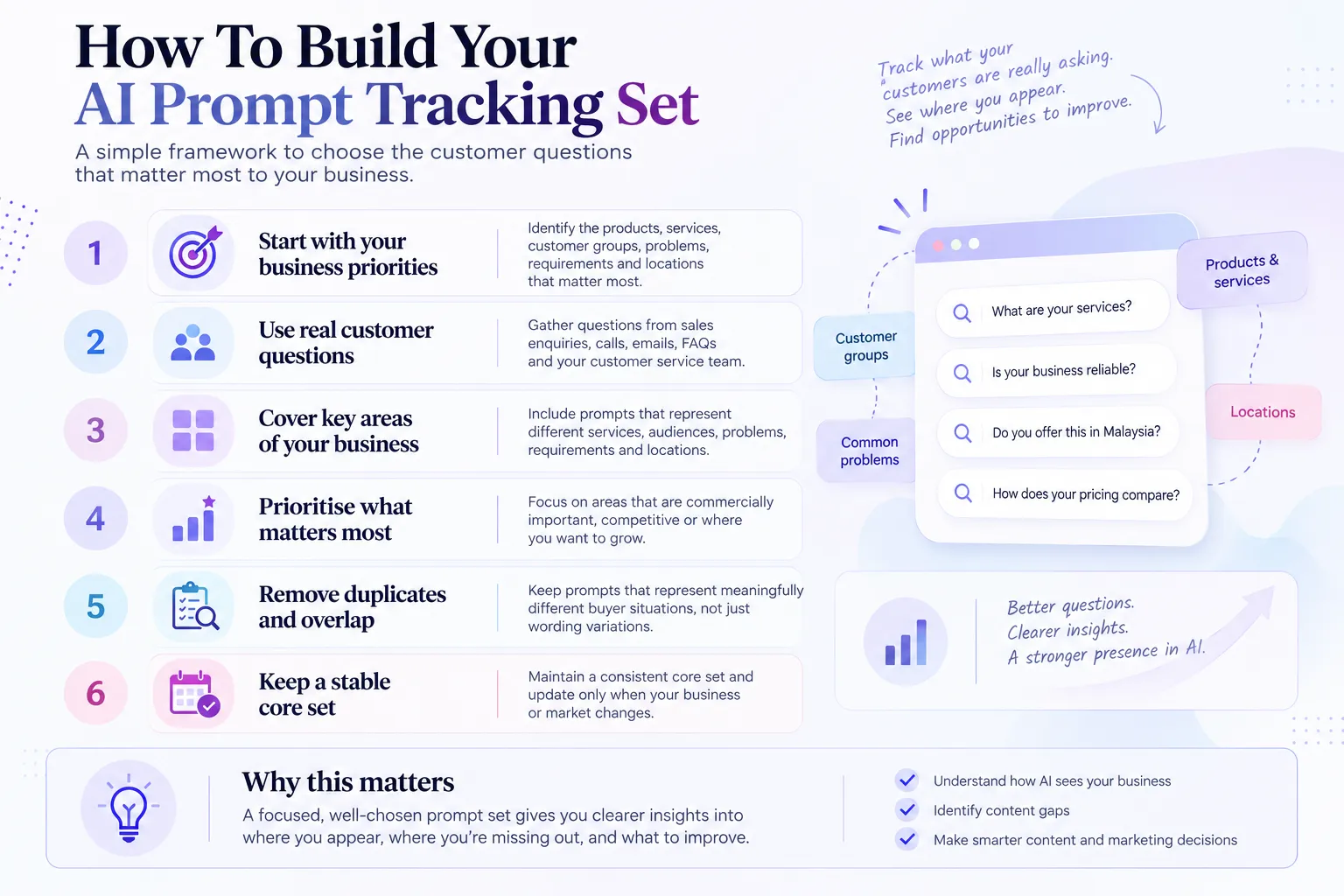
Start with the parts of your business that matter most
Do not start by asking AI to generate a long list of random questions.
Start with your business priorities.
Think about the areas where being recommended by AI could make a meaningful difference.
These may include:
- your main products or services;
- your most valuable customer groups;
- important customer problems;
- particular capabilities or requirements;
- priority locations or markets; and
- services you want to grow.
For example, an accounting software company may serve retailers, professional services firms and ecommerce businesses.
Tracking only:
“What is the best accounting software?”
would give a very narrow picture.
It may be more useful to understand whether the company appears when different customer groups ask questions related to invoicing, inventory, multiple outlets or ecommerce integrations.
Your prompt set should therefore reflect how your business actually makes money, not simply the broad category you belong to.
Use real customer questions as your starting point
One of the best sources of prompts is the questions customers already ask.
Look at:
- sales enquiries;
- consultation calls;
- quote requests;
- customer emails;
- website FAQs;
- product enquiries;
- common objections; and
- questions heard repeatedly by sales or customer service teams.
These questions reveal what customers care about before making a decision.
For example, an event production company might regularly hear:
- “Can you manage both creative and technical production?”
- “Do you handle corporate product launches?”
- “Can you provide LED screens?”
- “Do you work outside Kuala Lumpur?”
You would not necessarily track those exact questions word for word.
Instead, use them to identify the needs, requirements and situations your prompt set should represent.
How to build coverage across the main customer situations?
A useful prompt portfolio should not depend too heavily on one type of question.
Think about several dimensions.
| Area | What your prompts might represent |
|---|---|
| Products or services | Your main commercial offerings |
| Customer types | SMEs, enterprises, families, retailers or specific industries |
| Problems | The problems customers need solved |
| Requirements | Important features, expertise or capabilities |
| Locations | Cities, neighbourhoods or markets where location affects the choice |
| Use cases | Specific situations where customers need your product or service |
For example, a digital marketing agency may want questions around SEO, paid media and social media, but also around ecommerce brands, B2B companies and businesses in Malaysia.
This provides a much more useful view than tracking many variations of one generic “best agency” question.
How to decide which areas deserve more prompts?
Not every part of your business needs equal coverage.
Give more attention to areas that are:
- commercially important;
- strategically important;
- frequently requested by customers;
- highly competitive; or
- areas where you specifically want to grow.
A company with five services may decide that two deserve heavier tracking because they generate most new business.
Similarly, a multi-location business may prioritise the cities where it actively competes instead of creating prompts for every location it could theoretically serve.
Prompt tracking should reflect business priorities, not just topic volume.
How to ensure the individual prompts are suitable for visibility tracking?
Once you know what areas you want to monitor, the next step is choosing questions that can actually reveal brand visibility.
This is where buyer intent becomes important.
A question such as:
“What is payroll software?”
may be relevant to your industry, but AI can answer it perfectly without recommending any provider.
A question such as:
“Which payroll software is suitable for a Malaysian SME?”
creates a clearer opportunity for businesses to appear.
Learn How To Choose Buyer-Intent Prompts That Can Actually Reveal Brand Visibility to check whether each question is suitable for measuring visibility.
Include location when it genuinely changes the choice
Location matters more for some businesses than others.
A plumber, clinic, tuition centre, restaurant or local professional service may need prompts that reflect the areas customers actually search from.
For example:
“Which dental clinics in Petaling Jaya are suitable for families?”
may be more useful than:
“Which dental clinics are recommended?”
For a business selling nationally, city-level prompts may be unnecessary.
Use location when it would realistically affect which business a customer could choose.
Remove prompts that represent the same situation
Prompt lists can grow quickly because small wording changes feel different.
Consider:
- “Best payroll software for SMEs”
- “Top payroll software for SMEs”
- “Recommended payroll software for SMEs”
The wording differs, but the underlying customer situation is almost identical.
You may still test wording variations occasionally, but your core tracking set should prioritise meaningfully different customer situations.
For example:
- payroll software for a 10-person SME;
- payroll software with leave management;
- payroll software for multiple branches; and
- payroll software suitable for Malaysian compliance needs.
Each introduces a genuine difference in what the customer needs.
Keep a core set that you can monitor consistently
Your prompt list should evolve, but not constantly.
If you replace large numbers of questions every week, changes in your visibility data become difficult to interpret.
Did your business improve?
Or are you simply measuring different questions?
Keep a stable core set and make changes when there is a real business reason, such as:
- launching a new product;
- entering a new market;
- targeting a new customer group;
- discovering an important customer need; or
- retiring an old service.
This gives you a more meaningful baseline over time.
How should you organise your Prompt strategy?
As your prompt set grows, it helps to organise the questions into meaningful groups rather than treating them as one long list.
You might group prompts by:
- products;
- services;
- customer segments;
- locations; or
- types of buying questions.
You may also want to separate questions you are actively tracking from those you are still reviewing or no longer need to monitor.
This makes it easier to see whether visibility differs across different parts of the business instead of relying only on one overall number.
Zicy can help organise this process by letting you manage prompts as Draft, Active or Paused and group them with tags based on the areas that matter to your business.
What should you do first?
Start with your business rather than starting with AI.
Write down:
What do we most want customers to find us for? Who are those customers? What problems are they trying to solve? Which locations or requirements matter?
Turn those priorities into a manageable list of customer situations.
Then check whether each question creates a genuine opportunity for AI to recommend businesses.
You do not need hundreds of prompts.
You need enough good questions to give you a representative view of the parts of your business that matter.
Find and track the AI prompts
that matter to your business with Zicy.
Zicy tracks brand mentions, website citations, share of voice and average AI ranking across ChatGPT, Gemini, Perplexity, Google AI Overviews and Google AI Mode.
