How To Check Your Business Across AI Answer Engines
Learn how to check whether your business appears across ChatGPT, Gemini, Perplexity and Google AI when customers search for products or services like yours.
Key Takeaways
- Use the same non-branded, buyer-focused questions across several AI engines so you can compare results fairly.
- Check more than whether your business appears; look at positioning, competitors, website citations and the context of each mention.
- Results can vary across ChatGPT, Gemini, Perplexity, Google AI Overviews, and Google AI Mode, so a single platform is not enough to judge overall visibility.
- Repeat the same checks over time to build a more reliable picture of your AI discoverability.
Introduction
Ask ChatGPT for businesses like yours and see your company in the answer. That is encouraging, but it tells you only what happened on one platform, for one question, at one moment.
Your business may appear prominently in ChatGPT but not in Gemini. Perplexity may cite your website, while Google AI may recommend different competitors.
To understand your AI visibility, you need to ask a broader question:
When potential customers ask AI for businesses, products or services like yours, how often does your business actually appear?
This is a test of discoverability. Your business name should not be included in the question.
That makes it different from checking whether AI understands your business correctly after you name it. For that, see How To Check What AI Knows And Says About Your Business.
What are you actually checking?
The aim is to see whether AI independently identifies your business as a relevant option when a potential customer is still deciding what to buy or who to contact.
A useful visibility check looks at:
- whether your business appears;
- how prominently it appears;
- which competitors appear instead;
- whether your website is cited; and
- whether visibility differs between AI engines.
You are not asking, “Does AI know my company exists?”
You are asking:
“Would AI choose to show my business to someone who has not already asked for it?”
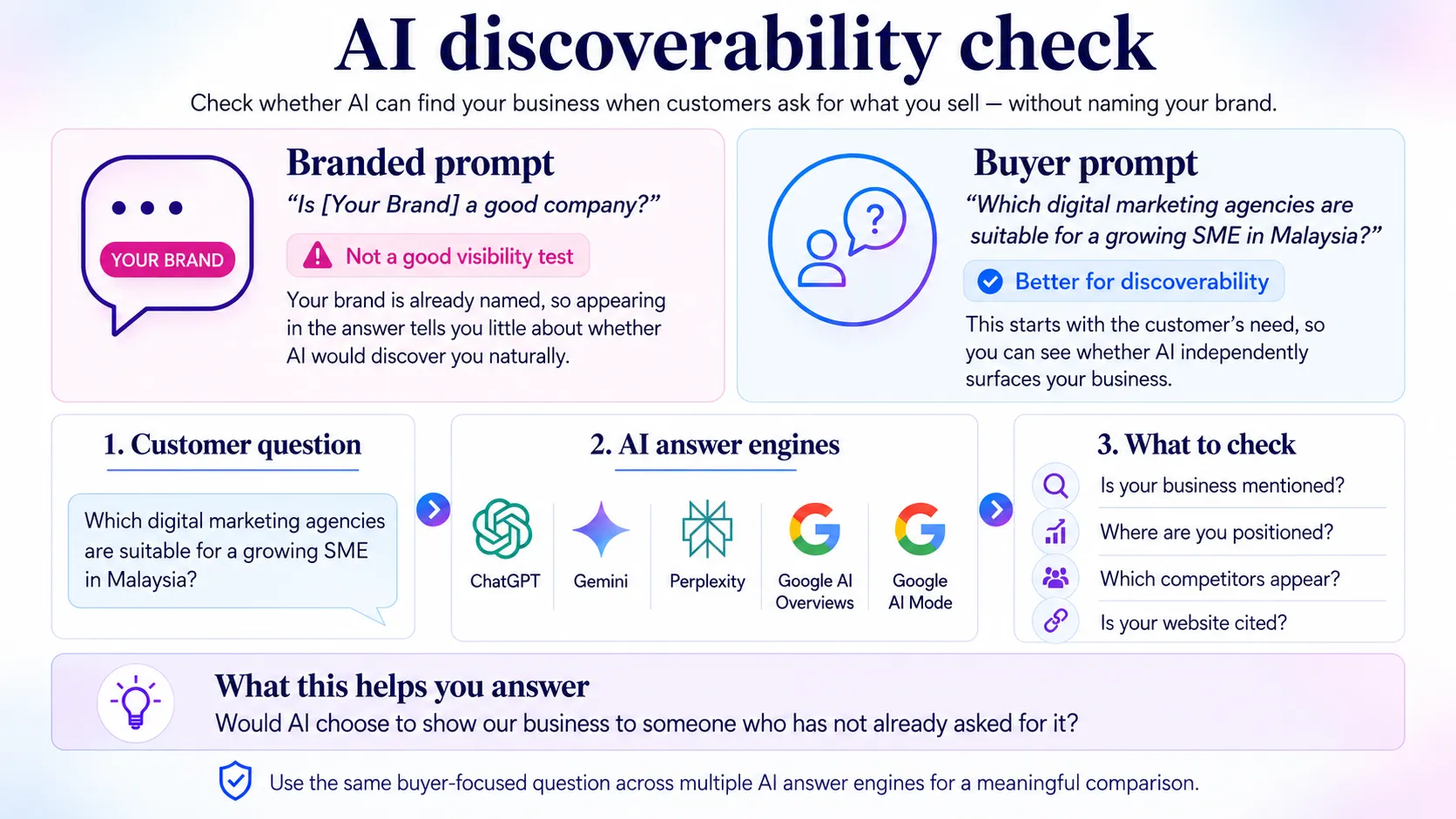
Which AI answer engines should a small business check?
A practical starting point is:
- ChatGPT
- Gemini
- Perplexity
- Google AI Overviews
- Google AI Mode
These platforms can produce different answers to the same customer question.
One may recommend your business first. Another may favour a competitor. Another may not mention you at all.
That is why checking only one AI engine can give you an incomplete picture of your visibility.
What questions should you ask?
Start with questions a real potential customer might ask before choosing a business.
The question should describe the customer's need, location or buying criteria, rather than naming your brand.
For example:
Accounting software
“What accounting software is suitable for a small retail business?”
Marketing agency
“Which digital marketing agencies are suitable for a growing SME in Malaysia?”
Local fitness studio
“What are the best fitness studios for beginners in Singapore?”
Avoid questions such as:
“Is [Your Brand] a good company?”
Because your business has already been named, appearing in the answer tells you little about whether AI would have discovered it naturally.
A stronger test starts with the customer's need, not your brand.
What should you check in each AI answer?
Do not stop at whether your name appears.
| What to check | What it tells you |
|---|---|
| Is your business mentioned? | Whether AI considered your business relevant |
| Where are you positioned? | How prominently you appear beside alternatives |
| Which competitors appear? | Which businesses AI associates with the same customer need |
| Is your website cited? | Whether AI directs users to information you control |
| Which other sources are cited? | Which websites may be influencing the recommendation |
Also look at the context.
Being recommended as one of the first options is different from being briefly mentioned near the end of an answer.
You may find that ChatGPT recommends your business, Gemini repeatedly favours a competitor and Perplexity cites your website even when other engines do not.
Those differences are the insight.
Should you use the same question across every AI engine?
Yes, when comparing platforms.
If you ask a different question in each engine, you cannot tell whether the result changed because of the platform or because of the wording.
Use the same buyer-focused question across each platform and keep the location, customer type and buying situation consistent.
Once you have a baseline, create variations around important factors such as:
- location;
- budget;
- customer type;
- service;
- use case; or
- buying criteria.
This helps reveal which types of customer questions your business is strongest or weakest for.
How should you record the results?
Keep the comparison simple.
For each question, record:
- AI engine;
- whether your business appeared;
- your approximate position;
- competitors mentioned;
- whether your website was cited;
- other sources cited.
Save the question wording as well.
This makes it easier to compare like-for-like results when you repeat the check later.
How can you monitor AI discoverability more consistently?
Manual checking is useful for a small number of important questions.
But the workload grows quickly.
Testing 10 customer questions across five AI engines means reviewing 50 separate answers.
You would then need to compare business mentions, positions, competitors and citations across all of them and repeat the process later to see what changed.
Without a structured record, it is easy to focus on one positive result while missing the wider pattern.
To monitor discoverability more consistently, you need a way to keep the same buyer-focused questions, compare results across platforms and review what changes over time.
That means looking beyond a single positive result and tracking patterns such as:
- which brands appear most often;
- where your business is positioned;
- whether your website was cited; and
- which AI engines include or exclude you; and
- the actual responses behind those results.
A platform like Zicy can bring these results into one place, making it easier to compare the same questions across major AI answer engines and spot patterns that may need further investigation.
What should an SME business do first?
Choose three to five buyer questions that represent real customer needs.
Do not include your business name.
Ask exactly the same questions across several AI engines and record:
Did we appear? Where did we appear? Who appeared instead? Was our website cited?
Repeat those checks periodically rather than relying on one search.
That gives you a much clearer baseline for understanding whether AI is actually discovering your business when potential customers are looking for what you sell.
See how visible your business is
across AI answer engines with Zicy.
Zicy tracks brand mentions, website citations, share of voice and average AI ranking across ChatGPT, Gemini, Perplexity, Google AI Overviews and Google AI Mode.
