How To Choose Buyer-Intent Prompts That Can Actually Reveal Brand Visibility
Learn how to choose buyer-intent prompts that help reveal whether AI recommends your business when potential customers are evaluating their options.
Key Takeaways
- Buyer-intent prompts are questions where recommending or comparing real businesses, products or providers would make the answer more useful.
- General informational questions may be useful for content, but they often tell you very little about whether AI would recommend your brand.
- Strong prompts usually include sufficient context about the customer, problem, requirement, location, or use case to create a realistic decision-making scenario.
- A good test is whether AI has a genuine reason to name businesses in order to answer the question well.
Introduction
Not every customer question is useful for measuring AI brand visibility.
Compare:
“What is payroll software?”
with:
“What payroll software is suitable for a small Malaysian company?”
The first asks AI to explain a topic.
The second asks AI to help someone identify a suitable solution.
That difference matters.
If you want to understand whether AI puts your business in front of potential customers, you need questions where products, services or providers could naturally form part of the answer.
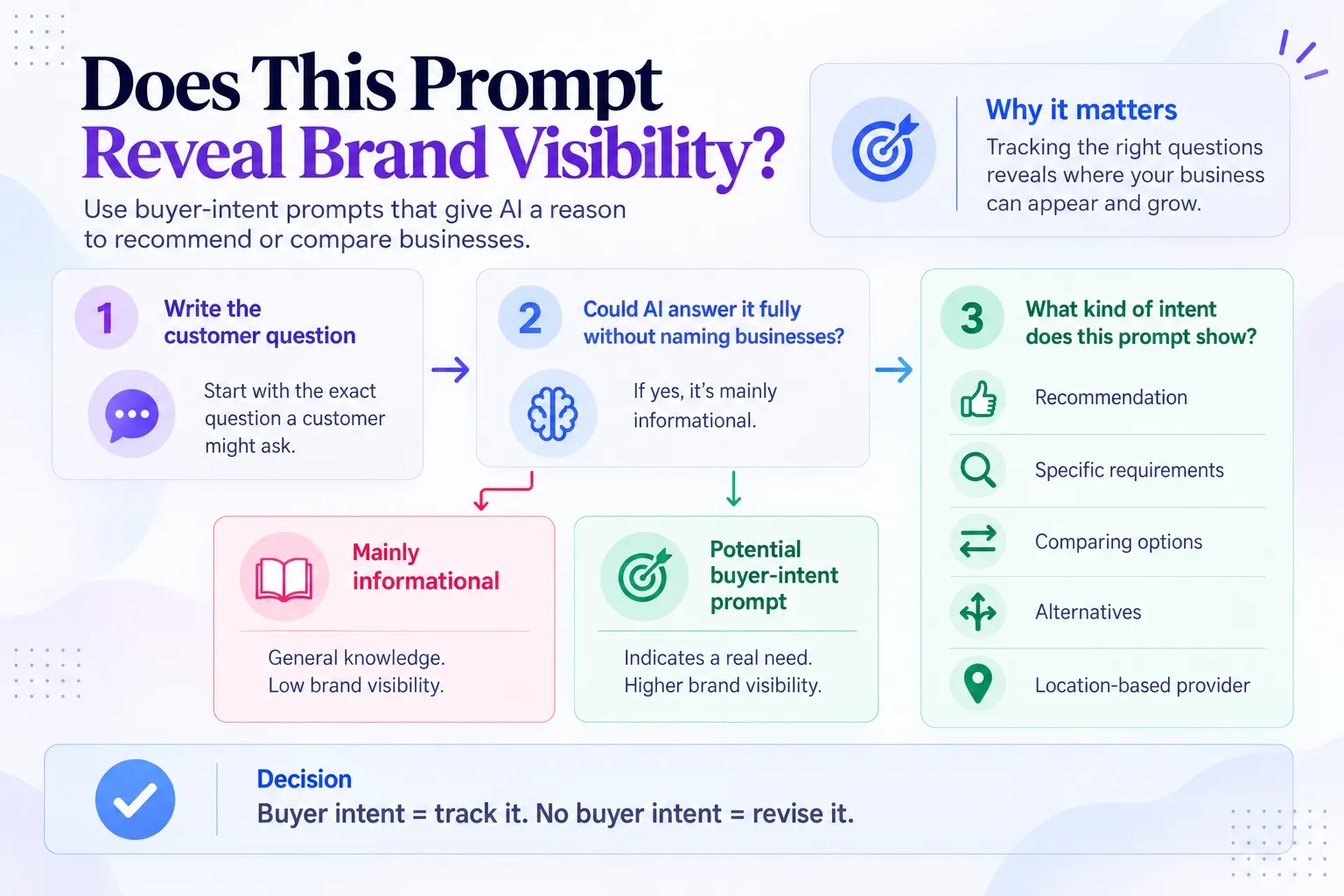
These are buyer-intent prompts.
The key question is: Would mentioning businesses make the AI answer more useful to the customer?
If yes, the prompt may be suitable for visibility measurement.
What does buyer intent mean in an AI prompt?
Buyer intent does not mean the customer is ready to make a purchase immediately.
It means the question has moved beyond simply learning about a topic towards evaluating how to solve a need or which option might suit them.
For example:
Informational
“What does a digital marketing agency do?”
Buyer intent
“Which digital marketing agencies are suitable for a growing ecommerce business in Malaysia?”
Or:
Informational
“What is an HR management system?”
Buyer intent
“What HR software is suitable for a company with 50 employees that needs payroll and leave management?”
The buyer-intent versions create a situation where identifying or comparing actual options makes the answer more useful.
Why can informational prompts give misleading visibility data?
Informational questions are valuable.
Customers ask them, and they can be useful for content marketing.
The problem comes when you use them to judge whether your brand is being discovered.
Suppose you track:
“What is cloud accounting?”
ChatGPT, Gemini and Perplexity could all provide excellent explanations without naming a single accounting software company.
If your brand receives zero mentions, that does not automatically mean your AI visibility is weak.
The question simply gave AI no strong reason to recommend a business.
This is why visibility measurements are more meaningful when the underlying prompt creates an opportunity for brands to appear.
A useful test is:
If all company and product names were removed from the answer, would the customer still have what they need?
For:
“What is contrast therapy?”
probably yes.
For:
“Where can I try contrast therapy in Kuala Lumpur?”
probably not.
The second question needs actual options to become useful.
What signals buyer intent?
Do not judge a prompt only by individual words.
Buyer-intent prompts may include terms such as:
- which;
- recommended;
- suitable;
- alternatives;
- provider;
- where can I find;
- options; or
- best for.
But the intent behind the question matters more than the wording.
The customer should be trying to identify, evaluate or choose a solution.
For example:
“What software can help a retailer manage invoices across multiple outlets?”
does not say “best” or “recommended”.
It can still create buyer intent because a useful answer may involve suggesting specific software products.
What does a strong buyer-intent prompt look like?
Strong prompts usually combine a real customer need with enough information for AI to determine which options are relevant.
| Informational or too broad | Stronger buyer-intent prompt |
|---|---|
| What is CRM software? | What CRM is suitable for a small sales team? |
| How does payroll outsourcing work? | Which payroll outsourcing services are suitable for SMEs in Malaysia? |
| What is event production? | Which event production companies can handle a corporate product launch in Kuala Lumpur? |
| What are international schools? | Which international schools in Johor Bahru offer Cambridge IGCSE? |
| How does inventory software work? | What inventory software is suitable for a small retailer with multiple outlets? |
The stronger versions represent situations in which a potential customer could realistically be deciding what to use or whom to contact.
How much context should you add?
Add information that could genuinely change which businesses are suitable.
Useful context may include:
Customer type: “for a small manufacturer”
Problem: “that needs automated payroll”
Requirement: “with multi-currency invoicing”
Location: “in Penang”
Use case: “for a 200-person corporate conference”
For example:
“What accounting software should I use?”
could become:
“What accounting software is suitable for a small Malaysian retailer that needs invoicing and inventory management?”
The second question gives AI a clearer decision situation.
But more detail is not automatically better.
Do not make prompts artificially long. Add context only when it could reasonably affect which option is suitable.
Do buyer-intent prompts need to ask for the “best” option?
No.
Customers do not always ask:
“What is the best...?”
They may ask:
- “What software can help me manage...?”
- “Which provider is suitable for...?”
- “What are my options for...?”
- “Where can I find...?”
- “Which service supports...?”
All can reveal visibility if a useful answer naturally involves suggesting businesses or products.
Tracking only “best” questions may actually give you too narrow a view of how customers make decisions.
Should you include your own brand name?
Usually not when you are measuring natural discovery.
Compare:
“Is MyBrand suitable for small businesses?”
with:
“Which providers are suitable for small businesses that need [specific requirement]?”
The first tells AI which business to discuss.
The second lets AI decide which businesses are relevant.
Branded prompts still have a useful purpose when you want to check what AI knows and says about your business.
But they are not a fair test of whether AI would independently introduce your business to someone who had not already heard of you.
How does buyer intent fit into your overall prompt strategy?
Buyer intent indicates whether a given question is suitable for measuring visibility.
It does not tell you which products, services, customer groups, locations and problems your entire tracking programme should cover.
That is a separate decision.
Once you know how to identify strong buyer-intent questions, see How To Find The Right AI Prompts To Track For Your Business to build those questions into a balanced prompt portfolio.
The distinction is simple:
Choose the right business areas first. Then make sure the questions you use to represent those areas are fair tests of AI visibility.
How should you measure buyer-intent prompts?
Once you have chosen suitable buyer-intent questions, track what actually happens when those questions are asked across AI answer engines.
Look at whether your brand appears, where it is positioned, which competitors are mentioned and whether your website is used as a source.
But always interpret those results in the context of the question.
A zero for a question where AI had no reason to mention brands tells you very little.
A zero for a question where a potential customer is actively asking AI to recommend suitable businesses is much more meaningful.
A platform like Zicy lets you track these buyer-focused questions and review the results by individual AI engine, so you can see what actually happened for each customer question rather than relying on occasional manual searches.
Which buyer-intent prompts should you start with?
Begin with one simple question:
What would a potential customer ask AI when they know what they need but have not yet decided who to choose?
Turn those situations into natural questions.
Then ask:
Would AI reasonably need to recommend or compare businesses to answer this well?
If yes, the prompt is likely worth considering for visibility tracking.
The aim is not to make every customer question transactional.
It is to make sure the questions used to measure AI visibility actually create an opportunity for your business—or a competitor—to appear.
Track the buyer questions that matter
and see where your brand appears with Zicy.
Zicy tracks brand mentions, website citations, share of voice and average AI ranking across ChatGPT, Gemini, Perplexity, Google AI Overviews and Google AI Mode.
