What Is AI Share of Voice? A Simple Guide for Small Businesses
Learn what AI Share of Voice (SOV) means, what affects it, and how to compare competitors and see where your brand stands with Zicy.
Key Takeaways
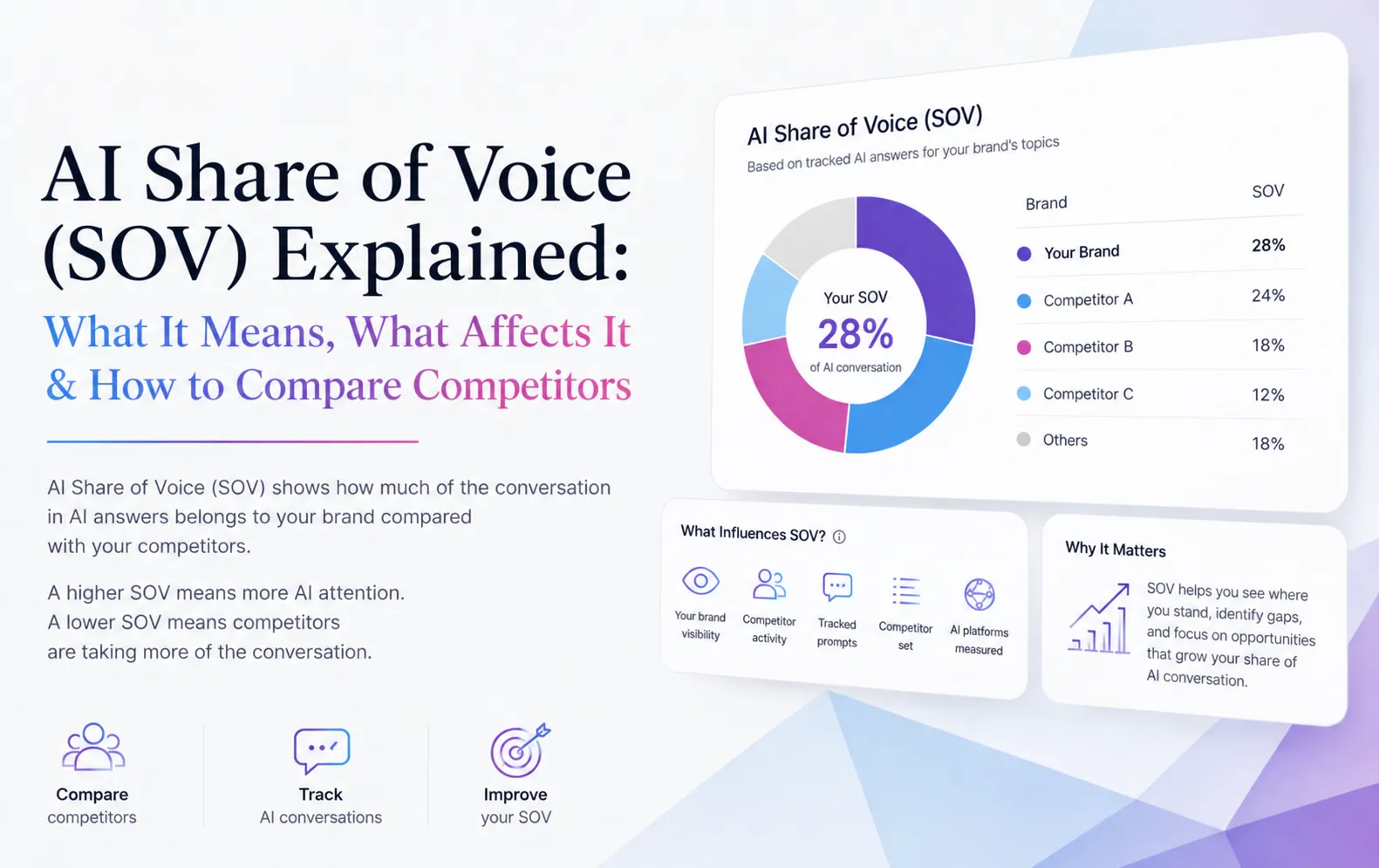
- AI Share of Voice (SOV) shows how much of the brand conversation in tracked AI answers belongs to your business compared with competitors.
- A higher SOV means your business is taking a larger share of the attention, while a lower SOV means competitors are occupying more of the conversation.
- SOV can vary based on your visibility, competitors' activity, the prompts being tracked, the brands included in the comparison and the AI platforms being measured.
- The most useful way to read SOV is against relevant competitors and over time, so you can see where you stand, where gaps exist and whether your position is improving.
Introduction
AI answers often mention multiple businesses in a single response. That makes it difficult to tell whether your brand is getting a meaningful share of the attention or competitors are dominating the conversation.
Without comparing that visibility, it is hard to see where your business really stands. AI Share of Voice gives you a clearer way to compare that attention.
What Is AI Share of Voice?
AI Share of Voice (SOV) measures the share of brand mentions your business receives across tracked AI-generated answers compared with competing brands.
For example, a restaurant menu brand such as MenuPilot could appear alongside several competitors in AI answers about menu pricing, menu design or menu analytics. SOV shows how the brand mentions across those answers are divided among the businesses being compared.
- Higher SOV: Your business receives a larger share of the brand mentions.
- Lower SOV: Competitors take a larger share of the conversation.
AI SOV does not measure market share, sales or customer preference. It only reflects your share of brand mentions within the AI answers being tracked.
Why Does AI Share of Voice Matter?
AI Share of Voice gives you a useful competitive benchmark for AI search. It can show where you stand relative to other businesses, where they have an advantage and whether that picture is changing over time.
- See who is leading the conversation: Find out which businesses are taking the largest share of attention across the AI answers you track.
- Spot competitive gaps: See where other brands have a stronger presence around the customer needs that matter to your business.
- Track changes over time: Monitor whether your position is improving, staying steady or losing ground.
- Know where to focus: Use those gaps to prioritise the topics and customer questions that need the most improvement.
What Can Affect Your AI Share of Voice?
Your AI Share of Voice can rise or fall as the balance of brand mentions changes across the conversations you track.
- Your brand mentions: More appearances across relevant AI answers can increase your share.
- Competitor mentions: If competitors start appearing more often, your SOV can fall even when your own visibility stays similar.
- The prompts you track: Different customer questions can bring different brands into the conversation, which changes the overall share.
- The competitors being compared: Your SOV depends on the competitive set. Missing relevant competitors can give you an incomplete picture.
- The AI platforms and time period: Each answer engine, like ChatGPT or Gemini, can surface different brands, and their answers can change over time.
This is why SOV is most useful when you compare a consistent set of relevant prompts and competitors over the same period.
How Is AI Share of Voice Calculated?
AI Share of Voice is calculated by dividing your brand mentions by the total brand mentions across the tracked AI answers, then multiplying by 100.
AI SOV = Your Brand Mentions ÷ Total Brand Mentions × 100
For example, if your brand receives 40 mentions out of 200 total brand mentions, your SOV is:
40 ÷ 200 × 100 = 20%
That means your business accounts for 20% of the brand mentions across the AI answers being measured. The total includes your own mentions and those of the competing brands within the same tracked set.
How Small Businesses Can Improve Their AI Share of Voice
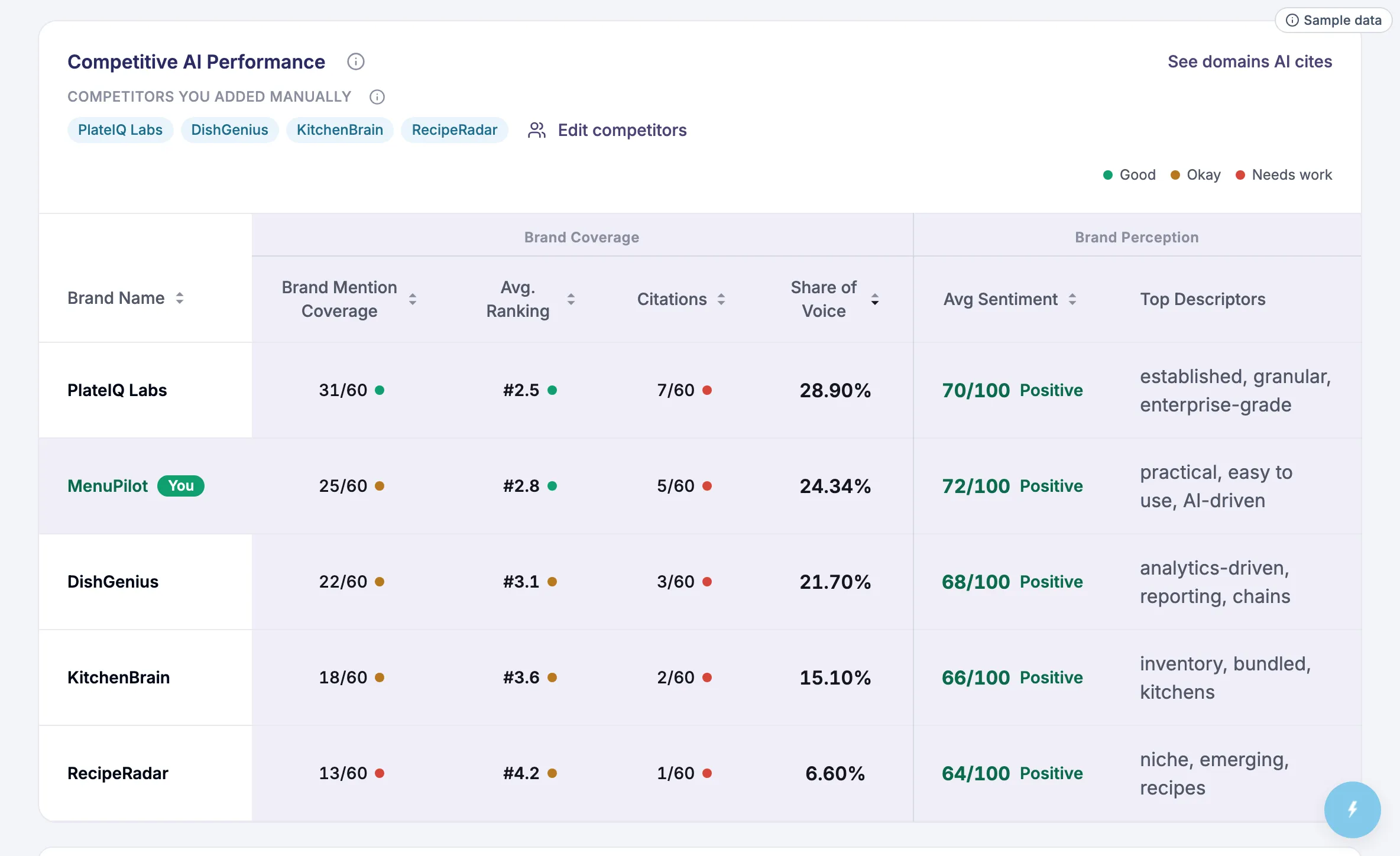
Looking at several competitive signals together gives you more context than Share of Voice alone.
You can compare how often brands appear, where they tend to rank, the citations they receive and how AI describes them.
From there, it becomes easier to spot close competitors, larger gaps and areas worth investigating further.
See Who Owns More of the Conversation
Compare your SOV with other brands that appear in the same tracked AI answers. You can quickly see who holds the largest share, which competitors are close to you and where the biggest gaps are.
Find Your Closest Competitors
The most useful competitor is not always the biggest company in your industry.
Comparing the brands that appear alongside yours can also reveal competitors you didn't originally include in your comparison.
This can help you decide which businesses are most useful to benchmark against.
Identify Where Competitors Are Gaining Ground
A lower overall SOV shows that competitors are taking more of the conversation, but not necessarily why.
From there, you can investigate related prompts to see which customer questions competitors appear more strongly for and where your brand has less of the conversation.
For example, a restaurant menu brand such as MenuPilot may perform well around menu pricing but have a smaller presence in conversations about menu design or analytics.
Turn SOV Gaps Into Content Priorities
Once you know which customer conversations need attention, you have a clearer idea of what to improve.
That could mean strengthening an existing service page, answering an important customer question more clearly or creating useful content around a topic where your business has relevant expertise but limited AI visibility.
The focus stays on the customer needs that matter, rather than on producing more content for its own sake.
Track Whether Your Share Is Improving
Use consistent prompts and competitors when comparing similar time periods.
This lets you see whether your share is growing, whether the gap with a close competitor is narrowing or whether another brand is beginning to take more of the conversation. That makes SOV useful as an ongoing competitive benchmark rather than a one-off percentage.
FAQs
Can a Small Business Have a Higher SOV Than a Much Larger Competitor?
Yes. Business size does not automatically determine AI visibility. A smaller brand can have a higher SOV if it takes a larger share of the relevant AI conversations being tracked.
Can Two Competitors Have Almost the Same Share of Voice?
Yes. Brands can have very similar SOV percentages when they receive a similar share of attention across the tracked AI answers.
A near-tie is worth watching because even a small shift in visibility could change which business holds the larger share.
Should I Compare My SOV With Every Business in My Industry?
No. Focus on competitors that serve similar customers, compete for the same needs or regularly appear alongside your business in relevant AI answers.
A smaller, more relevant competitor set usually yields a more meaningful comparison than including every business in the industry.
How Long Does It Take to Improve AI Share of Voice?
There is no fixed timeframe. Changes in AI SOV depend on your brand's broader visibility, competitors' activity and how AI platforms respond to the topics being tracked.
It is more useful to monitor the direction of your SOV over time than to expect an immediate change after updating a page or publishing new content.
Can a New Competitor Suddenly Affect My SOV?
Yes. If another business starts taking a larger share of the same AI conversations, your percentage can change even if your own visibility remains relatively stable.
This is one reason it is useful to keep an eye on new or previously untracked brands appearing in your competitive space.
See Your Place in the AI Conversation
AI Share of Voice gives you a simple way to understand how much of the AI conversation your business owns compared with competitors.
More importantly, it gives that visibility competitive context. You can see who is taking more of the conversation, where the biggest gaps are and whether your position is changing over time.
For a small business, that makes SOV more than another percentage. It becomes a practical way to decide where to direct your AI visibility efforts next.
See how much of the AI conversation
your business owns.
Zicy helps you compare competitors, spot visibility gaps and track whether your Share of Voice is improving over time.
