How To Find AI Battleground Topics Where a Small Push Could Make a Difference
Learn how to find AI battleground topics where your business already appears but competitors are stronger, and decide which opportunities deserve a focused push.
Key Takeaways
- An AI battleground topic is a customer need where your business already appears in AI answers, but competitors are stronger.
- Battlegrounds are often easier to improve than blind spots, because AI already connects you with the topic.
- The biggest visibility gap is not automatically the best opportunity. Commercial relevance comes first.
- Look for patterns across questions, AI platforms and time before acting.
- The fix is often an existing page, clearer information or stronger proof. New content is only one option.
- Choose one or two battlegrounds that matter to your business.
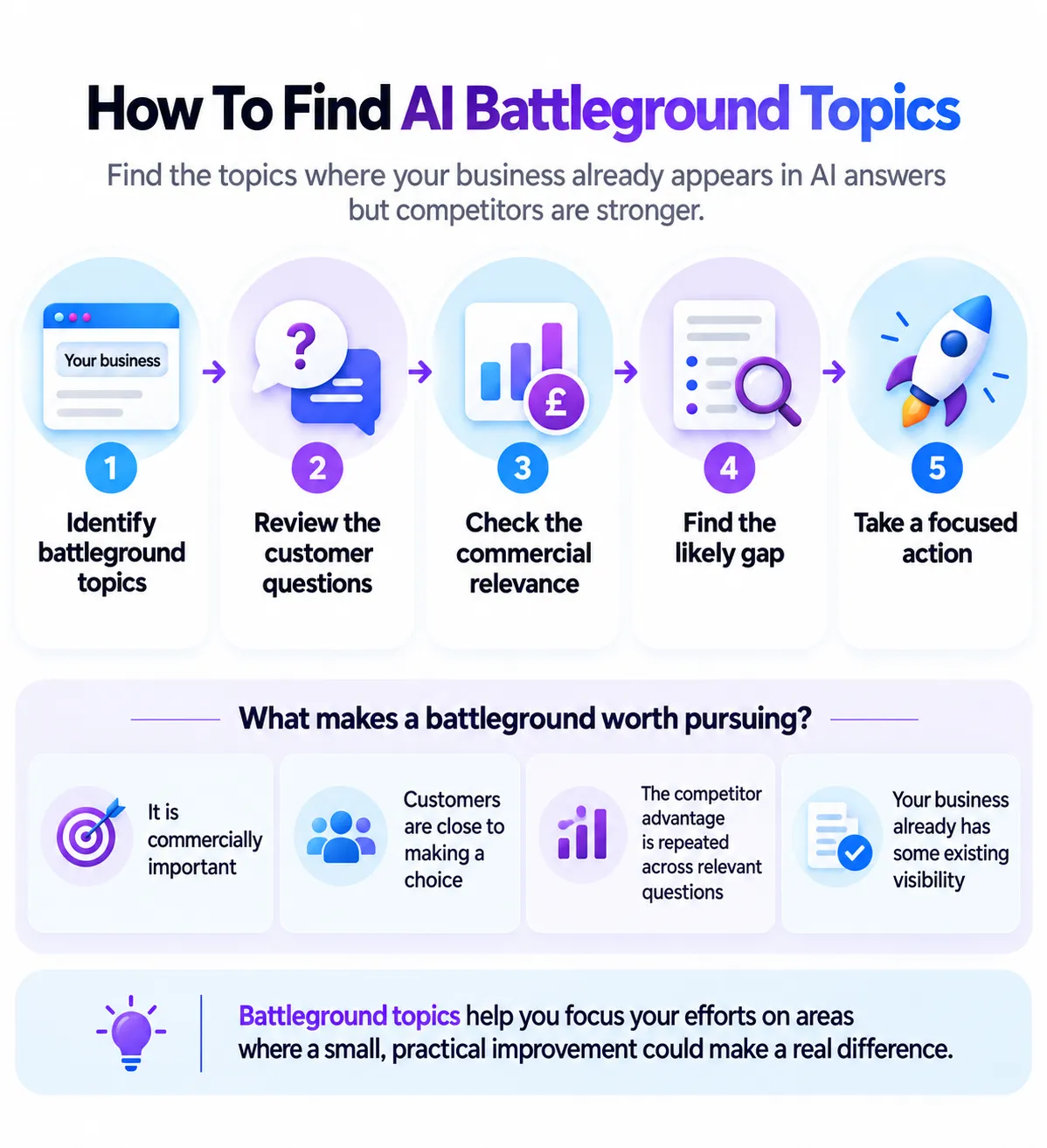
AI Visibility Is Rarely All or Nothing
Your business may already appear when customers ask AI about a product or service, while competitors appear more often, more prominently or across a wider range of questions.
These areas are worth investigating because your business is already part of the customer conversation.
For a small business with limited time and budget, focus on commercially important topics where you are already competing and where stronger competitor visibility deserves closer investigation.
What Is an AI Battleground Topic?
Imagine you run a commercial cleaning company in Kuala Lumpur, offering office cleaning, carpet cleaning, post-renovation cleaning, deep cleaning and recurring contracts.
Potential customers may ask AI questions such as:
- “Which companies provide office cleaning in Kuala Lumpur?”
- “What are some reliable cleaning companies for a small office?”
- “Which commercial cleaners offer recurring office cleaning contracts?”
Your company appears in some of these answers.
However, two competitors appear more consistently. One is frequently placed near the top of recommendation lists. Another appears whenever customers ask specifically about recurring office contracts.
Your business is not invisible. It already appears in answers around that customer need, but other businesses currently have the stronger presence.
That is an AI battleground topic.
The battleground is therefore not the entire office-cleaning category. It is the specific customer needs where your business already appears but competitors are gaining more visibility.
| Topic type | What it looks like |
|---|---|
| Brand leader | AI mentions you more than anyone else |
| Battleground | AI mentions you, but a competitor is stronger |
| Blind spot | Customers ask about it, but AI rarely mentions you |
For blind spots, see How to Find AI Blind Spots for Your Products and Services.
Why Can a Small Push Make a Difference?
AI already connects your business with the topic.
On a blind spot, you may need to build that connection from scratch. On a battleground, it exists but is weaker than a competitor's. Closing the gap can be as simple as clearer service details or easier-to-find proof.
For example:
This does not guarantee results. AI answers vary between platforms and over time. It simply gives you a focused starting point.
How Do You Find Battleground Topics?
Start With Customer Questions
Battleground analysis is most useful when it starts with questions real customers may ask while researching or choosing a provider.
Your website might describe the service as “professional hygiene solutions”, while customers ask much more specific questions such as:
- “Who provides weekly office cleaning in Kuala Lumpur?”
- “Which cleaning company can handle a 40-person office?”
- “What are reliable options for outsourced office cleaning?”
These questions are more useful because they represent actual needs and buying decisions.
If you have not yet built a focused set of customer questions, see How to Build a Simple Prompt Set Around Problems, Comparisons, Reviews, Pricing and Alternatives.
Group Them Into Topics
Once you have enough relevant questions, group similar ones into broader topics.
This makes it easier to see where your business is already part of the conversation and where competitors are stronger.
| Customer question | Broader topic |
|---|---|
| “Best office cleaners in KL” | Office cleaning |
| “Reliable cleaning company for small offices” | Office cleaning |
| “Weekly office cleaning contracts” | Recurring commercial cleaning |
| “Office cleaners with good reviews” | Office cleaning reputation |
| “Affordable office cleaning for SMEs” | Office cleaning pricing |
Look for the Signs
How do you know whether a topic is really a battleground?
A battleground usually shows a repeated pattern: your business appears, but another provider has the stronger presence. This can happen in several ways.
- You appear less often. Of ten office-cleaning questions, you appear in four and Competitor A in eight.
- You appear lower down. AI repeatedly places your competitor first or describes it in more detail.
- Your visibility depends on the wording. You appear for “office cleaning companies in Kuala Lumpur” but not for “office cleaning for a 50-person corporate office”.
- One competitor owns a specific need, such as recurring contracts, larger offices or after-hours cleaning.
The last sign is the most useful. “Competitor A is strong when customers ask about recurring corporate cleaning” gives you a specific need to investigate.
Which Battleground Topics Deserve Attention?
Not every battleground deserves more investment.
A simple way to narrow the list is to ask three questions.
Does the Topic Matter Commercially?
Suppose your business earns most of its revenue from recurring office contracts.
A gap around recurring commercial cleaning is likely to matter more than a larger gap around a minor service you rarely sell.
The biggest numerical gap is not automatically the biggest business opportunity.
Is the Customer Close to Choosing a Provider?
Compare:
with:
The first is mainly informational.
The second asks AI to help shortlist providers.
Pay closer attention to topics built around recommendations, comparisons, reviews, pricing, location and specific customer needs.
Does the Competitive Pattern Repeat?
Do not react to one AI answer.
The signal becomes stronger when the same competitor:
- repeatedly appears across similar customer questions;
- performs strongly on more than one AI platform;
- remains visible over several analysis periods; and
- consistently appears ahead of your business.
If unfamiliar companies keep appearing alongside you, How To Find Your Real Competitors Inside AI Answers explains how to decide whether they are genuine competitors or simply incidental names.
| Battleground topic | Commercial value | Close to a decision |
|---|---|---|
| Recurring office contracts | High | Yes |
| Larger offices | High | Yes |
| After-hours cleaning | Medium | Yes |
| Eco-friendly cleaning | Low | Yes |
Read the AI Answers Before Changing Anything
A battleground identifies where to investigate, but the individual AI answers help explain what may be creating the gap.
Suppose your analysis shows that recurring office cleaning is a battleground. Before creating new content, read the individual AI answers behind the topic to understand what may be creating the difference.
Ask:
- Which companies are being recommended?
- How is your business described?
- How are stronger competitors described?
- Are they associated with customer needs that you are not?
- Are important service details missing from your own website?
- Which sources are supporting competitors?
- Does the same pattern appear across several AI platforms?
When you are reviewing many questions, an AI visibility platform can make this easier by connecting broader topic patterns with the individual tracked questions and AI responses behind them.
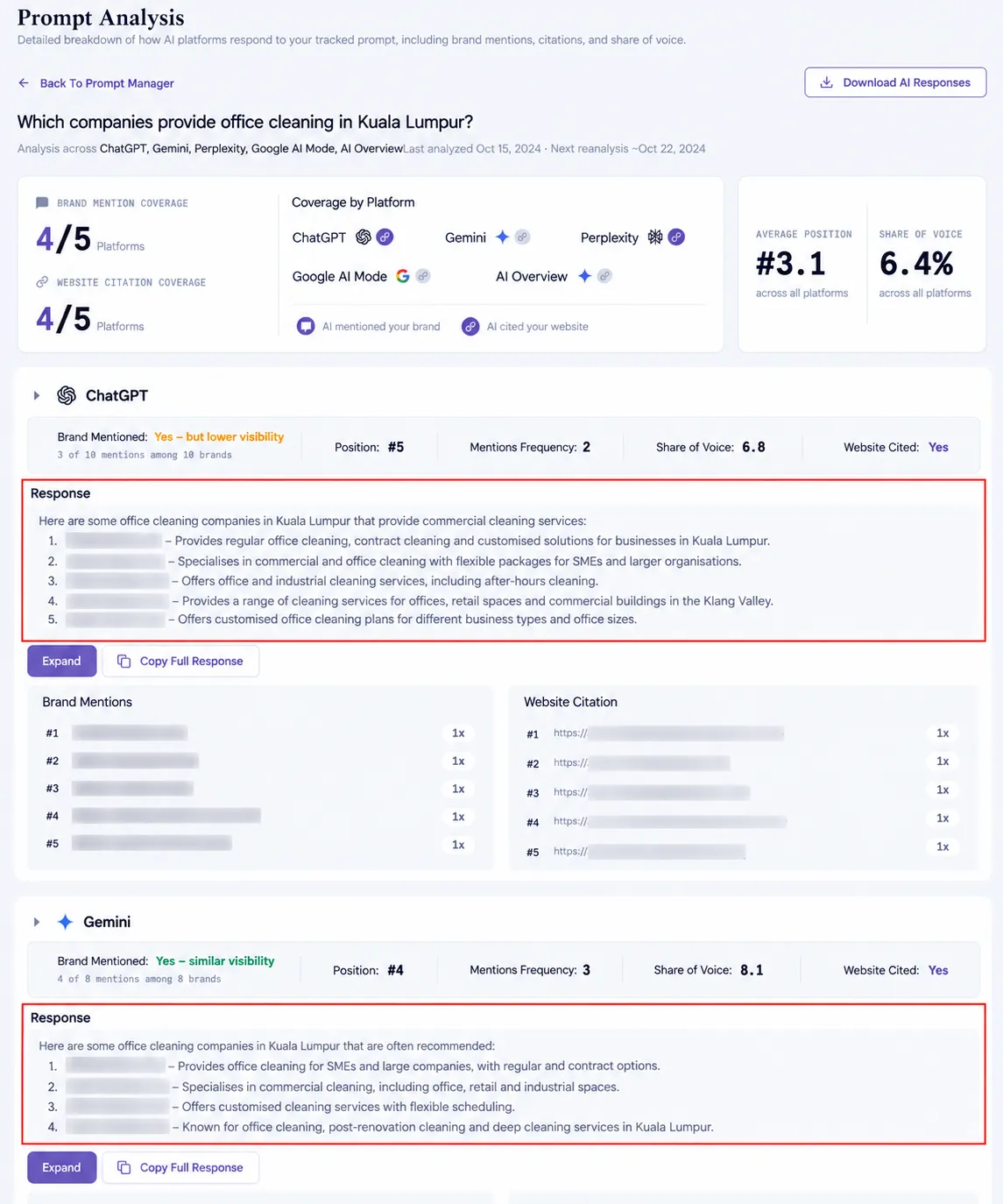
The important principle is:
For a deeper walkthrough, see How to Read a Single Tracked Prompt and See the Exact AI Answers Behind Your Scores.
Diagnose Why Competitors Are Stronger Before Deciding What to Change
Once you identify the businesses that are stronger around the topic, look for possible reasons.
Common reasons include:
Clearer Service Information
A competitor may explain:
- who the service is for;
- what is included;
- how often it is provided;
- where it is available; and
- relevant contract options.
Your page may simply say:
Both businesses offer the service, but one gives customers, and AI, much clearer information.
Better Alignment With the Customer Need
Customers may frequently ask about cleaning for small offices.
A competitor has a page specifically explaining office cleaning for SMEs.
Your website discusses commercial cleaning only in general terms.
Their information may simply match the question more directly.
Stronger Proof
Competitors may provide clearer case studies, certifications, testimonials, project examples and experience.
Ask whether your own website makes equivalent, legitimate evidence easy to find and understand.
Third-Party Sources May Reinforce Them More Strongly
Reviews, directories, industry sites and other third-party sources may also reinforce a competitor's connection with a service.
If AI repeatedly uses those sources, the visibility difference may not be caused by the competitor's website alone.
The goal isn't to copy a competitor's website. It is to understand which information, proof or external signals may make that business easier for AI to connect with the customer need.
What Does a Focused Improvement Look Like?
A focused improvement should address the specific gap you found rather than trigger a broad content campaign.
Depending on the diagnosis, that could mean:
- improving an existing service page;
- clarifying which customers the service is for;
- adding missing contract or service information;
- strengthening genuine proof;
- clarifying locations or service areas;
- improving useful internal links; or
- addressing a genuine content gap.
If customers repeatedly ask about weekly cleaning contracts but your service page never explains whether you offer them, adding that information may be more useful than publishing another broad article about commercial cleaning.
Let the diagnosis determine the action.
How Can You Find Battlegrounds Across Many AI Answers?
When you monitor only a small number of questions, you can often spot patterns manually.
As the number grows, grouping questions into topics becomes more useful.
For a cleaning business, topics might include:
- office cleaning;
- recurring contracts;
- pricing;
- post-renovation services; and
- reputation and reviews.
You can then compare how consistently your business appears within each topic. For larger prompt sets, an AI visibility platform can help organise these patterns.
A topic-level view can separate Brand Leaders, Battlegrounds and Blind Spots so you can more easily see where your business already appears but competitors remain stronger.
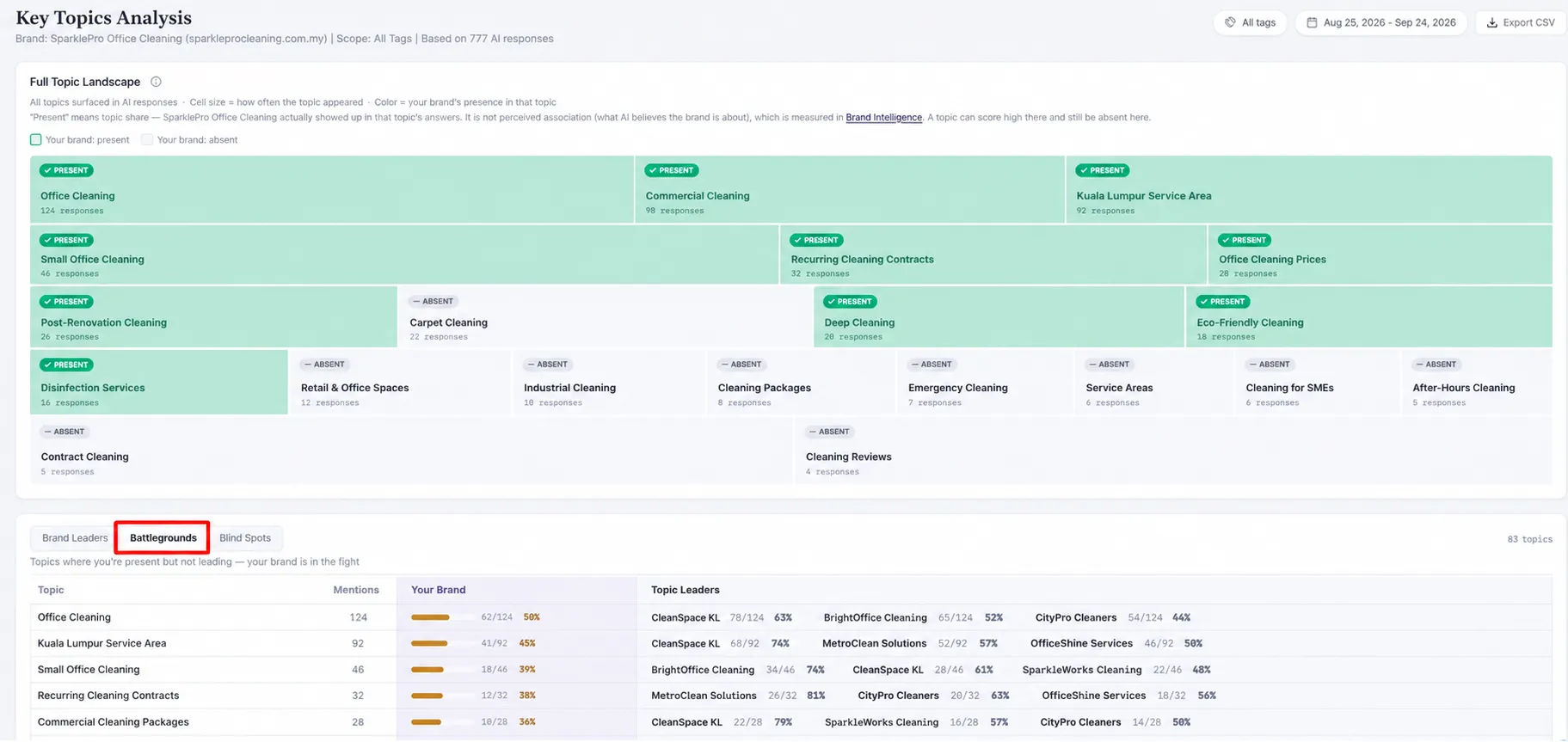
Treat the result as a diagnostic starting point, not a list of topics that all need optimisation.
A platform like Zicy can bring these topic patterns and the underlying tracked questions together, making it easier to identify which battlegrounds deserve a closer look.
How to Find AI Battleground Topics Worth Working On
Step 1: Start With Customer Questions and Group Them Into Topics
Use questions that reflect how potential customers search, compare and choose.
Group questions that represent the same underlying customer need so you can see broader patterns rather than treating every wording variation separately.
Step 2: Find Topics Where Your Business Already Appears
Look for topics where your business is part of the answers but competitors appear more consistently or prominently.
These are your battleground candidates.
Step 3: Check Whether the Battleground Matters Commercially
Ask:
- Is this an important product or service?
- Are customers close to making a decision?
- Does the competitive advantage repeat?
- Does improving this area support a real business priority?
Topics that meet most of these criteria are stronger candidates for further investigation.
Step 4: Read the Underlying AI Answers
Move from the topic to the individual customer questions.
Look at which businesses appear, how they are described and which sources support them.
Step 5: Diagnose the Likely Gap
Check whether the difference may be related to:
- clearer competitor service information;
- stronger proof;
- closer alignment with the customer need; or
- stronger third-party support.
The right response may be improving existing information, proof or external signals rather than adding new content.
Step 6: Make One Focused Improvement and Monitor the Pattern
Choose the action that most directly addresses what you found.
Then keep the core customer questions reasonably stable so you can see whether your visibility changes over time.
If you need help separating short-term movement from a more persistent change, see How to Read Daily, Weekly and Monthly AI Visibility Trends.
Focus on the Battlegrounds That Matter
You do not need to challenge every topic where a competitor has stronger AI visibility.
Focus on commercially important customer conversations where your business already has some presence, investigate what may be giving competitors the stronger position and make one relevant improvement your team can realistically complete.
If your investigation instead reveals important services where your business is barely appearing at all, continue with How to Find AI Blind Spots for Your Products and Services.
See Where Your Business Is Already in the Fight
Zicy can help surface topics where your brand already appears alongside stronger competitors, giving you a clearer starting point for deciding which battlegrounds deserve attention.
