How To Find AI Blind Spots for Your Products and Services
Learn how to identify products and services that AI discusses without mentioning your business, understand why the gap exists and decide what to investigate next.
Key Takeaways
- An AI blind spot is a commercially relevant topic where customers ask about a product, service or need but your business rarely or never appears.
- A blind spot is different from a battleground. On a battleground, AI already mentions you but a competitor is stronger. On a blind spot, AI rarely connects you with the topic at all, so it usually needs deeper investigation.
- A blind spot matters only when it relates to something you genuinely offer and want customers to find you for.
- Look for repeated absence across relevant customer questions rather than reacting to one AI answer.
- Read the actual answers before deciding what needs fixing; the problem may be unclear service information, weak proof, limited third-party signals or poor alignment with the customer's question.
- The goal is not to remove every blind spot, but to find the ones that represent meaningful missed customer opportunities.
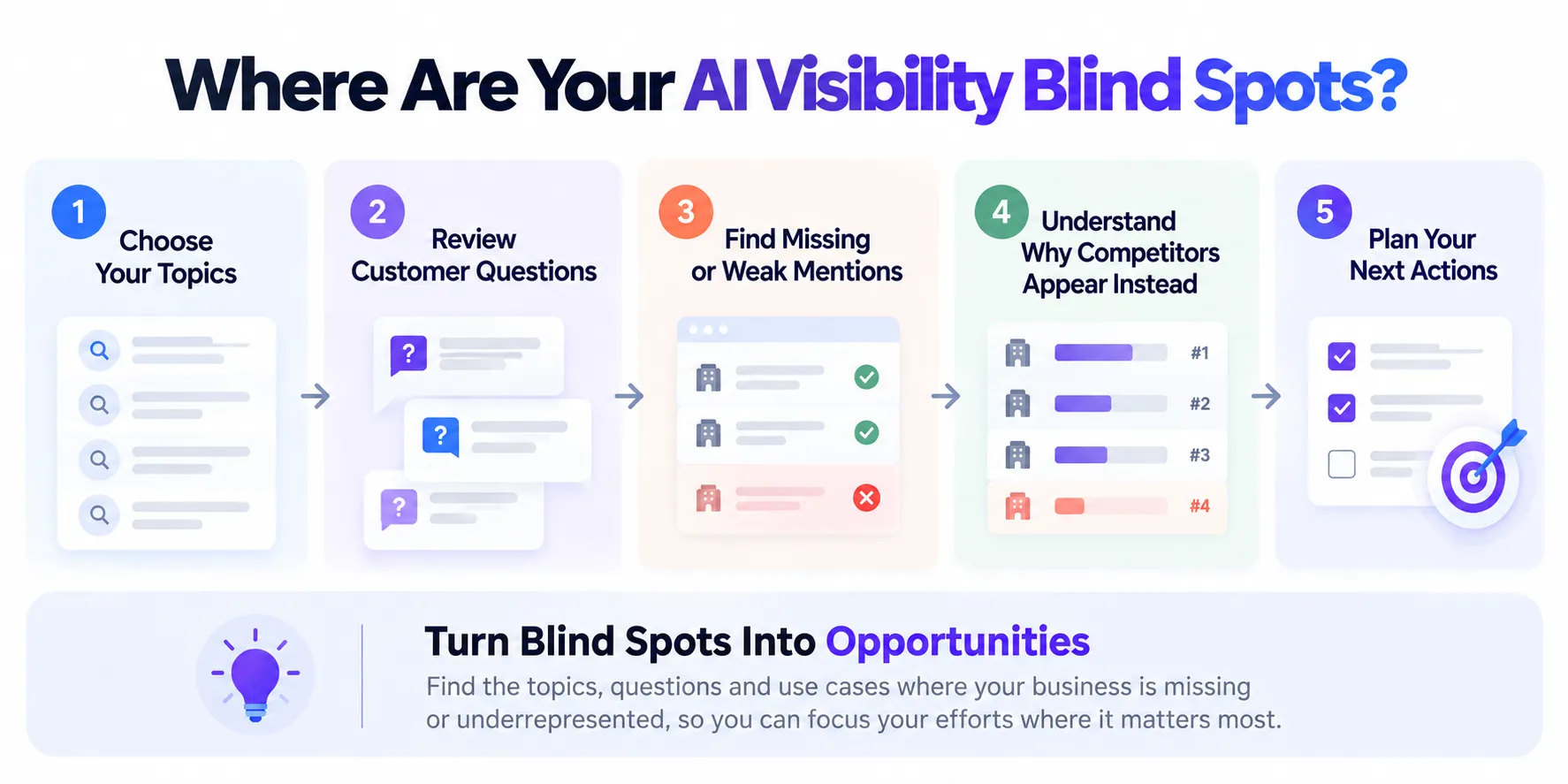
Find Where AI Is Not Connecting Customers With Your Business
Your business may genuinely offer a product or service, yet AI rarely mentions you when customers ask about it.
Instead, the same competitors keep appearing.
That is more useful than a low overall visibility score because it shows where the disconnect is happening.
For a small business, these gaps matter when they affect products, services or customer needs you actively want to compete for.
The aim is not to appear for every topic in your industry. It is to find commercially important areas where potential customers are asking for what you sell, but AI is not consistently connecting that need with your business.
What Is an AI Blind Spot?
Imagine you run a commercial cleaning company in Kuala Lumpur.
Your business offers regular office cleaning, recurring commercial cleaning contracts, carpet cleaning, post-renovation cleaning and deep cleaning.
When customers ask:
your business appears regularly.
But when they ask:
several other cleaning companies appear and yours rarely does.
That becomes interesting because post-renovation cleaning is a real service you provide. The customer need is relevant, but competitors keep showing up instead.
AI is therefore not consistently connecting your business with that part of your offer.
That is an AI blind spot: a relevant area of demand where your business should reasonably be considered but rarely appears.
| Topic type | What it looks like | What it usually needs |
|---|---|---|
| Battleground | AI mentions you, but a competitor is stronger | A focused improvement |
| Blind spot | Customers ask about it, but AI rarely mentions you | A deeper look at why AI does not connect you with it |
If you already appear but competitors are stronger, see How To Find AI Battleground Topics Where a Small Push Could Make a Difference.
Use Customer Questions to Reveal the Gaps
Your product list tells you what matters to the business.
Customer questions show you whether AI connects those products with your brand.
For example:
| Service | Customer question |
|---|---|
| Office cleaning | “Which companies provide office cleaning in Kuala Lumpur?” |
| Recurring contracts | “Who offers weekly office cleaning contracts?” |
| Post-renovation cleaning | “Which companies clean offices after renovation?” |
| Carpet cleaning | “Who provides commercial carpet cleaning in KL?” |
| Deep cleaning | “Which cleaners provide deep cleaning for offices?” |
Looking across several questions helps you see which parts of your offer AI consistently recognises and which it overlooks.
If you still need to build the questions themselves, see How to Build a Simple Prompt Set Around Problems, Comparisons, Reviews, Pricing and Alternatives.
Why Can Blind Spots Matter to a Small Business?
A customer using AI may never ask for your brand by name.
They may instead describe what they need:
- “Who can clean an office after renovation?”
- “Which companies provide after-hours office cleaning?”
- “Who offers eco-friendly commercial cleaning in Kuala Lumpur?”
AI then decides which businesses, products or sources appear relevant to that need.
If your business genuinely offers the service but repeatedly disappears from those answers, potential customers may never know you are an option.
That is why overall visibility scores tell only part of the story. A business can look reasonably visible overall while still being almost absent from commercially important conversations around:
- a high-value service;
- a growth product or service;
- an important customer segment; or
- a location or use case you want to grow.
Which Blind Spots Are Worth Investigating?
A missing mention only becomes useful when it matters to the business.
Start with the products, services and customer needs you genuinely want to grow.
For the cleaning company:
| Business area | Importance |
|---|---|
| Recurring office cleaning | Core service |
| Post-renovation cleaning | Growth service |
| Deep cleaning | Important add-on |
| Carpet cleaning | Supporting service |
| Residential sofa cleaning | Not a strategic focus |
This gives you a commercial filter for deciding which absences deserve attention.
If AI rarely mentions the company for residential sofa cleaning, that may not matter.
If it rarely mentions the company for post-renovation office cleaning, a service the business actively wants to grow, the gap deserves closer attention.
A useful blind spot usually passes three checks:
It Matches Something You Genuinely Offer
Do not treat industrial factory cleaning as a problem if your company only serves offices and retail spaces.
The Customer or Use Case Matters Commercially
A service you technically provide but do not want to grow should not automatically become a priority.
The Absence Repeats
One missing mention is weak evidence. The signal becomes stronger when your business remains absent across several related questions, AI platforms or analysis periods.
For example:
- “Post-renovation office cleaning Kuala Lumpur”;
- “Commercial cleaners after office renovation”; and
- “Who cleans offices after renovation work?”
If competitors repeatedly appear across these variations while your business does not, you have a much stronger blind-spot signal.
Also check that the question gives AI a reason to name businesses. “What is post-renovation cleaning?” usually gets a definition back with no companies mentioned, so your absence there is not a blind spot.
Diagnose the Blind Spot Before Deciding What to Fix
A blind spot does not automatically mean you need a new article or landing page.
If AI rarely mentions your company for post-renovation cleaning, first investigate why.
Open the customer questions where your business is absent and read the actual AI answers.
Look at:
- which businesses appear instead;
- how those businesses are described;
- which services or specialisations AI highlights;
- which websites or third-party sources support the answer; and
- whether the same competitors appear across several AI platforms.
You might discover that competitors are repeatedly described as:
while your own website mentions post-renovation cleaning only as one bullet in a long list.
You now have a specific problem to investigate: competitors are strongly associated with the service, while your own website barely explains it.
If you are reviewing many customer questions, an AI visibility platform can make this easier by linking each tracked question to the individual AI responses behind it.
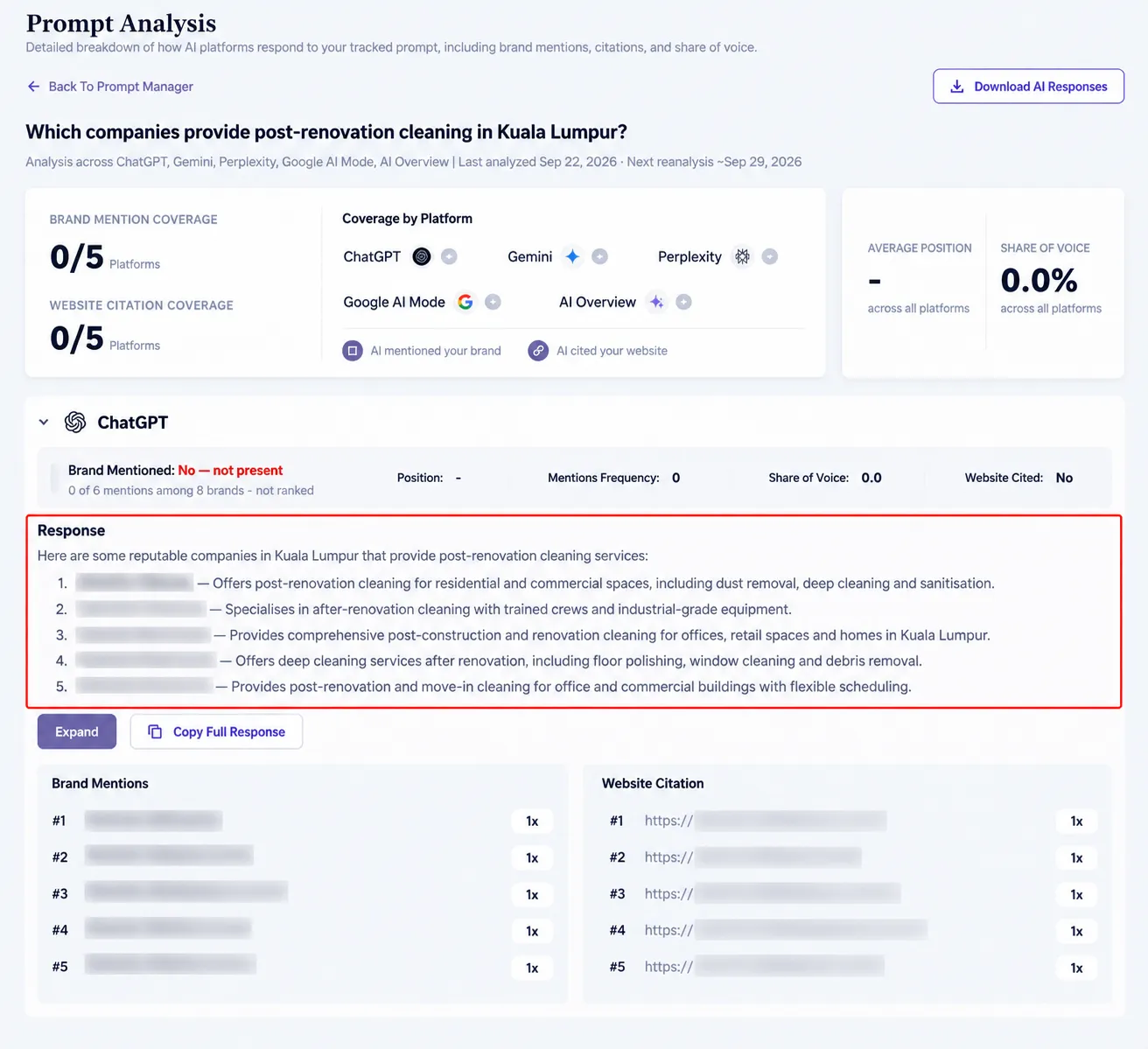
Whether you use software or check manually, the principle is the same:
For the full prompt-level workflow, see How to Read a Single Tracked Prompt and See the Exact AI Answers Behind Your Scores.
What Can Cause an AI Blind Spot?
There is rarely one cause. Check several possible reasons before deciding what needs to change.
Your Service Is Mentioned Too Vaguely
Your website might say:
That does not tell a customer, or AI, whether those services include:
- post-renovation cleaning;
- office move-in cleaning;
- carpet extraction;
- weekly cleaning contracts; or
- after-hours cleaning.
If an important service is hidden inside generic language, its connection with your business may be weak.
The Information Exists but Is Buried
Perhaps post-renovation cleaning appears on one page halfway through a paragraph.
Meanwhile, a competitor has:
- a dedicated section;
- clear service details;
- FAQs;
- project examples; and
- relevant internal links.
Your website may have the information, but it is difficult to find and understand.
Your Wording Does Not Match the Customer Need
You might use industry terminology such as:
while customers ask:
Both may refer to similar work, but the customer need is expressed very differently.
Good content should still use accurate industry language, but it also needs to explain what the service means in terms customers understand.
You Have Weak Proof
You may claim to offer a service without showing much evidence.
Relevant proof might include:
- project examples;
- case studies;
- client types;
- certifications;
- service processes;
- testimonials; and
- before-and-after examples where appropriate.
If stronger competitors provide clearer evidence, AI may have more information connecting them with the topic.
Competitors Have Stronger Third-Party Signals
AI answers can draw on information beyond company websites.
Reviews, business directories, industry publications and other third-party sources may repeatedly associate competitors with a particular service.
Your website may say you provide it, but the wider web may give AI much stronger evidence about somebody else.
Your Business Information Is Inconsistent
One profile may describe you as an office cleaning company.
Another may emphasise general housekeeping.
A directory may list only carpet cleaning.
Your website may use a completely different service description.
Inconsistent information can weaken the overall picture of what your business actually does.
A blind spot may result from one issue or several working together. Diagnose the gap first rather than assuming the answer is more content.
How Can You Find Blind Spots Across Many Products and Services?
For a business with only a few services, a spreadsheet may be enough.
List your priority products or services alongside the customer questions that relate to them, then record whether your business appears.
As the number of questions grows, group them into broader topics such as:
- office cleaning;
- post-renovation cleaning;
- recurring contracts;
- deep cleaning;
- pricing;
- reviews; and
- cleaning for SMEs.
You can then look for topics that appear frequently in AI answers while your business has little or no presence.
AI visibility tools can organise this at scale.
For example, Zicy's Key Topics view sorts your topics into Brand Leaders, Battlegrounds and Blind Spots, showing how often each topic comes up in AI answers, your presence in it and which brand currently leads it.
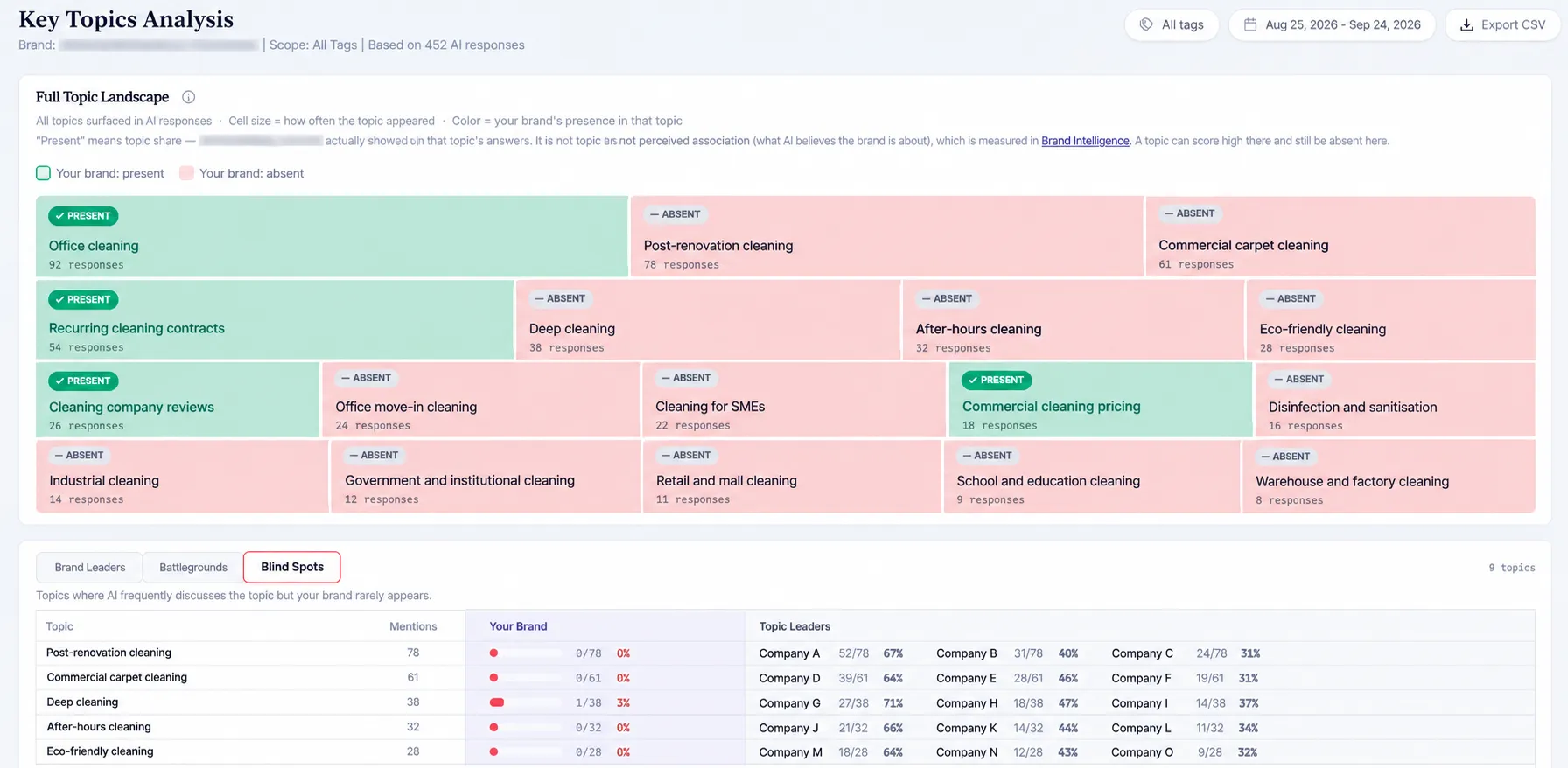
Treat the result as a signal to investigate, not an automatic instruction to create content.
How to Find AI Blind Spots for Your Products and Services
Step 1: List the Products and Services That Matter
Start with core services, growth areas and commercially important use cases.
Do not build the exercise around everything your business could theoretically provide.
Step 2: Build Customer Questions Around Each Area
Phrase each prompt as a question a potential customer could realistically ask while choosing a provider. For example:
Step 3: Look for Repeated Absence
Review several related questions and identify services where:
- competitors repeatedly appear;
- your business appears rarely; or
- your business is consistently missing.
Do not treat one result as a blind spot. Leave out learning questions such as “What is post-renovation cleaning?”, which rarely name any businesses.
Step 4: Confirm That the Gap Matters Commercially
Check that:
- you genuinely offer the service;
- you want more customers for it;
- the question reflects the customers you serve; and
- the topic is relevant to a real buying decision.
If not, deprioritise it.
Step 5: Diagnose Why Your Business Is Missing
Read the AI answers to understand what may be contributing to the gap. Review:
- how competitors are described;
- which sources support them;
- what your website currently says;
- whether your service information is clear;
- whether you have meaningful proof; and
- whether third-party information is accurate and consistent.
This tells you what may actually be missing.
Step 6: Decide What the Gap Requires
The appropriate response might be:
- improve an existing service page;
- clarify a customer use case;
- add genuine proof;
- improve internal links;
- strengthen or correct third-party information; or
- create new content where no suitable resource exists.
Do not turn every blind spot into a new article.
What Should You Do After Finding Several Blind Spots?
You may uncover more genuine blind spots than your team can address at once. Prioritise those tied to important services and customer decisions, especially where the absence repeats and the likely cause is reasonably clear.
Continue with How to Prioritise AI Visibility Gaps When You Have a Small Team and Budget.
Find the Services AI Is Overlooking
You do not need to appear for every possible topic. Find the commercially important products and services that customers ask AI about but where your business is repeatedly missing, then work out what may be causing the gap.
See Where Your Business Is Being Left Out
Zicy can help surface topics where relevant customer needs appear in AI answers but your brand rarely does, giving you a clearer starting point for investigation.
