How to Read a Single Tracked Prompt and See the Exact AI Answers Behind Your Scores
Learn how to stop trusting a dashboard number and start reading the actual AI answers behind your scores so you can see exactly what changed and why.
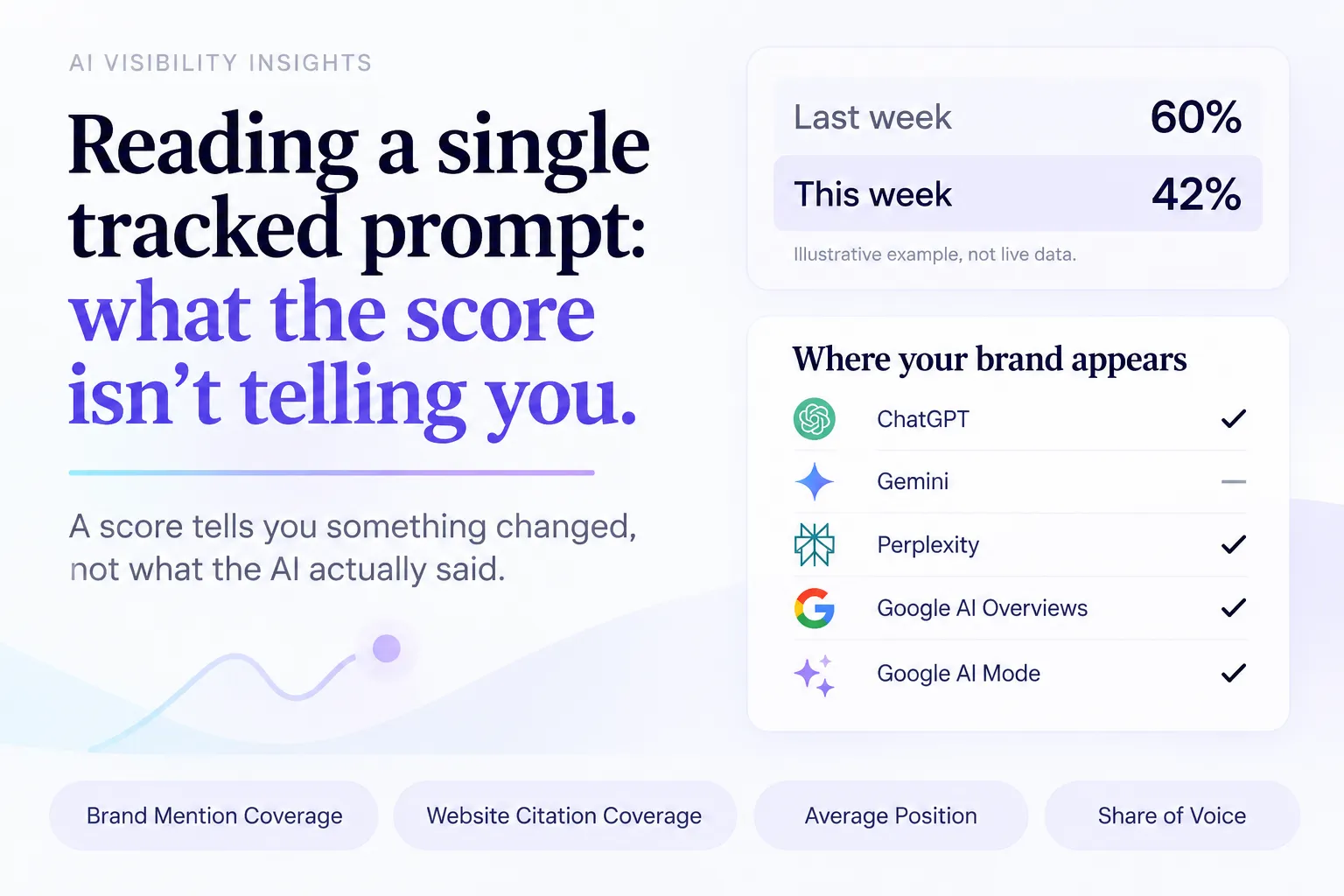
Key Takeaways
- A dashboard score tells you that something changed. It does not tell you what AI actually said.
- Every tracked prompt is one customer question tested across five AI platforms daily. Reading one prompt result shows exactly what happened for that question.
- Different platforms can give very different answers to the same question. A score of 3 out of 5 does not mean all platforms behaved the same way.
- The raw AI answer shows whether your brand was mentioned, where it appeared and whether a competitor took its place.
- You do not need to read every prompt every day. Start with the question where your score changed the most.
- Reading the answer turns a confusing number into something you can understand and act on.
Introduction
Imagine you own an aircon servicing company in Petaling Jaya. You open your dashboard on Monday morning. Last week, Brand Mention Coverage was 60%. This week, it is 42%.
Something changed, but the number does not tell you what.
Did a competitor start appearing? Did AI stop recommending any businesses? Did your website stop being cited? Did the answer change completely?
A score is useful because it tells you whether things are moving in the right direction. When something shifts, the score is just the beginning. The useful information is in the full AI answer, platform by platform, for that customer question.
This guide shows you how to find and read that answer.
What Is a Tracked Prompt?
A prompt is one specific customer question tracked across all five AI platforms every day. It is the kind of question a real buyer would type into ChatGPT or Gemini before choosing a business like yours.
For an aircon servicing company in Petaling Jaya, a tracked prompt might be:
“What are some reliable aircon servicing companies in Petaling Jaya for a small office?”
That question is tested across ChatGPT, Gemini, Perplexity, Google AI Overviews and Google AI Mode every day. Each platform creates its own answer, and each answer is recorded.
Your dashboard scores are calculated from those recorded answers. When a score changes, something changed in one or more of them. The only way to find out what changed is to read the answer.
What Does a Single Prompt Result Show?
When you open one tracked prompt, you see more than a number:
- Brand Mention Coverage: How many of the five platforms mentioned your business, shown as a score such as 3/5 or 5/5.
- Website Citation Coverage: How many platforms linked to your website. AI can name your business without linking to your site.
- Average Position: When your business was mentioned, did it appear first, second or third?
- Share of Voice: Across all five platforms, how much of the competitive conversation was about your business?
- Per-platform results: Whether your brand was mentioned, at what position, how often, whether your website was cited and the complete AI answer.
- Ranked Brand Mentions: Every business named in the answer, in order, with a “You” label beside your business.
- Website Citations: Which websites each platform linked to while answering the question.
Reading these together tells you exactly what happened.
Why Do Results Differ Across AI Platforms?
One of the most useful things about reading a single prompt result is seeing how different the answers can be across platforms.
Your aircon company might appear first in ChatGPT. Gemini might not mention it. Perplexity might mention it but link to a directory instead of your website.
Average Position is measured only across the platforms where you were mentioned. Appearing first on ChatGPT and appearing with a poor citation on Perplexity can average into a number that hides both situations.
Each AI platform works differently. They use different sources and methods for deciding which businesses to include and how to build an answer. A question answered well on one platform does not guarantee the same result on another.
When a score drops, first ask which platform changed. A drop on one platform is a different problem from a drop across all five. The per-platform view shows which one moved.
What Does the Raw AI Answer Tell You?
The score gives you a number. The raw AI answer gives you the story behind it.
Suppose Brand Mention Coverage drops from 5/5 to 3/5 for the aircon servicing question. The score tells you two platforms stopped mentioning you.
The raw answers may show that one platform now lists three competitors before mentioning you near the end. Another might give general advice without naming any business.
These are different situations. The first means a competitor is gaining ground. The second means the question is no longer producing business recommendations.
The answer also shows whether the description of your business is accurate. AI may describe you as serving a different area, offering a different service or leave out something important. None of that is visible in the score.
Reacting to the Number Without Reading the Answer
Many business owners check the score, see a drop, worry, change something and check again. They never read the actual AI answer.
That is like counting how many people walked past your shop without looking outside to see what was happening on the street.
A score drop can mean:
- one platform changed while the others stayed the same;
- a competitor moved higher in the answer;
- AI stopped recommending any businesses for that question; or
- your website changed and AI now uses a different source.
Each requires a different response. The score does not tell you which one happened. Reading the raw answer does.
What to Do First: A Simple Plan
- Find the prompt where your score changed the most this week.
- Open that prompt in Prompt Analysis.
- Check the per-platform results. Which platform showed the biggest change?
- Read the full AI answer for that platform. Is your business mentioned? Where does it appear? If it is absent, which businesses appear instead?
- Write down one finding. Record one thing that differs from what you expected or saw last week.
That one finding is more useful than any score on its own.
Finding and reading these answers by hand means opening ChatGPT, Gemini, Perplexity, and both Google AI surfaces for every question — fifty answers to track down for ten questions.
A platform like Zicy records the full answer from each platform automatically every day.
When a score moves, you can open that one question and read what each AI actually said.
Your Score vs the Answer Behind It
| How to use it | Your score | The answer behind it |
|---|---|---|
| What it shows | Whether things moved up or down | What AI actually said |
| What it tells you | That something changed | What changed and how |
| When to check it | Every week | When a score changes |
| What it cannot tell you | Which platform changed or why | The full picture is here |
| What to do with it | Notice the movement | Read it and find one finding |
Putting It All Together
The aircon servicing company owner who sees a score drop from 60% to 42% has two choices.
They can close the dashboard and hope it recovers next week. Or they can open the prompt that changed, read the AI answer and find out exactly what happened.
The score tells you something moved. The answer tells you what to do about it.
When a number changes, do not stop at the score. Open the prompt and read what AI actually said. That is where the real picture is.
Move from a changing score
to the answer behind it.
Zicy records each tracked question across five AI platforms, helping you see exactly what changed and where to investigate next.
