How to Build a Simple Prompt Set Around Problems, Comparisons, Reviews, Pricing and Alternatives
Learn how to build a simple AI prompt set around customer problems, comparisons, reviews, pricing and alternatives, with examples for SMEs.
Key Takeaways
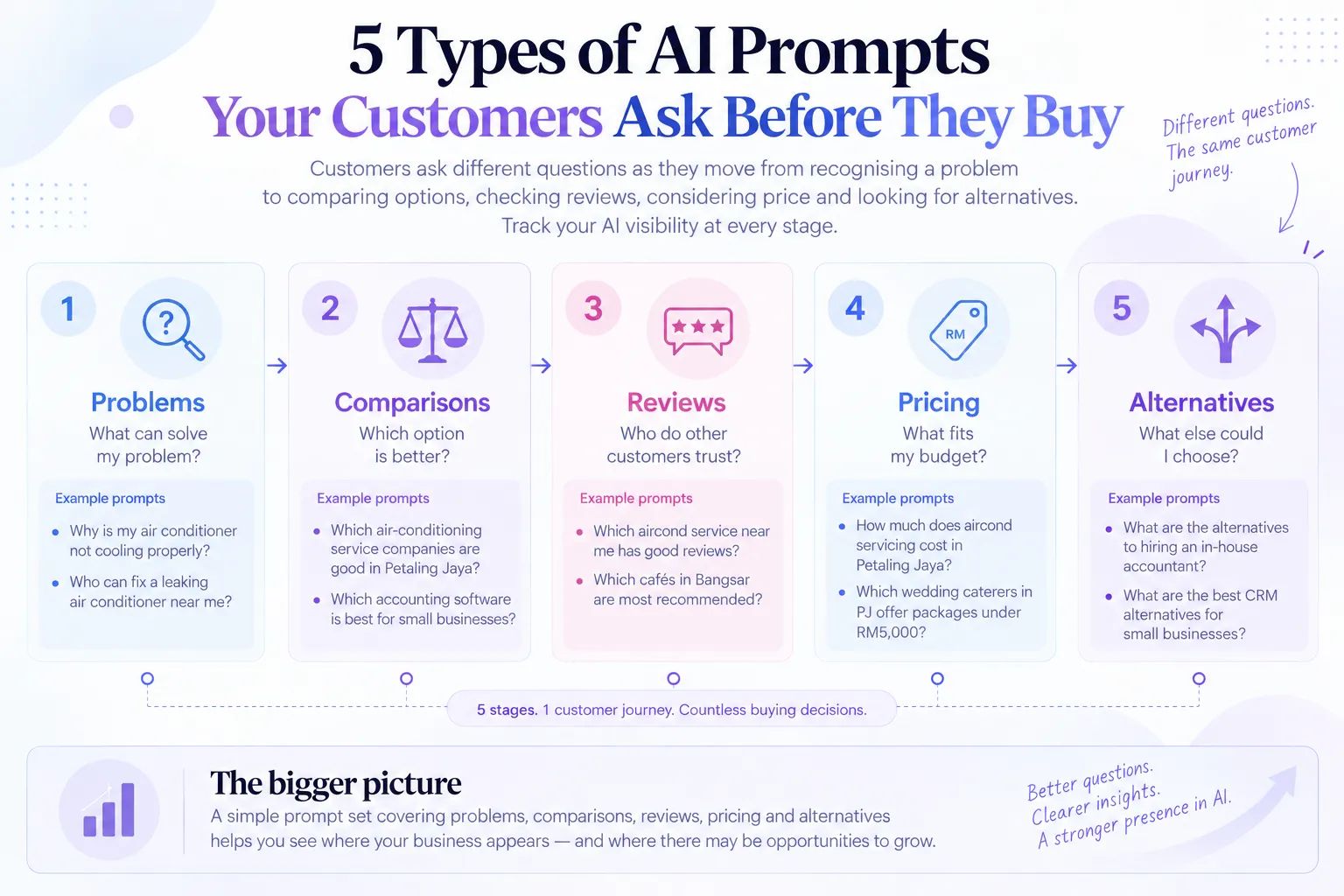
- Customers ask different questions as they move from recognising a problem to comparing options, checking reviews, considering price and looking for alternatives.
- An AI prompt set helps SMEs and micro SMEs track whether their business appears across these different customer questions.
- Start with a focused set of problem, comparison, review, pricing and alternative prompts rather than trying to track every possible question.
- Keep your core prompts reasonably consistent over time so changes in AI visibility are easier to compare.
Introduction
A customer rarely asks the same question from the moment they realise they have a problem to the moment they buy.
Imagine you run an air-conditioning service in Petaling Jaya.
At first, someone might ask ChatGPT:
“Why is my air conditioner not cooling properly?”
Later, they might ask:
“Which air-conditioning repair companies are good in Petaling Jaya?”
Then:
“Which aircond service near me has good reviews?”
And finally:
“How much does aircond servicing cost in Petaling Jaya?”
It is the same customer need, but the questions change as the person gets closer to making a decision.
Your business may appear for one question and disappear for another.
For a busy SME owner, that is the real reason to build a prompt set.
You are not trying to track every possible thing somebody could ask AI. You are trying to understand whether your business appears at different stages of a customer's decision-making process.
What Is an AI Prompt Set?
An AI prompt set is simply a collection of questions that represent the ways your customers may search, compare and decide.
Think of it as a small sample of your customers' conversations with AI.
Instead of asking only, “Does ChatGPT mention my business?” you track questions such as:
- Who can solve this problem?
- Which option should I choose?
- Which businesses have good reviews?
- What can I get within my budget?
- What other options could I consider?
These questions give you a broader picture of how AI sees your business. They also help avoid a common mistake: tracking only broad educational questions.
For example, “What is bookkeeping?” is useful if you want to understand what AI has to say about bookkeeping.
But if you want to know whether your accounting firm could be recommended, this is more useful: “Which bookkeeping services are suitable for a small business in Kuala Lumpur?”
The second question gives AI a reason to recommend an actual business.
Also read: How to Find the Right AI Prompts to Track for Your Business.
What Types of AI Prompts Should an SME Track?
A simple prompt set can be built around five common buying situations: problems, comparisons, reviews, pricing and alternatives.
Each tells you something different about how customers may discover and evaluate your business.
What Are Problem-Based Prompts?
Problem-based prompts are questions customers ask when they know something is wrong, but are not yet sure what solution they need.
A café owner might ask:
“How can I get more people to find my café online?”
A retailer might ask:
“How can I keep stock levels accurate across two online stores?”
Or a homeowner might ask:
“Who can fix a leaking air conditioner near me?”
These prompts help you see whether AI connects the customer’s problem with your business or the type of service you offer.
What Are Comparison Prompts?
Comparison prompts appear when customers are narrowing their choices and asking which option is better for them.
For example:
- “Which AI visibility tools are best for small businesses?”
- “Should a small business use AI visibility software or hire an agency?”
- “Which tools can compare a company's visibility across ChatGPT, Gemini and Google AI?”
These prompts show which businesses AI sees as relevant alternatives, including competitors you may not have expected.
There is an important difference between a category comparison and a named-brand comparison.
If you ask, “Is Zicy better than Competitor X?” you have already instructed AI to discuss those two brands.
That can still be useful research, but it does not tell you whether AI would naturally have selected either company. If your goal is to measure unprompted visibility, a question such as “Which AI visibility tools are suitable for small businesses?” provides a cleaner test.
The AI has to decide which businesses belong in the answer.
Also read: How to Use Branded and Non-Branded Prompts Without Distorting Your AI Visibility.
What Are Review-Based Prompts?
Review-based prompts come into play when customers want reassurance from other people’s experiences.
Compare “Best plumber in Petaling Jaya” with “Which plumber in Petaling Jaya has good reviews for emergency repairs?”
The second question adds an important decision factor: reputation.
A local business could therefore track prompts such as:
- “Which florist in Kuala Lumpur has good reviews for wedding bouquets?”
- “Which air-conditioning company in Subang Jaya is well reviewed for emergency repairs?”
- “What are the most recommended cafés around Bangsar for working during the day?”
These prompts show whether AI connects your business with the reputation customers value. A 2026 BrightLocal study found that 88% of AI users check whether a review is legitimate or examine its source before deciding what to do next.
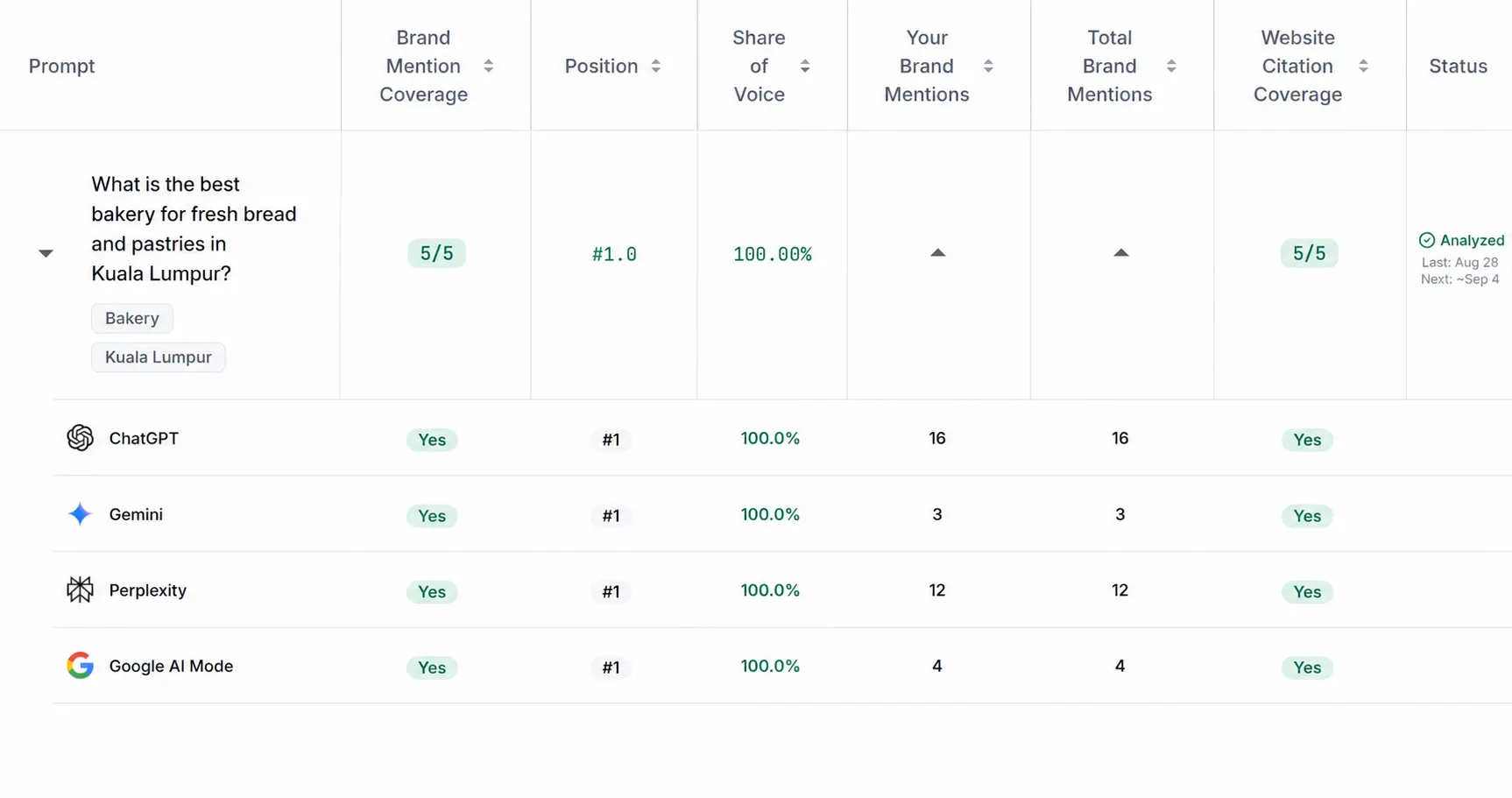
Once you track a prompt, you can compare how the same customer question performs across different AI platforms. Look at whether your brand was mentioned, where it appeared and whether your website was cited.
What Are Pricing Prompts?
Pricing prompts appear when customers start asking, “Can I afford this?” or “Is this good value?”
Someone asking, “What is the best CRM for small businesses?” may receive one shortlist.
But someone asking, “What is the best CRM under RM500 a month for a five-person company?” may receive a different shortlist because budget is now part of the decision.
Examples of pricing prompts include:
- “Which AI visibility tools offer good value for a small business?”
- “What are affordable AI visibility platforms for a small marketing team?”
- “Which catering companies in Petaling Jaya offer good-value packages for 30 people?”
- “Where can I order a wedding bouquet in Kuala Lumpur for under RM500?”
The key is to frame the prompt around choosing an option, not just asking for general price information.
“How much does wedding catering cost?” is mainly informational.
But “Which wedding caterers in Petaling Jaya offer packages for under RM5,000?” gives AI a reason to recommend specific businesses.
For visibility tracking, that difference matters.
What Are Alternative Prompts?
Alternative prompts are questions customers ask when they want to know what else they could choose instead.
“What are alternatives to manually checking ChatGPT every week?” could lead AI to recommend software.
But “What are alternatives to hiring an AEO agency?” could surface software, consultants, freelancers or in-house approaches.
Examples include:
- “What can a small business use instead of hiring an AEO specialist?”
- “Which tools can replace spreadsheets for tracking AI recommendations?”
- “What are alternatives to manually checking AI platforms for brand mentions?”
These prompts can reveal competitors and substitutes you may not have considered.
A software company, for example, may think it only competes with other software platforms, while customers are actually choosing between software, an agency, a freelancer or doing it themselves.
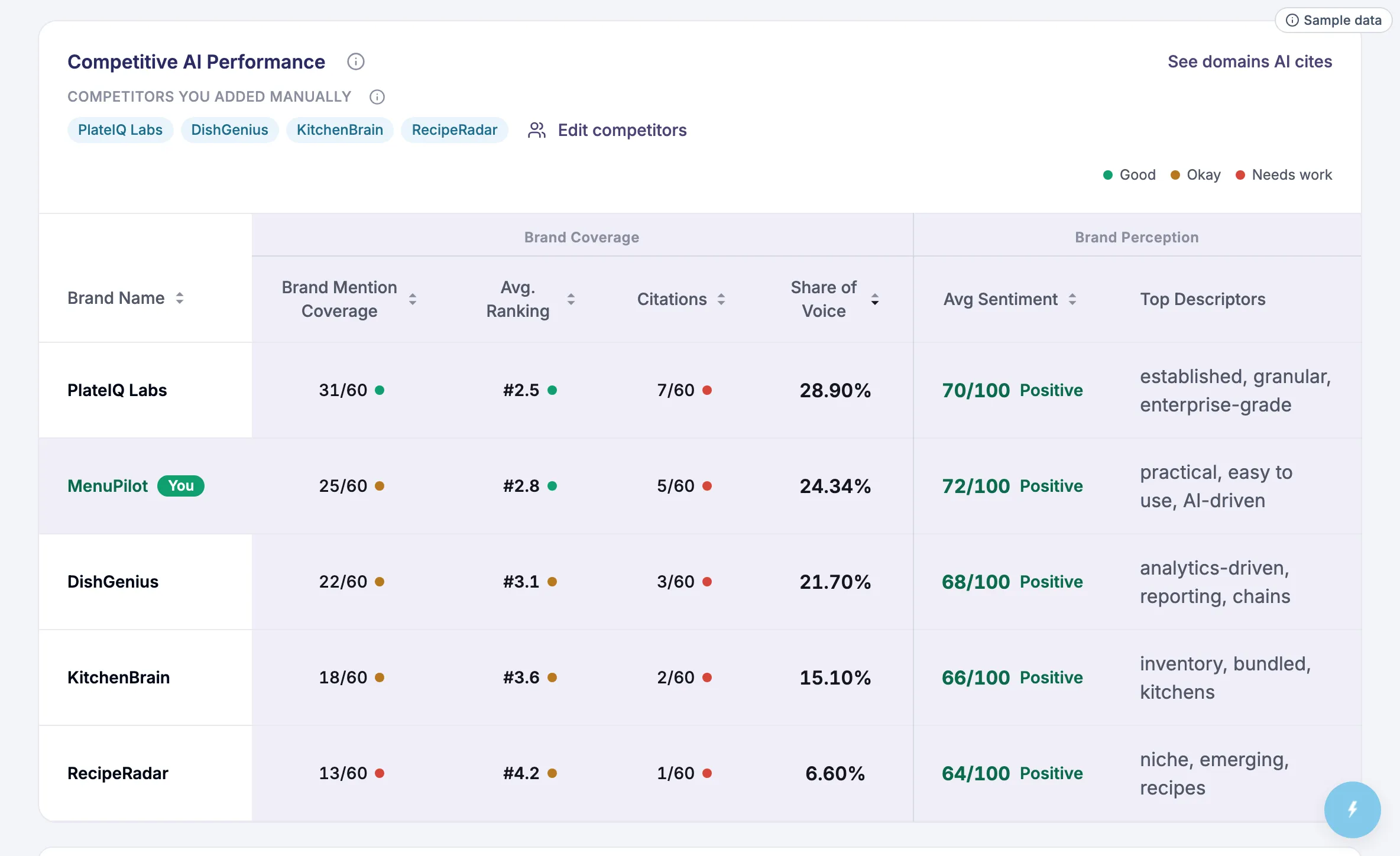
When you compare the brands that appear alongside yours, you can also see differences in how often they are mentioned, where they rank, how often they are cited and the share of voice they receive.
How Many AI Prompts Should a Small Business Start With?
You do not need 100 prompts.
For many SMEs and micro SMEs, 10 to 20 focused questions are enough to start learning.
A simple 15-prompt set could contain:
| Buying angle | Number of prompts | Example prompts |
|---|---|---|
| Problems | 3 | “What tools can help a small business monitor what AI says about it?” “Who can help fix a leaking air conditioner in Petaling Jaya?” |
| Comparisons | 3 | “Which AI visibility tools are best for small businesses?” “Which florist is best for wedding bouquets in Kuala Lumpur?” |
| Reviews | 3 | “Which dentist in Bangsar has good reviews for children?” “Which AI visibility tools are recommended for non-technical users?” |
| Pricing | 3 | “Which bridal florists in KL offer bouquets under RM500?” “What affordable AI visibility tools are suitable for small businesses?” |
| Alternatives | 3 | “What are alternatives to manually checking ChatGPT for brand mentions?” “What can a small business use instead of hiring a digital marketing agency?” |
The exact number matters less than the quality of the questions.
Ask yourself: Would a real customer actually ask this while deciding what to buy?
If the answer is no, the prompt may not be worth tracking.
How Can You Organise Different Prompts Without Making It Complicated?
Once you start tracking problems, comparisons, reviews, pricing and alternatives, it is easy for your prompt list to become difficult to manage.
Instead of keeping every prompt in one long list, group related questions by what they test, or by product, service, topic, or buyer intent.
For example, you could organise by:
- Pricing
- Comparisons
- Reviews
- Alternatives
This makes it easier to answer practical questions such as:
Are we visible when customers compare options, but missing when they ask about price?
Or:
Which topics have the strongest AI visibility, and which ones need more attention?
The goal is not to build a complicated tagging system. It is simply to make a growing prompt set easier to organise and understand.
In platforms like Zicy, you can use Tags to group related prompts and filter them together. This makes it easier to review how your visibility changes across different buying situations.
Should You Keep the Same Prompts Over Time?
Keep your main prompts reasonably consistent.
If you rewrite every question each month, it becomes harder to tell whether your visibility changed or the question changed.
A better approach is to keep a core set and add new prompts when something meaningful happens.
For example:
- you enter a new location;
- customers start asking about a new service;
- price becomes a bigger issue;
- a new competitor keeps appearing; or
- AI results reveal a question you had not considered.
This gives you enough consistency to spot trends while still allowing the prompt set to grow with your business.
Do You Need to Create Content for Every Prompt?
No.
If five prompts reveal the same underlying customer concern, you probably do not need five new articles. Use the prompt set first as a way to listen.
If AI repeatedly struggles to understand your pricing, clearer pricing information may help. If competitors dominate local prompts, check whether your location and service-area information is clear.
If your business disappears when customers ask about reviews, look at the reputation information available across the web.
The prompt tells you where the gap may be. Then you decide what actually needs fixing.
Start With the Questions Your Customers Already Ask
The simplest prompt set is not built around keywords. It is built around the customer's decision.
- What problem are they trying to solve?
- What options will they compare?
- Whose reviews will they trust?
- What price can they afford?
- What alternatives might they consider?
For an SME or micro SME, even a small set of questions across these five areas can give you a much clearer view of where AI includes your business and where it leaves you out.
The important part is to start with real customer questions, not hundreds of invented prompts.
Turn your prompt set into
something measurable with Zicy.
Zicy tracks brand mentions, website citations, share of voice and average AI ranking across ChatGPT, Gemini, Perplexity, Google AI Overviews and Google AI Mode.
