How to Compare AI Sentiment and Descriptors for Your Brand vs Competitors
Learn how to compare AI sentiment and recurring brand descriptors with competitors to uncover differences in positioning, strengths and customer perception.
Key Takeaways
- Your brand and a competitor can both appear in AI answers but still be framed differently.
- Competitor sentiment gives your own sentiment more context by showing how AI talks about other brands in the same category.
- Descriptors reveal the qualities, strengths and limitations AI repeatedly connects with each business.
- Similar sentiment scores can still hide very different brand positions.
- The most useful comparison is often between the words that distinguish you, the words competitors own and the words beginning to overlap.
- Changes in recurring descriptors can show when the competitive picture is starting to shift.
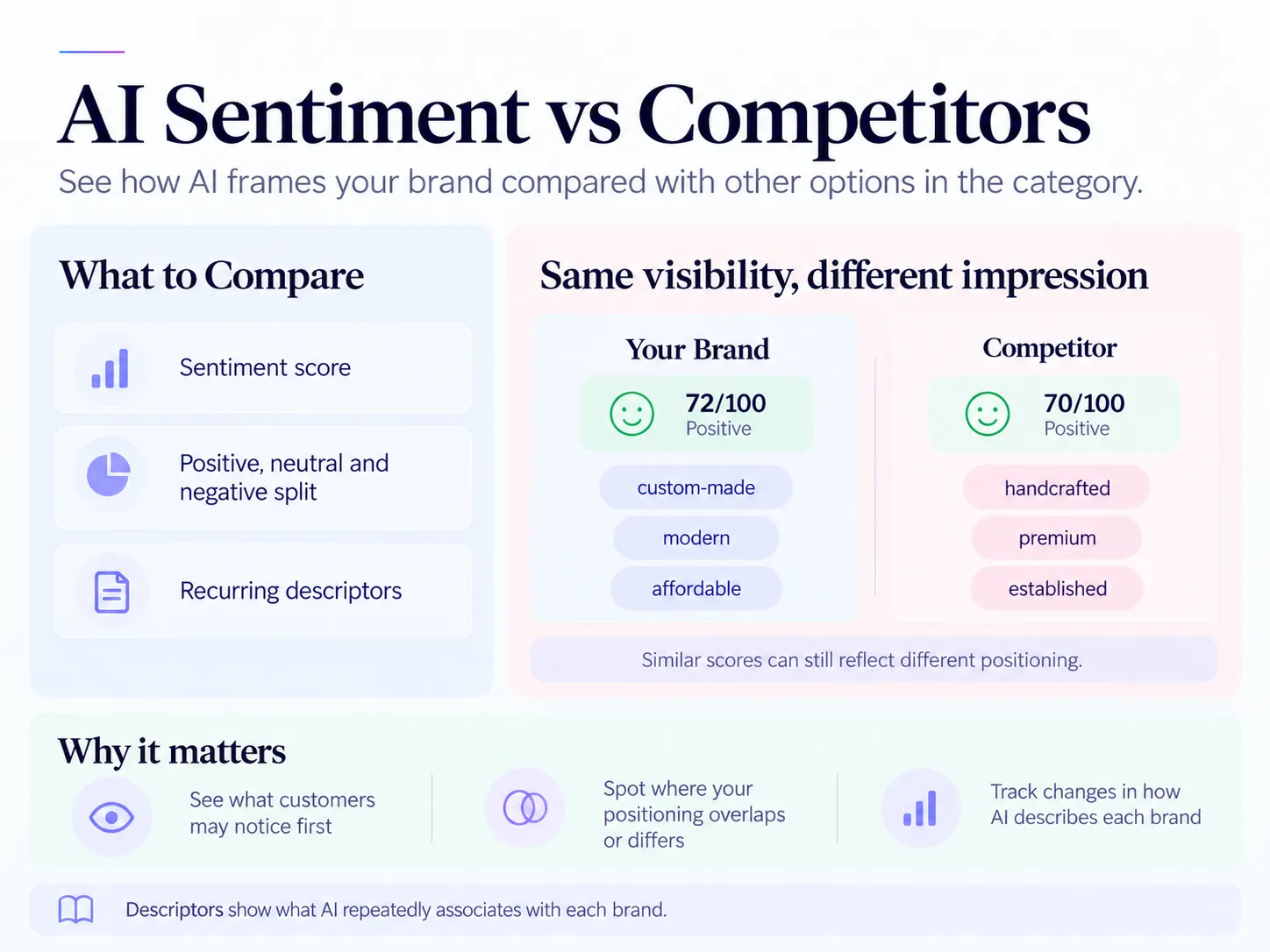
How Can Two Visible Brands Create Different Impressions?
Imagine you run a business that sells made-to-order furniture and home storage solutions.
A customer asks AI which businesses they should consider for a new home.
Your brand appears. So does a competitor.
But AI may describe your brand as:
- custom-made;
- modern;
- affordable; and
- made-to-order.
While the competitor is described as:
- handcrafted;
- premium;
- established; and
- solid wood.
Both businesses are visible.
But customers are being given a different impression of each one.
That is why competitor sentiment and descriptors are useful: they help you understand how AI separates your brand from the alternatives customers may also be considering.
What Are Competitor Sentiment Profiles?
A competitor sentiment profile shows how AI talks about another brand.
It can include:
- the overall sentiment;
- the positive, neutral and negative split;
- recurring positive descriptors; and
- recurring negative descriptors.
Your own sentiment tells you how AI describes your business.
A competitor profile gives that information context by showing what AI says about other businesses around you.
If you first need to understand your own profile, start with how AI describes your brand positively, neutrally or negatively.
A platform such as Zicy lets businesses compare these profiles across their own brand and tracked competitors in one view.
What Do Competitor Descriptors Tell You?
Descriptors are recurring words or short phrases AI uses when talking about a brand.
They may describe:
- price;
- style;
- materials;
- service;
- customer fit;
- product range;
- strengths; and
- limitations.
The important part is not one isolated word.
It is the pattern.
If the same qualities keep appearing around a competitor, they show what AI most strongly associates with that business.
That can help explain why two brands that sell similar products may still be presented very differently to customers.
If you want to see where that wording comes from, you can read the exact AI answers behind a tracked prompt instead of relying only on the summary descriptor.
Why Can Similar Sentiment Scores Still Mean Different Things?
Two brands can have similar sentiment scores without having similar profiles.
One may receive mostly neutral descriptions because AI talks about it in a straightforward, factual way.
Another may receive stronger positive descriptions but also more criticism.
The final scores could still sit close together.
That is why you should read the sentiment split and descriptors together.
The score tells you the general tone.
The descriptors tell you what sits behind it.
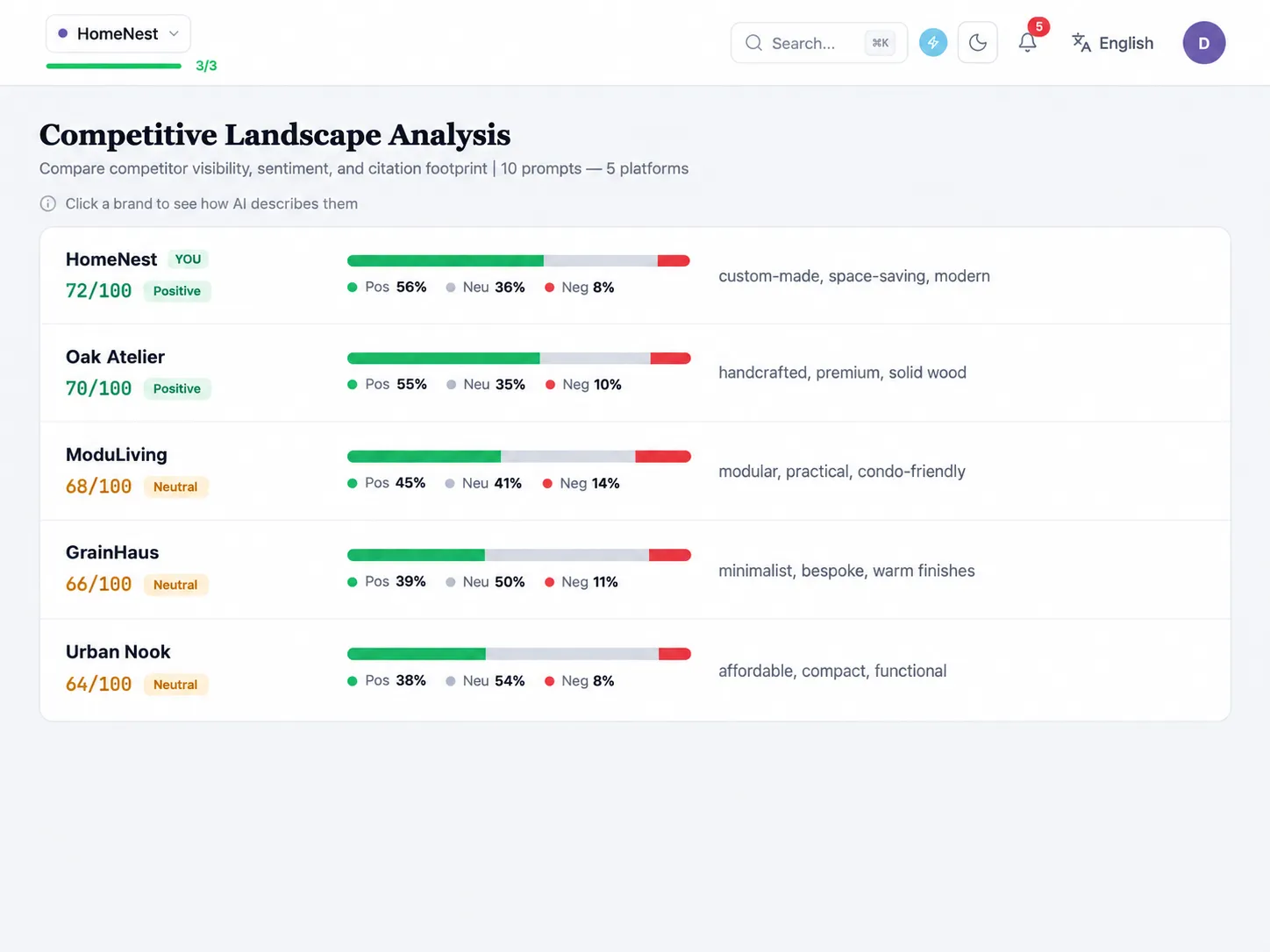
Where Does AI See a Difference Between You and Competitors?
This is where the comparison becomes useful.
Look at which descriptors appear more strongly around your business and which appear more strongly around competitors.
Descriptors That Distinguish Your Brand
These are qualities AI connects with your business more clearly than with competitors.
They may support the position you already want to build.
For example, your business might stand out for personalisation, convenience or a particular customer need.
If those associations are accurate and valuable, they are worth protecting.
Descriptors That Competitors Are Known For
A competitor may have stronger associations around other qualities.
That does not automatically mean you need to compete for the same words.
If AI strongly connects another brand with craftsmanship, heritage or specialist expertise, that may simply reflect a different position in the market.
The useful question is:
Descriptors That Are Starting to Overlap
Sometimes a word that once separated your brand starts appearing around competitors too.
For example, a rival may begin gaining an association that customers previously connected more strongly with your business.
That can make your positioning less distinct.
It does not mean you need to react immediately.
But it is worth watching, especially if the same shift appears across several customer questions.
For a broader view of the competitive picture, this can be read alongside AI Share of Voice, which looks at how much of the tracked competitive conversation each brand occupies.
Can a Competitor's Negative Descriptor Still Support Its Position?
Yes.
A negative word should not be judged on its own.
For example, a competitor may be described as higher-priced.
That sounds like a weakness.
But if AI also consistently describes the same business as highly specialised, premium and established, the higher price may simply be part of that position.
The customer is seeing a trade-off rather than a simple disadvantage.
The same applies to your own descriptors.
A word can be helpful in one position and less useful in another.
Context matters.
What If No Brand Is Strongly Associated With an Important Quality?
You may find that some useful qualities barely appear around any competitor.
For example:
- transparent pricing;
- fast turnaround;
- local sourcing; and
- specialist support.
That can point to a gap in how the category is currently described.
But an open descriptor is not automatically an opportunity.
It needs to match something your business genuinely offers and something customers actually care about.
If the association you want is missing from your own profile, this may connect to the gap between what you want to be known for and what AI currently knows you for.
Why Should You Watch Descriptors Over Time?
The words around a brand can change.
A competitor may begin gaining a positive association it did not have before.
One of your strongest descriptors may start appearing more often around rivals.
Or a new negative theme may begin showing up around a competitor.
Those changes can reveal shifts that a small movement in the overall sentiment score may not show clearly.
The useful question is not only:
It is also:
When comparing one period with another, keep the questions you track reasonably consistent. A changing prompt set can also change the kinds of brand descriptions you see.
See how to keep a stable AI prompt baseline and know when to reset it.
What If a Descriptor Is Actually Wrong?
Not every negative or limiting descriptor reflects genuine perception.
Some may come from incorrect or outdated information.
For example, AI might say a business:
- only sells ready-made products;
- does not deliver outside a certain area;
- offers limited material choices; or
- no longer provides a particular service.
Those are claims you can verify.
If the underlying information is wrong, the issue is not simply sentiment.
It is a factual accuracy problem.
That should be investigated through wrong or outdated business facts in AI answers rather than trying to change the tone around an incorrect claim.
What Should You Take From the Comparison?
Competitor sentiment should help you understand the differences AI is presenting to customers.
Look for:
- qualities that clearly distinguish your business;
- strengths AI associates with competitors;
- descriptors that are becoming common across several brands;
- useful associations that are still largely unclaimed; and
- changes that may be making your positioning less distinct.
The goal is not to collect more positive words than every competitor.
It is to understand what each business is becoming known for in AI answers, and whether that matches the position you want customers to see.
Compare How AI Frames Each Brand
Appearing beside a competitor does not mean AI presents both businesses in the same way.
The words around each brand can shape the reason a customer considers one over another.
By comparing sentiment and recurring descriptors, you can see where your position is clear, where competitors stand apart and where those differences are beginning to change.
See How AI Frames You Against Competitors
Zicy helps you compare sentiment and recurring descriptors across your brand and competitors so you can understand how AI differentiates each business.
