How to Check Whether AI Describes Your Brand Positively, Neutrally or Negatively
Learn how to read positive, neutral and negative AI descriptions of your brand, spot recurring sentiment patterns, and separate perception from factual errors.
Key Takeaways
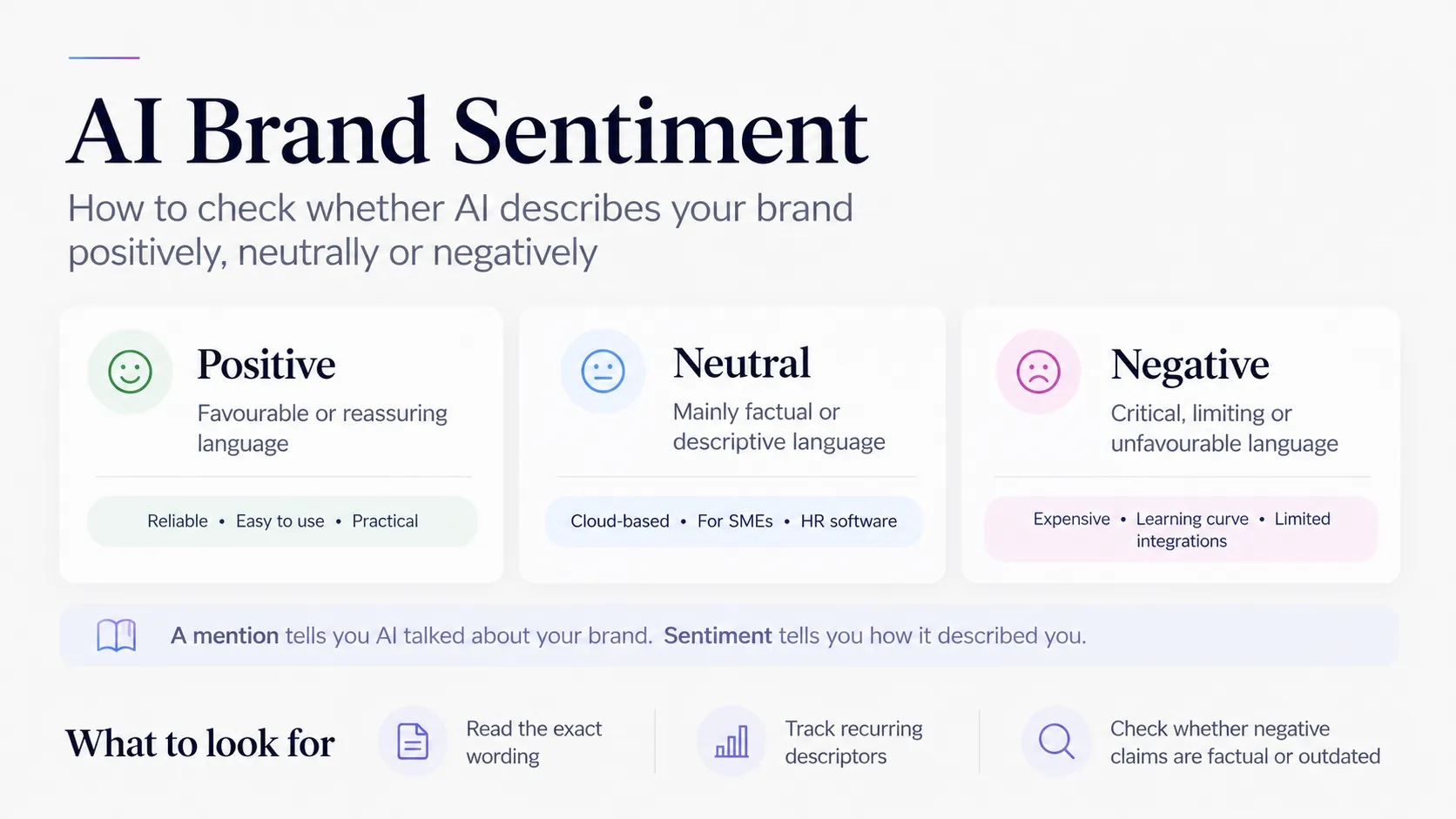
- A brand mention tells you that AI is talking about your business. Sentiment tells you how that mention sounds.
- Positive, neutral and negative descriptions should be read separately from visibility metrics such as mentions or rankings.
- Neutral language is not automatically a problem. AI often uses factual or descriptive language without expressing a strong opinion.
- Repeated words and phrases can reveal how AI currently frames your brand.
- A negative description may come from incorrect information rather than genuine negative perception.
- Read the actual AI answers before deciding what needs to change.
Introduction
Your business may appear in AI answers, but that doesn't automatically mean the mention helps you.
AI might describe your brand as:
- reliable and easy to use;
- a practical option for small businesses;
- expensive compared with alternatives; or
- difficult to learn.
All four are brand mentions.
But they create very different impressions.
That is why checking whether AI mentions your business is only part of the picture. You also need to understand how AI describes you when it mentions you.
What Is AI Brand Sentiment?
AI brand sentiment is the tone AI uses to describe your business.
In simple terms, the language can be:
- Positive: favourable or reassuring
- Neutral: mainly factual or descriptive
- Negative: critical, limiting or unfavourable
For example, AI might describe the same software company in different ways:
“Easy to use and suitable for growing teams.”
“A cloud-based accounting platform for SMEs.”
“May have a steep learning curve for first-time users.”
The brand is mentioned in every example.
What changes is the language around it.
Why Is a Brand Mention Not Enough?
A business owner may see their company appear in an AI answer and consider that a win.
But the mention could still carry a message that affects how a customer sees the business.
Imagine someone asks:
AI mentions your brand but describes it as:
Your business appeared.
But the customer also received a possible reason not to choose it.
That does not mean every negative phrase causes a lost sale. It does mean visibility and perception answer different questions.
Brand Mention Coverage asks whether your business appears.
Sentiment asks what AI says once it does.
If the description itself seems inaccurate or incomplete, look more closely at how AI understands your products, services and positioning.
What Does Positive AI Sentiment Look Like?
Positive sentiment appears when AI uses favourable language about the business, its products or the experience around them.
Examples might include:
- reliable;
- practical;
- easy to use;
- flexible;
- well suited to SMEs; and
- strong customer support.
The exact wording matters because these descriptions can reveal what AI currently associates with your brand.
That does not mean you should immediately copy every positive word into your marketing.
First ask whether the description is:
- accurate;
- relevant to your positioning; and
- supported by what the business actually offers.
A positive association only helps if it reflects the business you want customers to understand.
Is Neutral Sentiment a Bad Thing?
No.
Neutral descriptions are often simply factual.
For example:
That sentence is not strongly positive or negative.
It tells the reader what the company does.
Don't treat neutral wording as a failure just because it lacks praise.
Instead, check whether the neutral description is accurate and complete.
A neutral answer becomes more important when it leaves out something commercially significant.
For example:
may be accurate, but incomplete if HR management is now one of the company's main services.
If AI describes the business accurately but emphasises the wrong service, audience or strength, the issue may be a gap between your intended positioning and what AI knows you for.
What Does Negative AI Sentiment Look Like?
Negative sentiment appears when AI uses language that makes the business, product, or service sound less attractive.
Examples could include:
- expensive;
- limited;
- difficult to use;
- slow;
- complicated; and
- lacking certain features.
But do not react to the word alone.
You first need to understand why AI is saying it.
A phrase such as:
could reflect a real perception.
Or it could be based on outdated information about which integrations the product supports.
Those are two very different problems.
How Do You Check How AI Describes Your Brand?
Start by looking at branded questions.
These are questions that contain your business or brand name directly.
For example:
- What is [Brand] known for?
- Is [Brand] good for small businesses?
- What are the strengths of [Brand]?
- What are the drawbacks of [Brand]?
- Who is [Brand] best suited for?
- How does [Brand] compare with alternatives?
Branded questions are useful here because you are deliberately asking AI to describe the business.
Don't confuse them with non-branded questions used to measure natural discovery.
If you are unsure about that distinction, see how to use branded and non-branded prompts without distorting your AI visibility.
Is a Negative Description Actually Wrong Information?
This is one of the most important checks.
Imagine AI says:
Before treating that as negative brand perception, check the facts.
Perhaps AI is quoting an old pricing model.
Or it may have confused your brand with another product.
The same can happen with:
- old service limitations;
- outdated locations;
- discontinued products;
- incorrect pricing;
- missing features; or
- old customer policies.
If the underlying information is wrong, fix the factual problem first.
That may mean tracing wrong or outdated business facts in AI answers before treating the issue as a sentiment problem.
If the information is correct but customers or AI repeatedly describe it negatively, then you are dealing with a genuine perception issue.
Do not try to solve a factual error with better marketing language.
How Should You Review Sentiment?
A simple process is enough.
1. Check Whether the Brand Is Mentioned
If the answer does not mention your business, there is no brand sentiment to assess.
That is a visibility problem instead.
2. Read the Description Around the Mention
Look at the sentence or paragraph where your brand appears.
Ask:
- Does it sound favourable?
- Is it mainly factual?
- Does it highlight a weakness?
3. Record the Words That Repeat
Do not collect every adjective.
Focus on recurring descriptions across relevant answers.
4. Check the Fact Behind Any Negative Description
Ask whether the criticism is based on information that is:
- correct;
- outdated;
- incomplete; or
- completely wrong.
5. Separate Perception From Accuracy
If the fact is wrong, correct the information.
If the fact is right but the perception is negative, investigate why that perception exists and whether the business needs clearer explanation, stronger evidence or an actual product or service improvement.
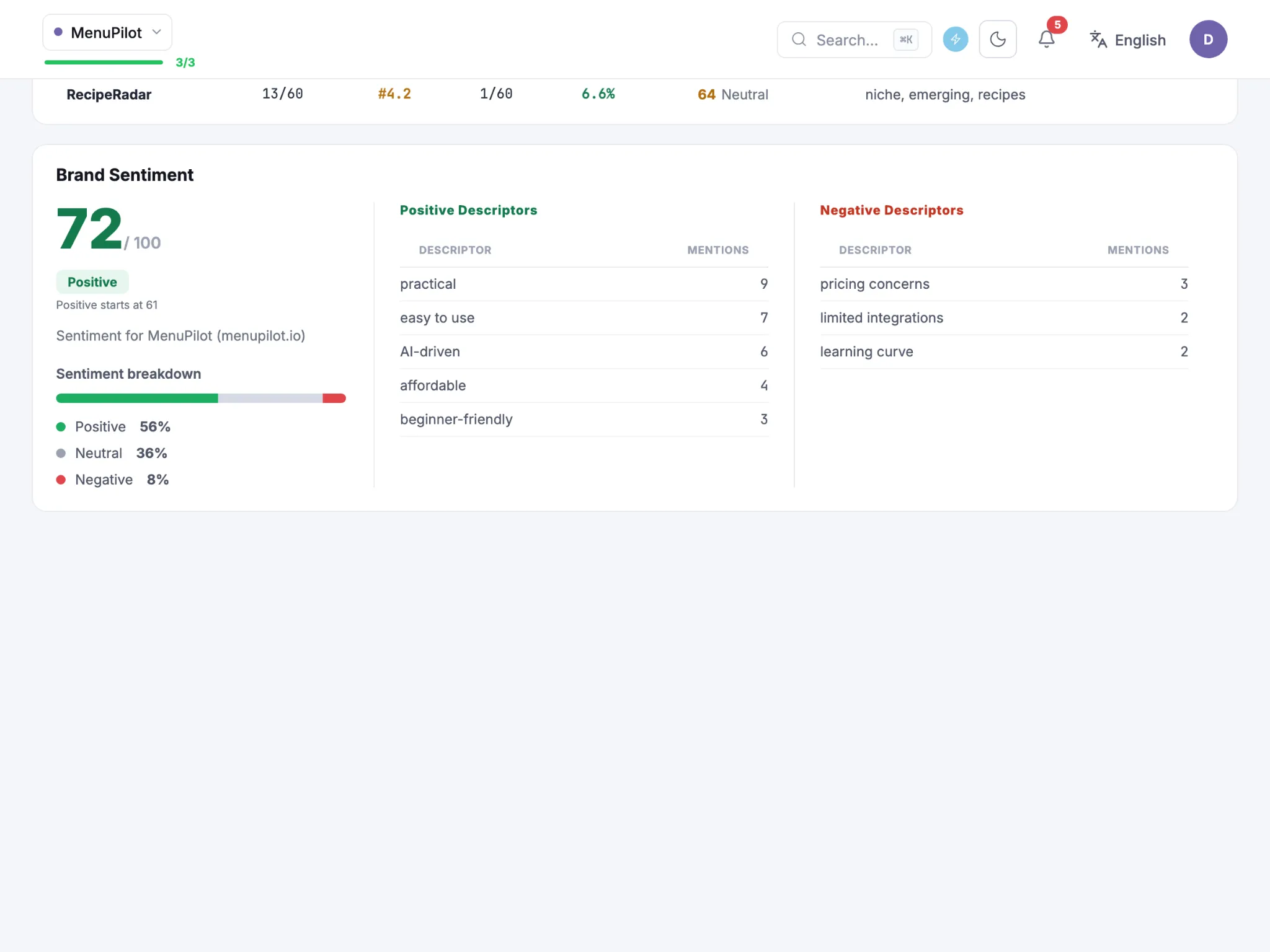
A platform such as Zicy can bring this together by analysing mentions of your brand, separating positive, neutral, and negative descriptors, and showing the recurring language AI uses.
Its documentation also warns against over-reading thin samples: the sentiment score needs at least three scored mentions before it shows a number.
Should You Try to Make Every AI Mention Positive?
No.
That would be the wrong goal.
Customers need accurate information, not artificial praise.
A useful AI description may be neutral.
A genuine limitation may also deserve mention.
The practical goal is to understand whether AI is describing your business fairly and accurately, and whether recurring perceptions match the experience and positioning you want customers to understand.
Google's current guidance for generative AI search also continues to emphasise established search fundamentals and useful, reliable information rather than special AI-only optimisation tricks.
Do not try to manufacture positive sentiment.
Make sure the information supporting your brand is accurate, clear and useful.
Read the Words, Not Just the Mention
Seeing your brand in an AI answer tells you that you are present.
It does not tell you what impression the customer receives.
Read how AI describes your business. Look for the positive qualities it repeats, the neutral facts it relies on and the negative descriptions that may need investigation.
Most importantly, separate a real perception problem from incorrect information.
A mention tells you AI talked about you.
The words around that mention tell you what it told the customer about you.
See How AI Describes Your Brand
Zicy helps you track the positive, neutral and negative language AI uses around your brand so you can see which descriptions repeat and which ones deserve a closer look.
