Which schema and entity markup are most critical for brands?

For AI, the most critical schema are Organization or LocalBusiness, Article or BlogPosting, Product or Service, FAQPage, and Person or Author. They make your brand machine-readable, reducing ambiguity so AI can correctly associate you with topics and cite you. Combining them on a page adds context and credibility. Zicy checks whether that markup is helping you get cited across the five engines.
Engines like Gemini, ChatGPT and Perplexity rely on structured data to understand context, not just keywords, which is where schema markup and entity tagging come in. They tell machines who you are, what you offer and why your content matters. In answer engine optimisation and generative engine optimisation, schema is the connective tissue between your human message and AI comprehension. It does not just improve visibility; it improves interpretation accuracy, reducing ambiguity and increasing the likelihood that AI correctly associates your brand with relevant topics.
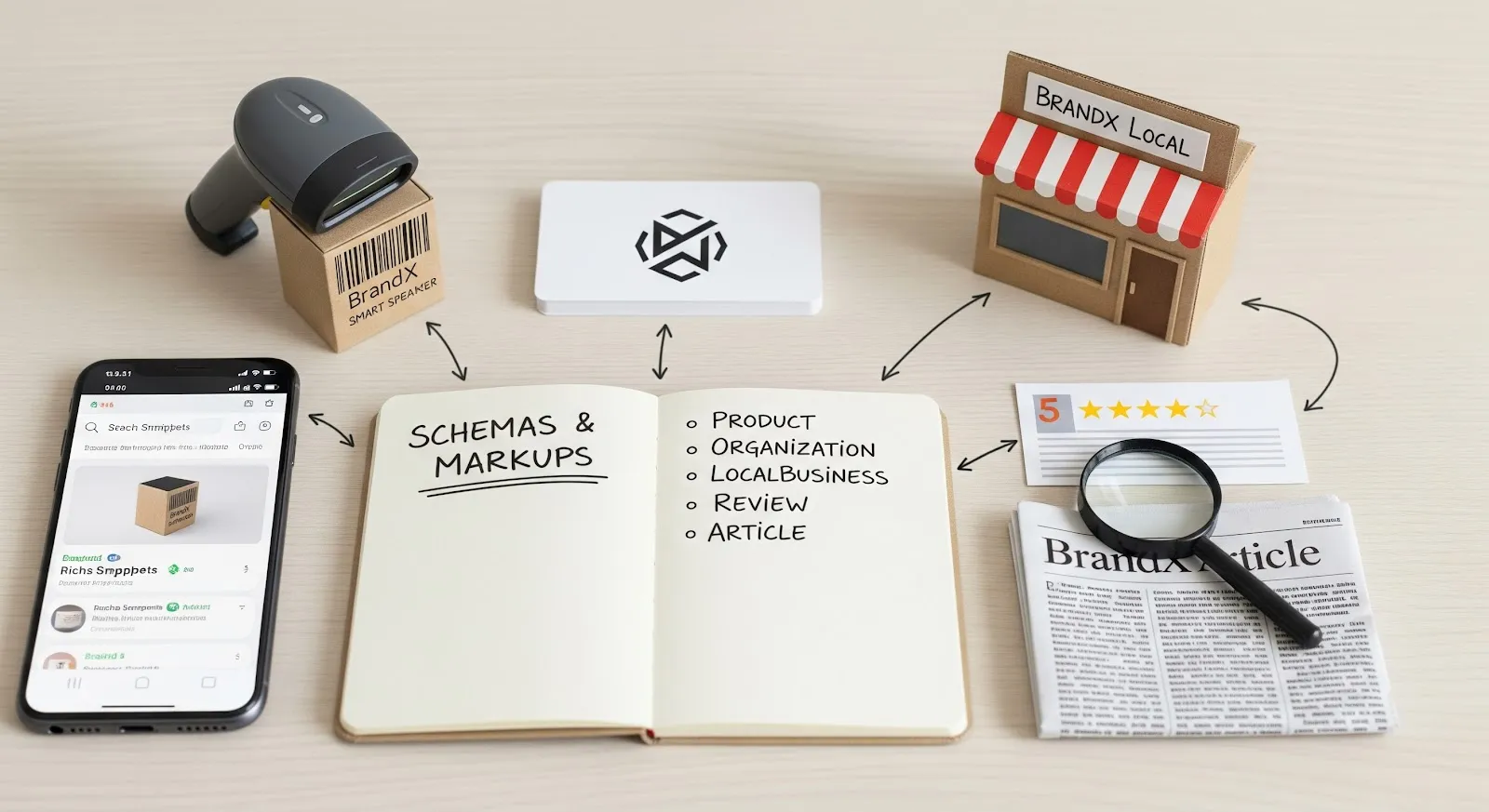
What schema markup actually does.

A schema is a standardised vocabulary that helps engines interpret your content. Instead of merely reading text, AI can understand relationships between people, organisations, products and ideas. For example, if your about page lists your CEO's name, schema ensures AI knows this person leads your company rather than was simply mentioned on the page. That clarity fuels visibility in AI Overviews, chat responses and voice assistants. Schema also enables relationship mapping, connecting your brand with related entities such as industries, products and partners within the knowledge graph. Without structured data, AI must infer meaning from raw text, which increases the risk of misinterpretation or omission. Simply put, schema makes your brand's digital identity machine-readable, and therefore citable. It is a prerequisite for preparing your site for Google AI Overviews.
Set expectations honestly. Google is explicit that there is no special schema you must add to appear in AI features; what matters is standard indexing, helpful content, and structured data that matches your visible text (Google Search Central, 2026).
In the only controlled test, adding JSON-LD barely moved AI citations, about -4.6% on Google AI Overviews and roughly +2% on AI Mode and ChatGPT, effectively zero. Cited pages were about three times more likely to already carry schema, but adding it to visible pages did not lift citations (Ahrefs, 1,885 pages versus 4,000 controls, 2026).
So schema buys machine-readability, eligibility and disambiguation, not a citation on its own.
Which schema types are most essential.
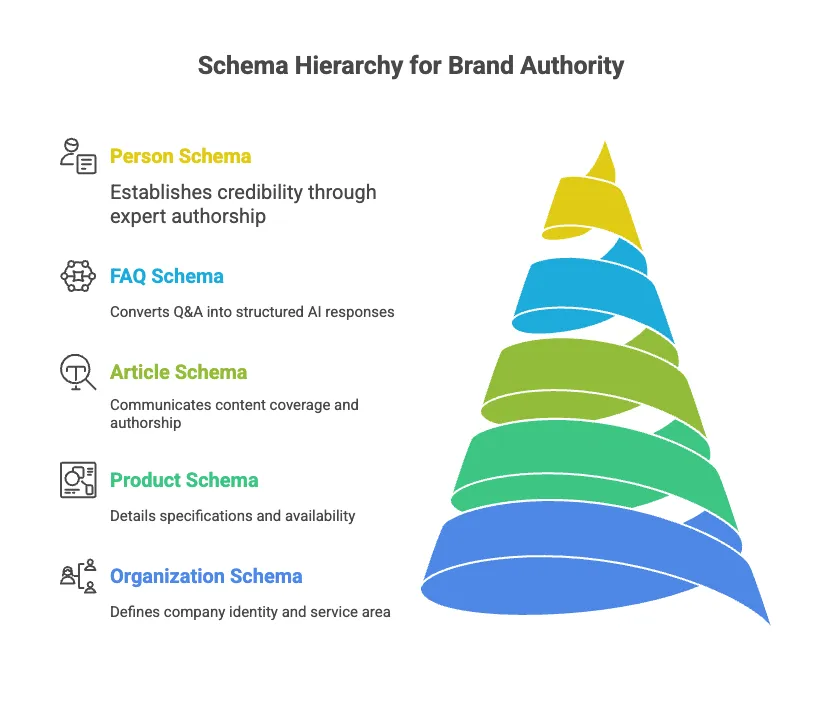
There are hundreds of schema types, but a few are foundational for entity-level authority:
- Organization or LocalBusiness: defines your company's identity, contact details and service area. Use it on every brand site.
- Article or BlogPosting: communicates what your content covers, who authored it and when it was updated, strengthening topical authority and recency.
- Product or Service: details specifications, pricing, reviews and availability, vital for brands with product lines and to whether AI engines recommend your products.
- FAQPage: converts question-and-answer content into structured responses AI can quote directly.
- Person or Author: establishes credibility through verified expert authorship, a cornerstone of digital trust.
Prioritise the types that directly support AI extraction and validation, particularly FAQPage, Article and Organization. Combining several types on a single page, such as Article, Author and FAQ, creates a multi-layered understanding that improves both context and credibility, turning your site into a knowledge-graph node AI can map and reference. This underpins the trust signals AI recognises.
One 2026 change to note. Google removed FAQ rich results from Search on 7 May 2026, and had already retired HowTo results in 2023 (Search Engine Journal, 2026). FAQPage and HowTo markup are still valid structured data and useful for machine-readability, but they no longer produce visible rich results. Prioritise Organization, Article or BlogPosting, Product or Service, and Breadcrumb, and keep every field matching the visible page.
Schema markup versus entity optimisation.
Schema describes your content's structure; entity optimisation defines your brand's identity. An entity is a concept AI can recognise, categorise and associate with others, for example Tesla connecting to electric vehicles and to sustainability. When your schema, metadata and external profiles all reinforce the same facts, the result is entity consolidation, where AI forms a single, stable representation of your brand across sources. Schema is the technical layer and entity optimisation is the strategic layer; both must align for consistent AI recognition, and strong alignment improves disambiguation so your brand is identified correctly even when similar names exist. This is the mechanism behind becoming an authoritative entity for AI engines.
This is where the real leverage sits. AI systems assemble answers grounded in entities, not keywords (iPullRank, 2025).
Linking your brand to public identifiers, using schema.org sameAs and @id, Wikidata and product IDs, lets AI features disambiguate you and avoid confusing you with a similarly named company, though inclusion is never guaranteed (iPullRank, 2025). Wikidata matters because Google draws on it for its Knowledge Graph and knowledge panels (MLforSEO, 2026).
How to maintain schema and entity hygiene.
Treat structured data like your company's digital DNA that needs regular checkups:
- Audit quarterly: ensure all schema types remain valid and error-free.
- Update promptly: reflect new products, leadership changes or awards.
- Cross-verify data: keep consistency between website schema, Wikidata and social profiles.
- Test frequently: use Google's Rich Results Test and the Schema.org validator to confirm accuracy.
Keep schema consistent across templates so similar page types follow the same patterns, and watch for schema drift, where content changes are not reflected in structured data, a common issue that reduces AI confidence. Over time, consistent implementation contributes to a stronger entity footprint and more citations. Schema markup is the new metadata of trust: the more precisely you define your brand's entities, the more confidently AI can quote, recommend and rank your content. To see how you compare, read how to benchmark your AEO readiness against competitors.
Keep it accurate, not clever. Mismatched or invisible markup is a policy violation (Google Search Central, 2026), and since 15 May 2026 manufactured authority signals are treated as spam (Search Engine Land, 2026). Consistent, truthful entity data across your site and the wider web is the durable foundation, the Presence pillar in Growth.pro's PAVA framework.
Questions about schema and entity markup.
Does adding schema markup actually get you cited by AI?
Not directly. In a controlled test, adding JSON-LD changed AI citations by about -4.6% to +2%, effectively zero (Ahrefs, 1,885 pages versus 4,000 controls, 2026). Schema helps AI read and trust your content, but it is not a citation lever on its own.
Which schema types still matter now that FAQ and HowTo rich results are gone?
Google removed FAQ rich results on 7 May 2026 and HowTo in 2023 (Search Engine Journal, 2026), though the markup stays valid for machine-readability. Prioritise Organization, Article or BlogPosting, Product or Service, and Breadcrumb, all matching your visible text.
What are sameAs, Wikidata and @id for?
If Google says no special schema is needed, is structured data still worth doing?
Yes. Google requires only that structured data match your visible text, not that you add AI-specific markup (Google Search Central, 2026). Accurate schema improves machine-readability, eligibility and entity clarity, so it remains worthwhile, just not a shortcut to citations.
Check whether your schema is earning citations.
Zicy audits how AI reads your brand and where it cites you across ChatGPT, Gemini, Perplexity, Google AI Overviews and Google AI Mode.