What does it mean to become an authoritative entity for AI engines?

An authoritative entity is a brand that AI engines recognise as a uniquely identifiable, verified part of the knowledge graph, not just a set of pages. Authority shifts from backlinks to consistent, corroborated facts about who you are. Zicy tracks how accurately AI describes your entity, and your AI visibility, across ChatGPT, Gemini, Perplexity, Google AI Overviews and Google AI Mode.
In traditional SEO, authority meant backlinks and domain strength. In the AI era, authority means something deeper: being understood and trusted as a factual entity. When systems like ChatGPT, Gemini or Perplexity cite your brand as a reliable source, they are not responding to keywords but to credibility patterns. Becoming an authoritative entity means your organisation is formally recognised by machines as a verified part of the global knowledge graph. This is a move from document-level authority, pages and links, to entity-level authority, who you are rather than just what you publish, a more persistent and scalable form of visibility, and it is a core part of answer engine optimisation.
What an authoritative entity is.
In AI and semantic search, an entity is a uniquely identifiable object, a company, person, product or concept, that algorithms can connect across multiple data sources. When your brand is structured as an entity, AI engines can distinguish you from competitors, understand your expertise and recall you across topics. Being authoritative means that recognition is reinforced by trustworthy evidence: consistent facts, verified authorship and external validation. Strong entity definition supports disambiguation, so AI systems identify your brand correctly even when similar names exist, and well-defined entities are retrieved across more query variations. In simple terms, SEO tells search engines what you do; AEO teaches AI who you are and why you are credible.
How AI engines decide which entities to trust.
AI systems use contextual correlation and credibility scoring, cross-referencing your brand information with data from multiple authoritative sources. Trust builds when your brand facts, name, description, founders, sector and location, are consistent across:
- your website;
- profiles such as LinkedIn, Crunchbase and Wikidata;
- news mentions and PR coverage;
- structured data markup.
When these align, AI models form a single, stable understanding of your entity. Consensus signals matter: when multiple independent sources confirm the same information, confidence increases significantly. Contextual relevance matters too, since consistent association with specific topics reinforces your authority within those domains. Much of this depends on the schema you publish, covered in which schema and entity markup matter most.
How a brand strengthens its entity authority.
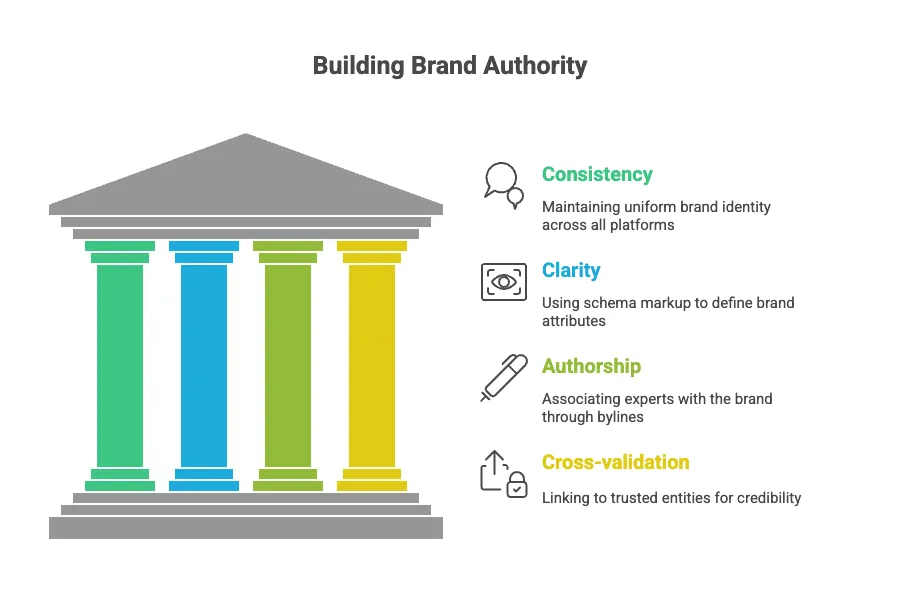
To be recognised as authoritative, a brand builds a rounded evidence profile that reinforces its credibility from every angle:
- Consistency: all external references use the same company name, tagline and core description.
- Clarity: schema markup defines organisation type, founders, headquarters and services.
- Authorship: real experts are associated with the brand through bylines and verified credentials.
- Cross-validation: your entity links to other trusted entities such as partners, certifications and awards.
Brands should also build topic-entity alignment, reinforcing expertise within a defined set of topics rather than spreading across unrelated areas, and establish first-party authority signals such as original research or proprietary data, which AI systems are more likely to reference. Over time these efforts create a stronger entity footprint, increasing the likelihood of being cited across queries. The companion guide on building trust signals AI recognises covers the verification layer in detail.
Why this matters now.
As AI-generated results replace traditional search, engines rely more on entities than URLs, so your entity authority determines your visibility. The stronger your profile, the more likely AI engines are to cite you across queries, even outside your direct niche. This creates a threshold effect: brands below a certain level of entity authority may rarely be cited, while those above it gain consistent visibility across multiple use cases. Being recognised as an authoritative entity increasingly becomes the entry ticket to being mentioned, recommended or quoted in AI-generated experiences, from summaries to product recommendations. Becoming an authoritative entity is not about gaming algorithms but earning digital trust through verifiable truth, and brands that invest in a strong, consistent entity today benefit from long-term, compounding visibility. In the AI-driven internet, authority is not claimed. It is confirmed.
See how AI recognises your brand as an entity.
Zicy measures how accurately, and how often, AI describes your brand across ChatGPT, Gemini, Perplexity, Google AI Overviews and Google AI Mode.
