How to prepare your website for Google AI Overviews (step by step)

Google AI Overviews summarise answers from a small pool of high-confidence sources, so inclusion depends on readiness, not ranking. You make your site crawlable to Google-Extended, structure content into front-loaded answer blocks, add accurate schema and verifiable trust signals, then monitor inclusion. Zicy tracks your AI visibility across Google AI Overviews, Google AI Mode, ChatGPT, Gemini and Perplexity.
Google AI Overviews are changing how search results appear and how users discover brands. Instead of showing ten blue links, Google now summarises key answers at the top of the page, often referencing only a few authoritative sites. For businesses, visibility depends less on ranking and more on readiness. Because AI Overviews pull from a limited set of high-confidence sources, even small improvements in readiness can decide whether your content is included. This is answer engine optimisation in practice, step by step.
First, a reality check on what actually moves the needle.
- The scale is large: AI Overviews reached about 2 billion monthly users by mid 2025 (Alphabet Q2 2025 earnings, via Digiday) and appeared on roughly 18% of US searches in early 2025 (Pew Research Center, 900 US adults, 2025).
- Google is explicit that there are no special requirements to appear: no dedicated schema and no AI text files, just standard indexing, helpful content, a crawlable site, and structured data that matches your visible text (Google Search Central, 2026).
Ensure AI crawl accessibility.
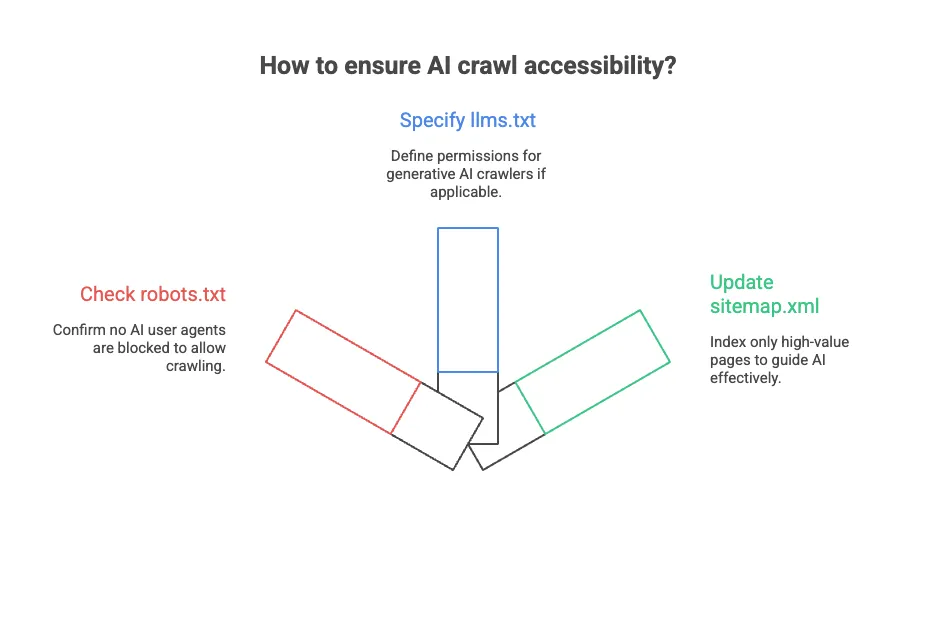
Before Google's AI can summarise your content, it must be able to see it. Check three foundational elements:
- robots.txt: confirm you are not blocking Google-Extended or other AI-related user agents.
- llms.txt: if you have one, specify permissions for generative AI crawlers.
- sitemap.xml: keep it updated and index only high-value pages.
These are your site's permission slips for AI access, and blocking them forfeits citation opportunities. Make sure key content is server-rendered rather than hidden behind heavy JavaScript, since AI crawlers may struggle to interpret dynamically loaded content, and check that your most important pages are consistently discoverable and refreshed.
One caution on llms.txt: Google does not use it. Treat it as an unproven, optional extra, not a requirement (Google Search Central, 2026). Focus on letting the crawlers you can verify (Googlebot, GPTBot, PerplexityBot) reach the site.
Structure your content for extraction.
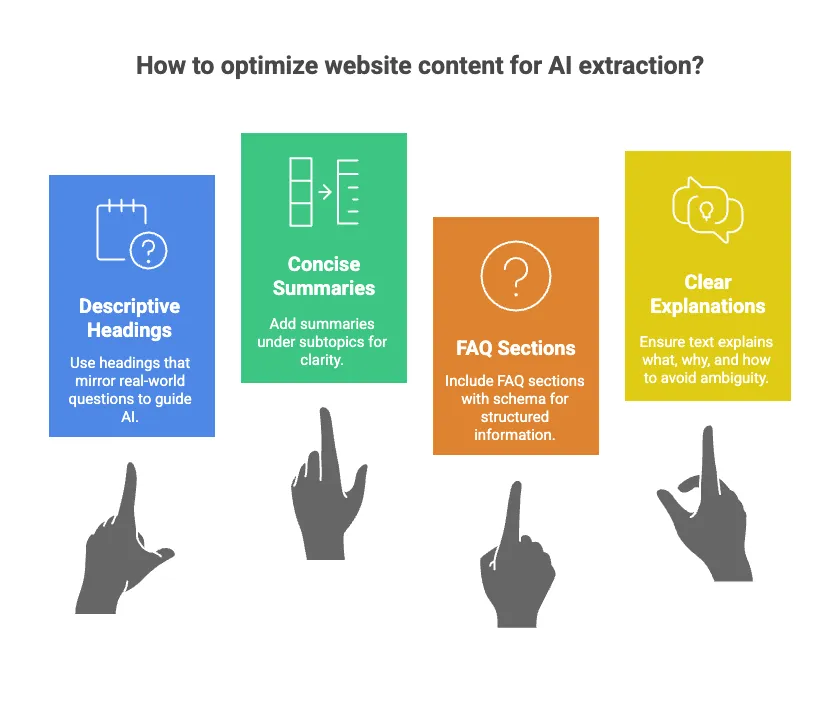
AI Overviews extract answers, not paragraphs, so make it effortless for AI to identify what matters most:
- Use descriptive H2 and H3 headings that mirror real-world questions.
- Add concise summary sentences under each subtopic.
- Include FAQ sections on important pages using FAQPage schema.
- Explain what, why and how clearly, since AI struggles with ambiguity.
Formatting for comprehension is the new formatting for SEO. Structure content into clear answer blocks that each resolve a single query completely, place key answers high within the section since AI favours early, clearly stated information, and avoid excessive narrative buildup in favour of direct, front-loaded explanations. The guide on what content AI prefers to cite expands on this.
Structure matters because ranking no longer guarantees a citation. Only about 38% of AI Overview citations now come from the top 10 organic results, down from 76% a year earlier (Ahrefs, 863,000 keywords, 2026), and an AI Overview cites around 11 sources, with the #1 result appearing in only 46% of them on desktop (Semrush, 200,000 keywords, 2025). Clear, answer-first passages give you a way in even when you do not rank first.
Implement essential schema and metadata.
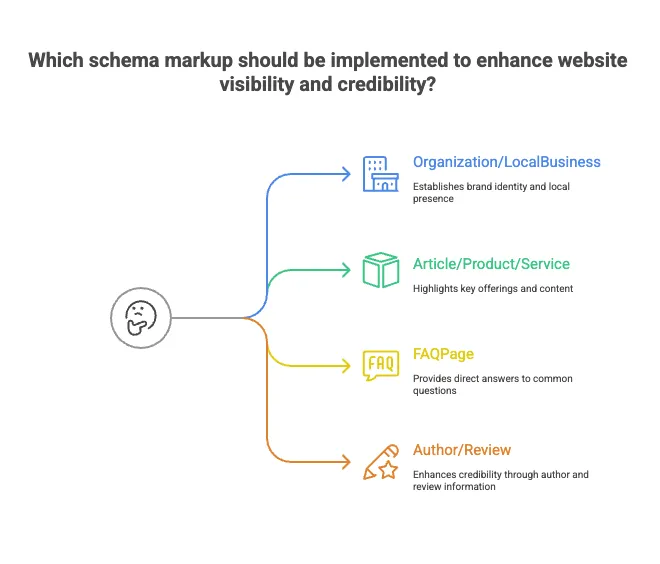
Schema markup tells Google what your data means, not just what it says. Prioritise:
- Organization or LocalBusiness schema for brand identity.
- Article, Product or Service schema for key offerings.
- FAQPage schema for direct question-and-answer content.
- Author and Review schema to enhance credibility.
Write meta titles and descriptions like clear answers, not slogans. For the full priority list, see which schema and entity markup matter most.
Set expectations for schema. It makes content machine-readable and keeps your facts consistent, which supports eligibility, but do not expect markup alone to win citations. In a controlled test, adding JSON-LD produced no meaningful change in AI citations (Ahrefs schema study, 1,885 pages versus 4,000 controls, 2026). Use schema to be accurate and crawlable, not as a growth hack.
Strengthen your brand's trust signals.
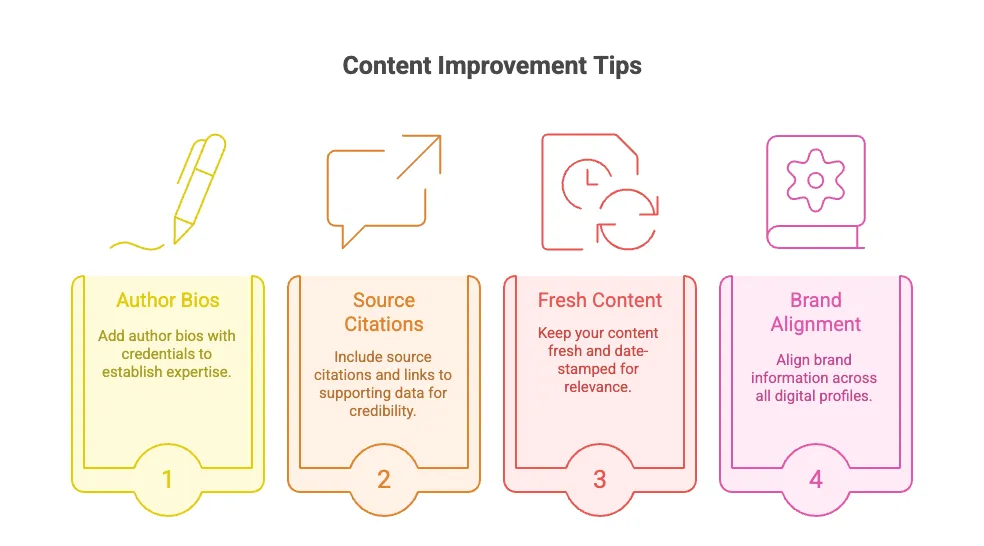
Google's AI models factor in credibility when deciding what to include, so E-E-A-T, experience, expertise, authoritativeness and trustworthiness, still matters, but now it must be machine-verifiable:
- Add author bios with credentials.
- Include source citations and links to supporting data.
- Keep content fresh and date-stamped.
- Align brand information across all digital profiles, such as LinkedIn, Crunchbase and Wikidata.
Focus on verifiable claims with supporting evidence, since AI is more likely to cite content it can cross-check, and maintain consistency over time so updates reinforce rather than contradict existing information. See how to build trust signals AI recognises.
Monitor inclusion and iterate.
After implementation, run regular audits to see which pages appear in AI Overviews or other generative summaries. Track three metrics:
- Visibility coverage: how often your pages appear in AI-generated results.
- Citation type: whether you are referenced directly or indirectly.
- Engagement outcome: traffic quality and lead conversions from those impressions.
Continuous monitoring lets you adjust schema, content and structure to keep your brand top-of-mind for AI and users. Track performance across informational, comparative and decision-based query types, maintain a prompt tracking framework using consistent queries over time, and compare results against competitors for relative gains. See how to track AI citations and their impact. Google AI Overviews reward sites that are accessible, structured and trustworthy: when your content is easy for AI to interpret and cite, you become hard to leave out.
Measure because the click math changed. When an AI Overview appears, users click a result in about 8% of searches, against 15% without one, and only 1% click a link inside the summary (Pew Research Center, 900 US adults, 2025). Appearing in the answer, not just ranking, is the outcome to track. And keep it genuine: since 15 May 2026 Google treats manipulating AI answers as spam (Search Engine Land, 2026).
Questions about preparing for Google AI Overviews.
Do I need to rank number one on Google to appear in AI Overviews?
Does adding schema or FAQ markup get me cited in AI Overviews?
Not on its own. Google says no special schema is required, only structured data that matches your visible text (Google Search Central, 2026), and a controlled test found adding JSON-LD produced no meaningful citation change (Ahrefs, 2026). Schema keeps you accurate and crawlable; it is not a shortcut.
How do I check whether my pages appear in AI Overviews or AI Mode?
Track a fixed set of queries across the engines and record where you are named or cited, then watch coverage over time. A tool that monitors ChatGPT, Gemini, Perplexity, Google AI Overviews and Google AI Mode together makes the gaps visible.
Can I be penalised for optimising for AI Overviews?
Yes. Since 15 May 2026 Google treats manipulating generative AI responses as spam (Search Engine Land, 2026). Optimise through clarity, accuracy and genuine expertise, not manufactured signals.
See whether you appear in Google AI Overviews.
Zicy tracks your presence across Google AI Overviews, Google AI Mode, ChatGPT, Gemini and Perplexity.
