How to Compare Your AI Visibility Across ChatGPT, Gemini, Perplexity and Google AI
Learn how to compare your AI visibility across ChatGPT, Gemini, Perplexity and Google AI using mentions, citations, rankings and Share of Voice.
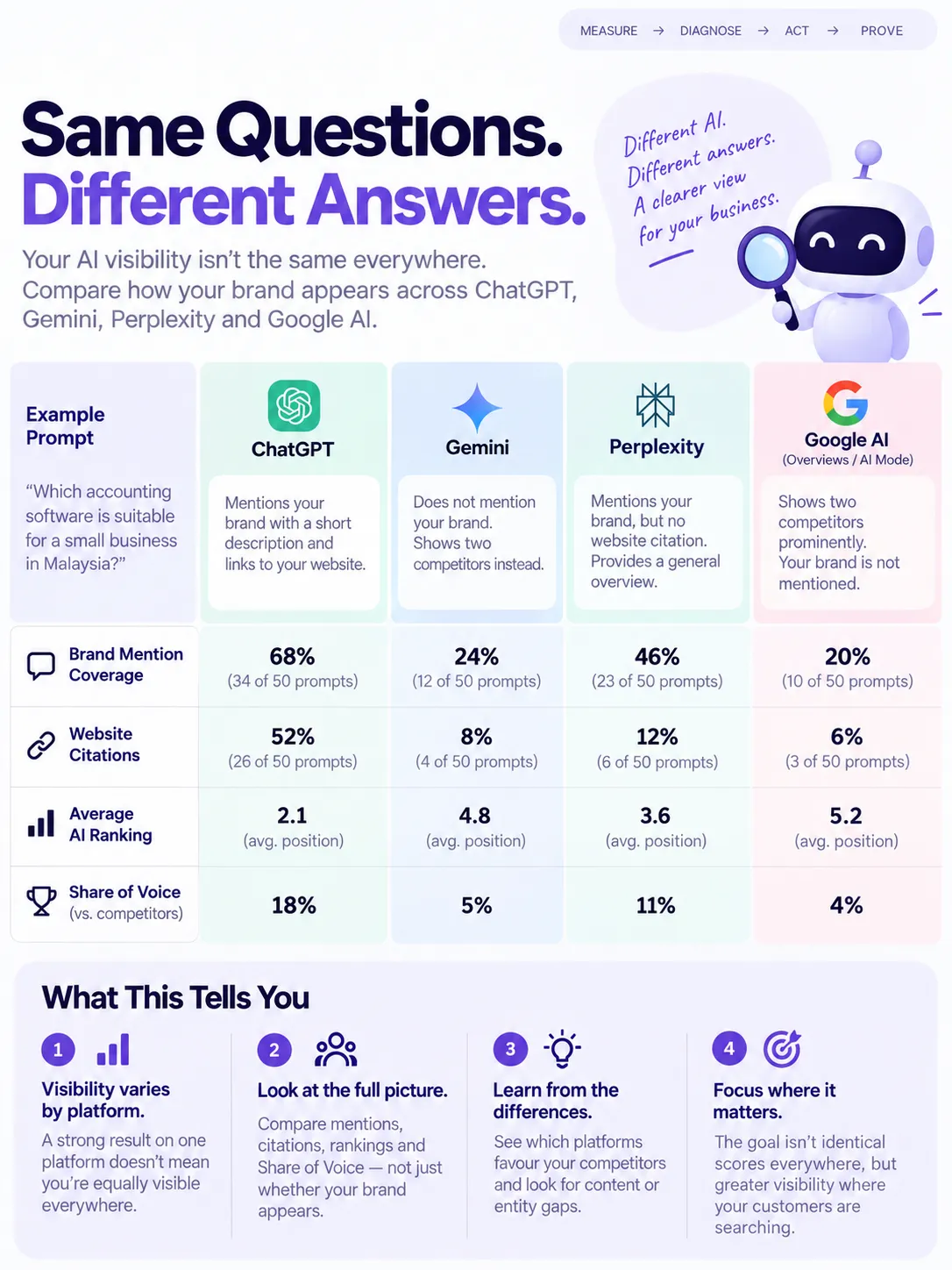
Key Takeaways
- Your AI visibility varies across platforms. A business that appears frequently in ChatGPT may be much less visible in Gemini, Perplexity or Google AI.
- Compare platforms using the same tracked prompts, market and language wherever possible. Otherwise, you may be comparing different customer journeys rather than different AI platforms.
- Look beyond whether your brand appears. Compare Brand Mention Coverage, Website Citation Rate, Average AI Ranking and Share of Voice across platforms.
- A weak result on one platform does not automatically mean something is wrong with your website. Look at the actual answers, competitors and cited sources before deciding what needs fixing.
- Do not rely on a handful of manual searches. Individual AI answers can vary, so a consistent tracked prompt set gives you a much more useful view.
- The goal is to understand where your business is visible, where competitors are stronger and which gaps matter commercially.
Introduction
You ask ChatGPT: “Which accounting software is suitable for a small business in Malaysia?” Your brand appears. Excellent.
Then you ask Gemini the same question. Your brand is missing. You try Perplexity. This time, your brand appears, but your website is not cited. Then Google AI shows two competitors prominently while your company is nowhere to be seen.
Which result tells you your “real” AI visibility? All of them do.
Customers may discover businesses through ChatGPT, Gemini, Perplexity, Google AI Overviews or Google AI Mode, and those experiences do not necessarily produce the same answer.
For an SME, checking ChatGPT once and seeing a mention is not enough. You need to understand where you are visible, where you are weak, who appears instead, and what those differences can tell you.
What Does It Mean to Compare AI Visibility Across Platforms?
It means measuring how your brand performs for a defined set of customer questions across different AI answer experiences.
Suppose you track 50 important questions customers may ask about your category. You then examine how your brand performs across:
- ChatGPT;
- Gemini;
- Perplexity;
- Google AI Overviews; and
- Google AI Mode.
You are measuring whether each platform surfaces your business when customers ask commercially relevant questions, not simply whether it knows your company exists.
An AI system may know plenty about Nike. But if Nike never appears for the particular questions being measured, its visibility for that prompt set would still be weak.
For an SME, ask: “Does my business appear when potential customers ask relevant questions about products and services like mine?” Then ask that question across the different AI platforms.
Why Can Your Visibility Differ Between ChatGPT, Gemini, Perplexity and Google AI?
These are different products. They do not all find, process and present information in exactly the same way.
ChatGPT Search can search the web for current information and provide citations and links to relevant sources. Search results and citations can sometimes be incomplete, outdated or incorrect, which is one reason important information should be checked against the underlying sources.
Perplexity describes itself as an AI-powered search engine that searches the web and produces conversational answers backed by citations to original sources.
Google's AI Mode uses what Google calls query fan-out. It can divide a question into subtopics, issue multiple searches and bring the information together into an AI-powered response. It can also draw on Google's broader information systems, including web content, Knowledge Graph information and other data sources.
The useful point for a small business is simpler: different AI experiences can arrive at different answers, so visibility needs to be measured across them rather than assumed from one.
What Is the Difference Between Google AI Overviews and Google AI Mode?
Businesses often treat Google AI as a single category, but there are two experiences worth distinguishing.
Google AI Overviews
AI Overviews can appear within regular Google Search results and provide an AI-generated summary for searches where Google determines an AI response may be helpful.
Google AI Mode
AI Mode is a more conversational AI search experience. Users can ask longer or more complex questions and continue with follow-ups. Google says it uses query fan-out to break questions into subtopics and search across them.
When comparing platforms, do not automatically treat every Google AI experience as identical.
Why Isn't Checking Your Brand Manually Enough?
Manual checks are useful, but they answer a narrow question: “What happened when I asked this particular question this particular time?” That is not the same as measuring AI visibility.
If you ask ChatGPT three questions and appear in two, you might conclude that ChatGPT visibility is excellent. But customers may ask dozens of important questions involving recommendations, comparisons, prices, alternatives, problems, reviews, specific products and specific services.
You could be visible for general questions but absent from high-value buying questions. Or you may have chosen three prompts where you already perform well. A defined, stable prompt set reduces this cherry-picking.
Instead of asking, “Can I make my brand appear?”, ask, “How consistently does my brand appear across the customer questions we decided were important?”
What Should Stay the Same When You Compare AI Platforms?
Where you want a fair platform comparison, keep the measurement conditions reasonably consistent.
Tracking “Which payroll software is suitable for Malaysian SMEs?” across ChatGPT, Gemini, Perplexity and Google AI gives you a useful comparison.
Measuring 30 Malaysian payroll prompts on ChatGPT, 20 Singapore HR prompts on Gemini and 15 general accounting prompts on Perplexity does not. The scores cannot tell you whether the difference comes from the platform or the questions.
Keep these consistent where appropriate:
- Prompt set
- Market
- Language
- Measurement period
- Brand and competitor definitions
You want the main changing variable to be the AI platform.
Which AI Visibility Metrics Should You Compare?
1. Brand Mention Coverage
Brand Mention Coverage answers: how often did this platform mention my brand across the tracked answers?
Imagine you track 100 prompts:
| Platform | Brand Mention Coverage |
|---|---|
| ChatGPT | 68% |
| Gemini | 51% |
| Perplexity | 62% |
| Google AI Overviews | 39% |
| Google AI Mode | 55% |
Your brand appears more consistently in ChatGPT than in Google AI Overviews for this tracked set. The figures do not yet explain why; that requires deeper investigation.
2. Website Citation Rate
A brand mention and a website citation are not the same thing. An answer may name your company while linking to a competitor, an industry article or a review site.
Perplexity explicitly builds source citations into its search experience, while ChatGPT Search can also provide citations and a Sources panel for web-search answers.
| Platform | Mention Coverage | Website Citation Rate |
|---|---|---|
| ChatGPT | 68% | 31% |
| Gemini | 51% | 25% |
| Perplexity | 62% | 48% |
| Google AI | 44% | 36% |
ChatGPT gives you the strongest mention visibility, while Perplexity gives your website the strongest citation visibility. Both are useful findings.
3. Average AI Ranking
When several brands appear in an answer, where does yours tend to appear? Suppose your Average AI Ranking is 1.9 on ChatGPT, 3.6 on Gemini and 2.4 on Perplexity.
Your brand appears across all three, but Gemini tends to position competitors ahead of you. That is a different problem from being absent entirely. Remember: a lower Average AI Ranking is better.
4. AI Share of Voice
Share of Voice adds competitive context. It asks how much of the tracked competitive AI conversation your brand captures relative to others.
If ChatGPT SOV is 18%, Gemini is 9% and Perplexity is 16%, your Gemini weakness is visible in another metric. The next question is which competitors are taking that Share of Voice.
What Does a Good Platform Comparison Actually Look Like?
Consider a Malaysian HR software company tracking the same 60 buyer-relevant prompts across its major AI platforms.
| Platform | Mention Coverage | Citation Rate | Avg. Rank | SOV |
|---|---|---|---|---|
| ChatGPT | 72% | 38% | 2.0 | 21% |
| Gemini | 43% | 19% | 3.5 | 10% |
| Perplexity | 65% | 52% | 2.3 | 18% |
| Google AI Overviews | 36% | 29% | 3.1 | 9% |
| Google AI Mode | 54% | 35% | 2.7 | 14% |
There is no single conclusion such as “Our AI visibility is good.” Instead:
- ChatGPT: Strongest overall brand presence.
- Perplexity: Strong visibility and particularly strong website citation performance.
- Gemini: The brand appears less frequently and tends to sit behind more competitors.
- Google AI Overviews: Weakest mention visibility in this tracked set.
- Google AI Mode: Middle of the pack.
Now the business knows where to investigate. That is more useful than one combined visibility percentage.
What Should You Do When One Platform Is Much Weaker?
Do not immediately start “optimising for Gemini” or “optimising for ChatGPT”. First diagnose the difference.
Check Which Prompts Are Weak
Your Gemini score may be low overall, but a topic breakdown could reveal strong payroll prompts, moderate leave-management prompts and very weak HR compliance prompts. Now you have a topic-level gap rather than a vague “Gemini problem”.
Check Which Competitors Appear
Find which competitor appears most often, what the platform associates it with, whether the same competitor dominates elsewhere, and whether different competitors win on different platforms.
Check the Cited Sources
Perplexity may repeatedly cite your guides, while Gemini surfaces industry publications and Google AI links to comparison sites. These are clues about the source environment surrounding each answer set.
Ask what sources seem to shape the conversation and why your brand is represented well in some but not others. That leads to a more useful investigation.
Should You Optimise Separately for Every AI Platform?
Not in the simplistic sense of creating a ChatGPT page, Gemini page, Perplexity page or Google AI page for the same topic. That quickly becomes unmanageable and can create overlapping content.
Look for the underlying visibility gap. If your company is weak across several platforms for “best payroll software for restaurants”, perhaps your website barely explains its restaurant payroll capabilities. The useful action may be to improve the relevant product or industry content.
If platforms repeatedly use inaccurate information about your company, the problem may involve unclear or inconsistent business information rather than one AI engine.
Platform comparison helps you diagnose. It should not encourage you to create content purely for machines.
What If You Are Strong on One Platform and Weak on Another?
Ask whether the difference is consistent, substantial and commercially important.
A ChatGPT Mention Coverage of 61% and Gemini coverage of 57% may not deserve an emergency strategy. A difference of 74% versus 19% across a stable set of buyer prompts deserves investigation.
Likewise, being weak on low-priority informational prompts may matter less than being absent from high-intent questions such as:
- “Which providers should I shortlist?”
- “What are the best alternatives to X?”
- “Which solution is suitable for a 50-person company?”
Prioritise the gaps closest to real business opportunities.
Why Should You Compare the Actual AI Answers Too?
Metrics summarise. Answers explain. A Gemini Mention Coverage of 35% tells you there is a gap, but the underlying answers might reveal different situations:
- You are completely absent: AI recommends competitors instead.
- You appear only occasionally: Your brand may have a weak association with the topic.
- You appear but rank low: AI recognises your relevance but tends to prioritise competitors.
- You are mentioned but not cited: The platform knows the brand but relies on other sources.
- You are mentioned incorrectly: The visibility exists, but the information itself is problematic.
These require different responses. AI visibility measurement should never stop at the score.
A Simple Monthly AI Platform Review for SMEs
A useful monthly review can answer five questions:
- Which AI platform gives us the strongest Brand Mention Coverage?
- Which gives us the strongest Website Citation Rate?
- Where do we tend to rank highest and lowest?
- Which competitors dominate the platforms where we are weak?
- Which commercially important prompts explain the biggest gaps?
Then identify perhaps three actions, not thirty.
- Finding: Gemini visibility is particularly weak for payroll compliance questions.
Action: Review whether existing payroll content adequately covers those customer needs. - Finding: Perplexity frequently mentions the brand but rarely cites the website for pricing prompts.
Action: Review whether pricing and product information is sufficiently clear and accessible. - Finding: Competitor X dominates Google AI for SME comparison prompts.
Action: Examine the relevant answers, cited sources and competitor positioning to understand the gap.
Now the report leads somewhere.
Running this review by hand across five platforms each month is a lot of repeated checking.
A platform like Zicy tracks the same prompt set across ChatGPT, Gemini, Perplexity and Google’s AI experiences.
You can then compare the four core measurements across platforms and open any platform gap to read the actual answers behind it.
What Should You Avoid When Comparing AI Platforms?
The biggest mistake is treating every movement as a conclusion. If ChatGPT visibility rises after you update a page, you can say visibility increased after the change. Be much more cautious about saying the page change caused the increase.
Many things can change around an AI answer ecosystem. Avoid:
- declaring one platform “better” from a handful of prompts;
- changing your prompt set whenever results look poor;
- comparing different markets or languages as though they were identical;
- assuming a mention automatically means a citation;
- treating every platform gap as a content problem; and
- chasing identical scores across every engine.
Use the data to find patterns worth investigating, not to manufacture certainty.
Build the Full Platform Picture
There is no single place where your business “ranks in AI”. One customer might ask ChatGPT and see your company first. Another might ask Gemini and never see you. A third might use Perplexity, where your brand appears and your website is cited. Google AI may surface an entirely different competitive set.
All of those experiences form part of your AI visibility.
Track the same meaningful customer questions across platforms. Compare Brand Mention Coverage, citations, rankings and Share of Voice. Then examine the answers behind the numbers.
You do not need identical performance everywhere. You need to know where commercially important gaps exist, why they may be happening and which ones deserve attention first.
That is when platform-level AI visibility stops being another marketing metric and starts becoming useful business intelligence.
Compare the AI platforms
your customers use.
Zicy brings mentions, citations, rankings and Share of Voice into one view, so you can find the platform gaps that matter.
