What kind of content does AI prefer to cite: blogs, FAQs or structured data?
AI engines cite content that is clear, factual and self-contained. FAQs have the highest direct citation potential because their question-and-answer format mirrors how people prompt; blogs build context and authority; and structured data lets AI verify what is true. The strongest approach integrates all three. Zicy shows which of your pages AI actually cites across the five engines.
When engines like ChatGPT, Gemini and Perplexity generate answers, they do not pull from random pages. They extract from content that is clear, factual and structured. For brands investing in answer engine optimisation or generative engine optimisation, understanding what AI prefers to cite can be the difference between being visible in answers and being invisible. AI systems typically retrieve information in small, high-confidence chunks, so content that delivers complete answers within compact sections is more likely to be cited.
What makes content AI-friendly.
AI models prioritise extractability, how easily they can find, isolate and quote precise information. They favour content that has:
- Logical structure: clear headings, bullet lists and short paragraphs.
- Direct relevance: content that answers questions explicitly, not vaguely.
- Factual consistency: claims that match what AI engines see in other authoritative sources.
Self-containment matters too: each section should be understandable on its own, without requiring the reader or the AI to reference other parts of the page. AI also favours precision over length, since a concise, well-structured explanation often outperforms longer, less focused content. AI does not care about keyword density; it cares about semantic clarity, so your page must explain rather than merely promote.
AI cites content it can lift cleanly and trust, not the best-written page.
- In a controlled study, adding citations, quotations or statistics each raised a page's visibility in AI answers by about 30% to 40%, while keyword stuffing gave no gain or hurt (Princeton GEO study, 10,000 queries, 2024).
- Across a meta-analysis of 54 studies, clear AI-ready structure scored 8.6 out of 10 as a citation factor and factual specificity 8.3, while domain authority scored only about 5.0 (Zyppy, 54 studies, 2026).
Structure and verifiable facts beat brand size.
Do blogs, FAQs or structured data perform best?
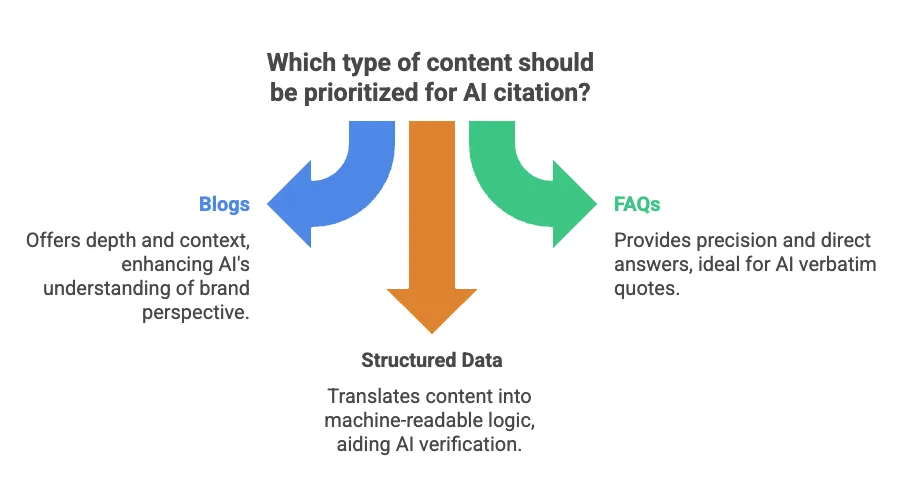
Each plays a different but complementary role:
- Blogs offer depth and context. They help AI understand your brand's perspective and expertise, and when well-formatted and source-supported they become the foundation for extractable insights.
- FAQs deliver precision. Question-and-answer formats mirror how users prompt chat models, so each well-written FAQ is an invitation for AI to quote your text.
- Structured data provides validation. Schema markup translates human explanations into machine-readable logic, letting AI verify what is true and where it comes from. See which schema and entity markup matter most.
In practice, FAQs often have the highest direct citation probability, blogs contribute to authority and context, and structured data improves interpretation accuracy. The most effective strategy is not choosing one format but integrating all three, so AI can combine context, clarity and validation when generating responses.
Format matters more than most teams expect.
- Listicles dominate: 63% of Gemini's most-cited URLs are ranked lists, and 40% to 65% across engines (Evertune, ~25,000 URLs, 2026).
- For branded queries, 57% of citations go to reviews, listicles, forums, social and case studies, and only about 5% to classic thought-leadership or how-to content (Omniscient Digital, 23,387 sources, 2026).
- Community carries weight: Reddit is the single most-cited domain, ahead of YouTube, LinkedIn and Wikipedia (Peec AI, ~30 million sources, 2026).
How to optimise your content mix for AI citation.
Think of your site as a hierarchy of clarity:
- Use blogs to explore topics and demonstrate expertise.
- Add FAQs under each major section to summarise key answers.
- Layer schema, such as FAQPage, Article, Product or Organization markup, to help AI map context to content.
- Link internally between related articles to strengthen semantic associations.
Update older content regularly, since AI engines assign higher reliability to fresh, maintained sources. Structure content into answer blocks that each respond to a specific query, prioritise high-intent phrasing such as what is, how to, best and versus, and keep formatting consistent across pages so retrieval systems can predict where to look. The companion guide on building trust signals AI recognises covers the credibility layer.
So build for extraction:
- Open each page with a direct, self-contained answer, then expand.
- Add original data, statistics and named sources; these lift citation the most (Princeton GEO study, 2024).
- Use clear H2 and H3 headings, short sentences and lists.
- Keep pages current; freshness helps, though how much depends on the query (Zyppy, 2026).
Why content structure now defines discoverability.
AI search rewards clarity over creativity. If your content can answer a prompt cleanly, it is more likely to be cited even if it ranks lower on Google. This flips the old SEO logic: instead of writing for algorithms, you are writing for comprehension. It also shifts competition from the page level to the section level, where individual answer blocks compete for inclusion in AI responses, so even a single well-structured section can outperform an entire page if it gives a clearer answer. AI engines prefer content that is easy to read, easy to trust and easy to quote. Blogs build expertise, FAQs build precision and structured data builds context, and together they make your brand hard to overlook. The most successful brands design content for retrieval systems as well as readers. When you are ready to test it, see how to get cited in ChatGPT and Perplexity.
One caution as you scale content. Google's 2026 updates confirm AI-generated content is not banned, but scaled low-value pages and bought or faked citations are penalised (Search Engine Land, 2026). Earned, specific, well-structured content is the durable path, the foundation of Growth.pro's PAVA framework.
Questions about the content AI prefers to cite.
What types of content do AI engines like ChatGPT and Perplexity cite most?
Structured, list-style and third-party content. Listicles are 40% to 65% of cited URLs (Evertune, ~25,000 URLs, 2026), and for branded queries most citations go to reviews, listicles, forums and case studies rather than classic thought-leadership (Omniscient Digital, 2026).
Does adding statistics, quotes or original data increase the chance of being cited?
Yes, measurably. In a controlled study each of citations, quotations and statistics lifted a page's AI visibility by about 30% to 40% (Princeton GEO study, 10,000 queries, 2024). Original, specific data is one of the strongest signals.
Do listicles and comparison pages get cited more than long-form blog posts?
Usually. Ranked lists dominate cited URLs across engines (Evertune, 2026), because they are easy to extract. A long post can still be cited if it opens with a clear answer and includes structured, specific facts.
Why does Reddit get cited so much, and can editorial content compete?
AI leans on community sources for real-world experience; Reddit is the most-cited domain (Peec AI, ~30 million sources, 2026). Editorial content competes by being specific, well-structured and backed by original data, not by length or brand alone.
See which of your pages AI actually cites.
Zicy shows the sources AI cites about your brand across ChatGPT, Gemini, Perplexity, Google AI Overviews and Google AI Mode.
