How to track AI citations and measure their impact on leads and sales
An AI citation is when a generative engine references your brand, domain or content in an answer, as a link or an unlinked mention. Because these rarely produce a click, you track them with recurring prompt tests, a standard prompt library and citation dashboards, then correlate them with leads. Zicy tracks citations across ChatGPT, Gemini, Perplexity, Google AI Overviews and Google AI Mode.
In traditional SEO, tracking performance is straightforward: rankings, clicks and conversions. In answer engine optimisation and generative engine optimisation, visibility looks different.
Your brand may be mentioned or cited by ChatGPT, Gemini or Perplexity even when users never visit your site. The challenge for marketing leaders is measuring the ROI of visibility that does not always generate clicks, which means decoupling visibility from traffic, where influence can occur without any measurable session or referral.
What an AI citation is, and why it matters.
An AI citation occurs when a generative engine references your brand, domain or content as part of an answer. It might show as a hyperlink, such as a source line naming your domain, or as an unlinked brand mention embedded in a synthesised paragraph. Both forms matter because they influence:
- brand recall, since users associate your name with trusted answers
- reputation, since being cited signals credibility
- lead quality, since cited brands attract higher-intent prospects who already trust them
In short, AI citations are the new backlinks: they do not drive traffic directly, but they build authority indirectly.
Not all citations are equal. Mentions that appear earlier in an answer or within primary summaries tend to carry more influence than those buried deeper in supporting text, and over time repeated citations across different queries reinforce how AI systems recognise and prioritise your brand.
AI answers lean on very few sources, so a place among them compounds.
- Wikipedia alone accounts for about 7.8% of all ChatGPT citations.
- Reddit accounts for about 6.6% of Perplexity's.
(Profound, 680 million citations, 2025.) When a small set of domains supplies most answers in your category, being one of them is a durable advantage.
How to track when AI engines mention your brand.
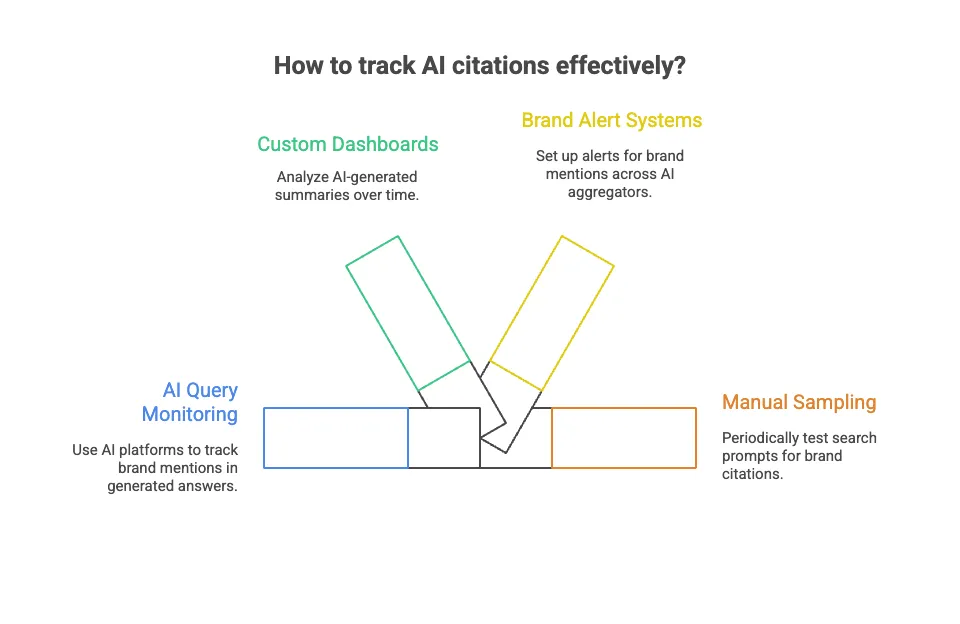
Unlike search rankings, AI citations are not indexed in public reports, so you need a multi-layer monitoring approach:
- AI query monitoring: run recurring prompts on ChatGPT, Gemini, Perplexity, Google AI Overviews and Google AI Mode using your target money questions, and track which brands appear.
- Custom dashboards: use analytics tools that crawl AI-generated summaries and store responses over time.
- Brand alert systems: track your company name and domain mentions across AI-powered aggregators.
- Manual sampling: for niche queries, periodically test your most important prompts to see if you appear in citations.
This hybrid method gives a running baseline of where and how often AI models reference your brand. For reliability, track across clusters of related prompts rather than isolated queries, since AI responses vary with phrasing and context, and maintain a standardised prompt library so measurement stays consistent. Capturing historical snapshots of AI responses lets you compare citation trends and detect gains or losses in visibility.
Which tools identify AI citations and mentions.
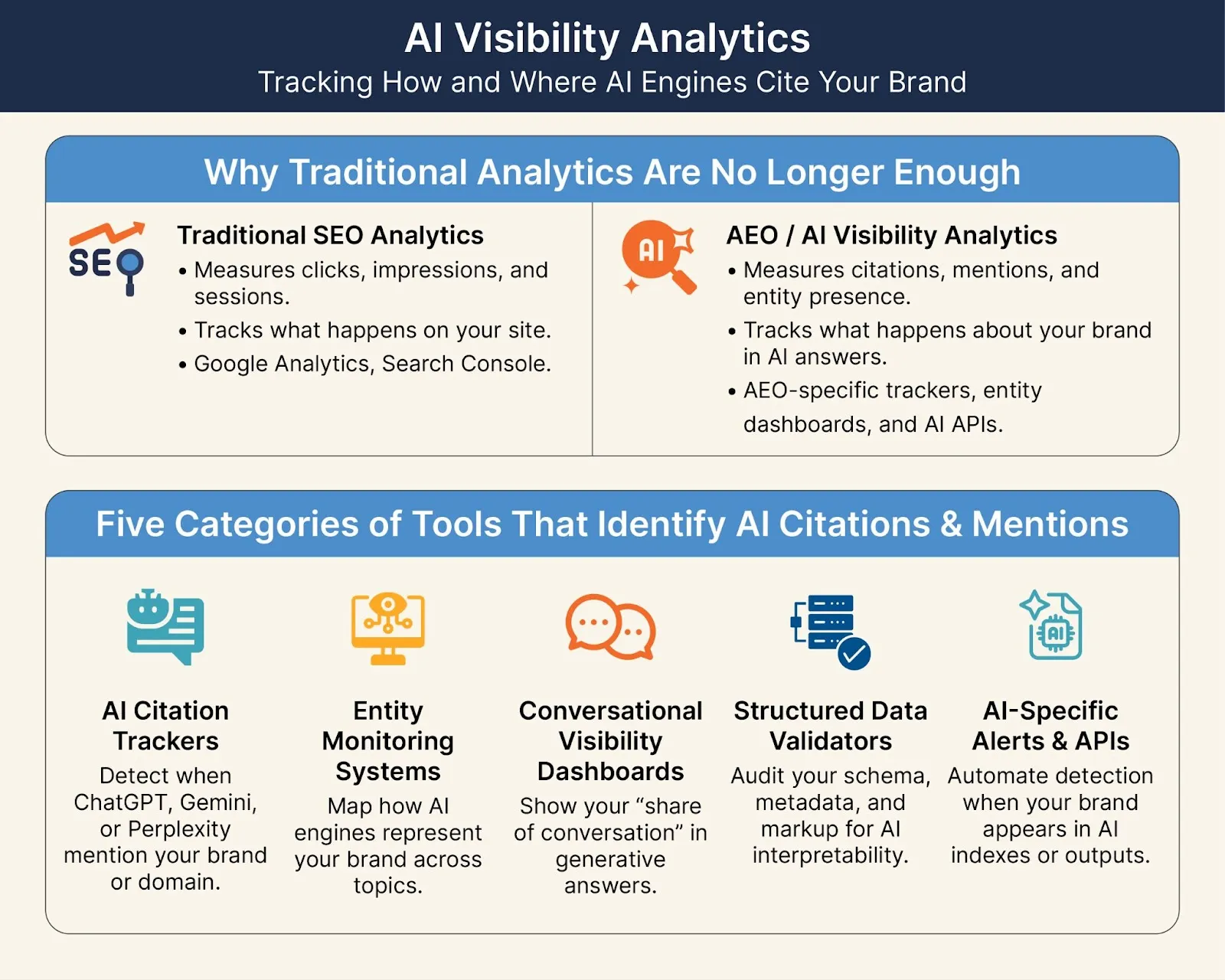
Standard analytics were built for visitors, not for zero-click exposure. Google Analytics can tell you who visited your site, but not who read about your brand inside an AI answer. This space is still emerging, but the key categories of tool are:
- AI citation trackers: crawl ChatGPT, Gemini and Perplexity outputs for brand or domain mentions, revealing which prompts trigger your citations and whether they appear as links or plain mentions.
- Entity monitoring systems: map how AI engines represent your brand, tracking name accuracy, service descriptions and topic associations.
- Conversational visibility dashboards: monitor your share of voice, how often your brand appears in generative summaries versus competitors.
- Structured data validators: check your schema, metadata and markup health so AI can interpret your site correctly. See which schema and entity markup matter most.
- AI-specific alerts and APIs: custom monitoring that detects when your domain is surfaced in AI models or public answer indexes.
Useful capabilities to look for include:
- prompt-level tracking, which identifies exactly which queries trigger your brand's appearance
- historical tracking of AI outputs
- competitive benchmarking across the same prompts
Tools like Zicy give marketers and executives visibility into AI-era influence, not just web traffic.
Tracking AI referrals in GA4.
Some of this shows up in your own analytics. AI engines usually arrive in GA4 as referrals from a few domains:
- chatgpt.com
- perplexity.ai
- gemini.google.com
- copilot.microsoft.com
Group them into a custom AI channel so they stop hiding inside general referral traffic (Rankshift, 2025).
Two cautions:
- Free ChatGPT clicks often send no referrer and land in Direct, so GA4 undercounts AI traffic. Tag your own shared links with UTMs to close the gap.
- AI-referred visitors can be high intent. Across 1,200+ publisher and news sites, visitors from large language models signed up at 1.66%, against 0.15% from search and 0.13% direct (Microsoft Clarity, 2025, via Digiday).
Treat single-site multiples with care, but the direction is consistent: people who arrive after an AI names you often already trust you.
What metrics to measure.
Tracking citations is not just about counting mentions; it is about interpreting impact. Three metrics to focus on:
- Brand mention frequency: how often your name appears across AI-generated results.
- Domain citation depth: how prominently your site is referenced, as a source, supporting example or hyperlink.
- Lead conversion correlation: whether cited visibility aligns with higher lead volume, lower acquisition cost or improved close rates.
To deepen insight, add prompt coverage rate, average citation position and citation consistency across repeated prompts. Compared against your CRM and analytics data, these start connecting AI visibility to real business outcomes. The companion guide on the KPIs that replace traditional SEO metrics covers how to frame them.
How to interpret ROI from AI visibility.
AI visibility produces compound influence, not linear traffic.
- In the short term, expect more branded search queries and social mentions after citation spikes.
- In the medium term, notice improved lead-to-conversion ratios as brand trust increases.
- In the long term, track recurring appearances in AI summaries, which reflect sustained authority rather than seasonal exposure.
Separate visibility spikes from visibility stability, since consistent presence across queries is a stronger signal of authority than occasional high-volume mentions, and watch for cross-query expansion into adjacent topics, which indicates growing topical authority. Combining citation metrics with CRM data supports influence-based attribution, a composite view of how AI exposure contributes to revenue beyond last-click tracking.
To make this comparable, integrate the metrics into your marketing dashboards:
- add AI citation counts alongside organic traffic
- compare share of conversation with keyword share
- correlate mention growth with leads and conversions
- visualise entity accuracy as part of brand authority
Leading teams combine citation metrics, prompt coverage and entity accuracy into a single executive scorecard, and track visibility by funnel stage, mapping which awareness, comparison and decision queries drive AI mentions.
Why tracking AI references is now a necessity.
If AI engines are already shaping your category narratives, tracking who they cite means tracking who owns influence. Because AI visibility is often limited to a small set of cited sources, even small improvements in citation frequency can produce disproportionate gains in competitive positioning, while without tracking, brands risk losing share in an invisible layer where decisions are influenced long before traditional analytics detect impact.
Traditional analytics measure visitors; AEO analytics measure visibility within the conversations that shape buyer intent. The goal is not just to track mentions, but to understand how AI-driven visibility shapes buyer intent before measurable engagement occurs.
One habit matters more than any tool: measure continuously, not once.
Re-running identical prompts within 24 hours kept only 32% to 43% of the cited sources, and about 65% changed from one day to the next (Schulte, Bleeker and Kaufmann, arXiv, 2026). The authors recommend at least seven runs per prompt.
That is why daily tracking across a stable prompt library is the honest way to measure AI citations. It is also the feedback loop behind Growth.pro's AI Citation Enablement practice.
Questions about tracking AI citations.
How do I track ChatGPT and Perplexity referrals in GA4, and why does so much show as Direct?
AI engines usually appear as referrals from domains like chatgpt.com and perplexity.ai, which you can group into a custom AI channel. Free ChatGPT clicks often pass no referrer and fall into Direct, so GA4 undercounts AI traffic; tagging your own shared links with UTMs helps close the gap (Rankshift, 2025).
Do visitors from AI answer engines convert better than organic search?
Early evidence is directional but promising. Across 1,200+ publisher and news sites, visitors referred by large language models signed up at 1.66% against 0.15% from search (Microsoft Clarity, 2025, via Digiday). Single-site multiples vary widely, so measure your own cohorts before assuming a benchmark.
How do I attribute revenue when AI citations are zero-click?
Combine three reads: AI referral sessions in GA4, branded-search and direct-visit lift after citation spikes, and influence or assisted attribution against your CRM. The goal is a composite view of how AI exposure contributes to pipeline, not a last-click number.
How often should I check my AI visibility?
Frequently. Re-running the same prompts a day apart changed roughly 65% of cited sources in one study (Schulte, Bleeker and Kaufmann, arXiv, 2026), so a single snapshot is unreliable. Daily tracking across a fixed prompt library is far more accurate.
Turn AI citations into measurable intelligence.
Zicy tracks your citations, positions and share of voice across ChatGPT, Gemini, Perplexity, Google AI Overviews and Google AI Mode.
