How to get your brand mentioned or cited in ChatGPT and Perplexity answers?
To get cited in ChatGPT and Perplexity, your brand must be understandable, verifiable and consistent: clear entity definitions, structured data, and facts that match across independent sources. AI cites what it can trust, favouring self-contained answer blocks and comparative content. Zicy tracks where your brand is mentioned and cited across ChatGPT, Gemini, Perplexity, Google AI Overviews and Google AI Mode.
Being mentioned in an AI-generated answer is a new form of digital authority. When ChatGPT, Gemini or Perplexity cite your brand, they publicly validate you as a reliable source, which drives awareness, credibility and influence even before a user clicks your website. AI citations often act as pre-qualification signals: users are more likely to trust and shortlist brands already named in answers, even before deeper research. This guide is part of answer engine optimisation.
How AI engines decide which brands to cite.
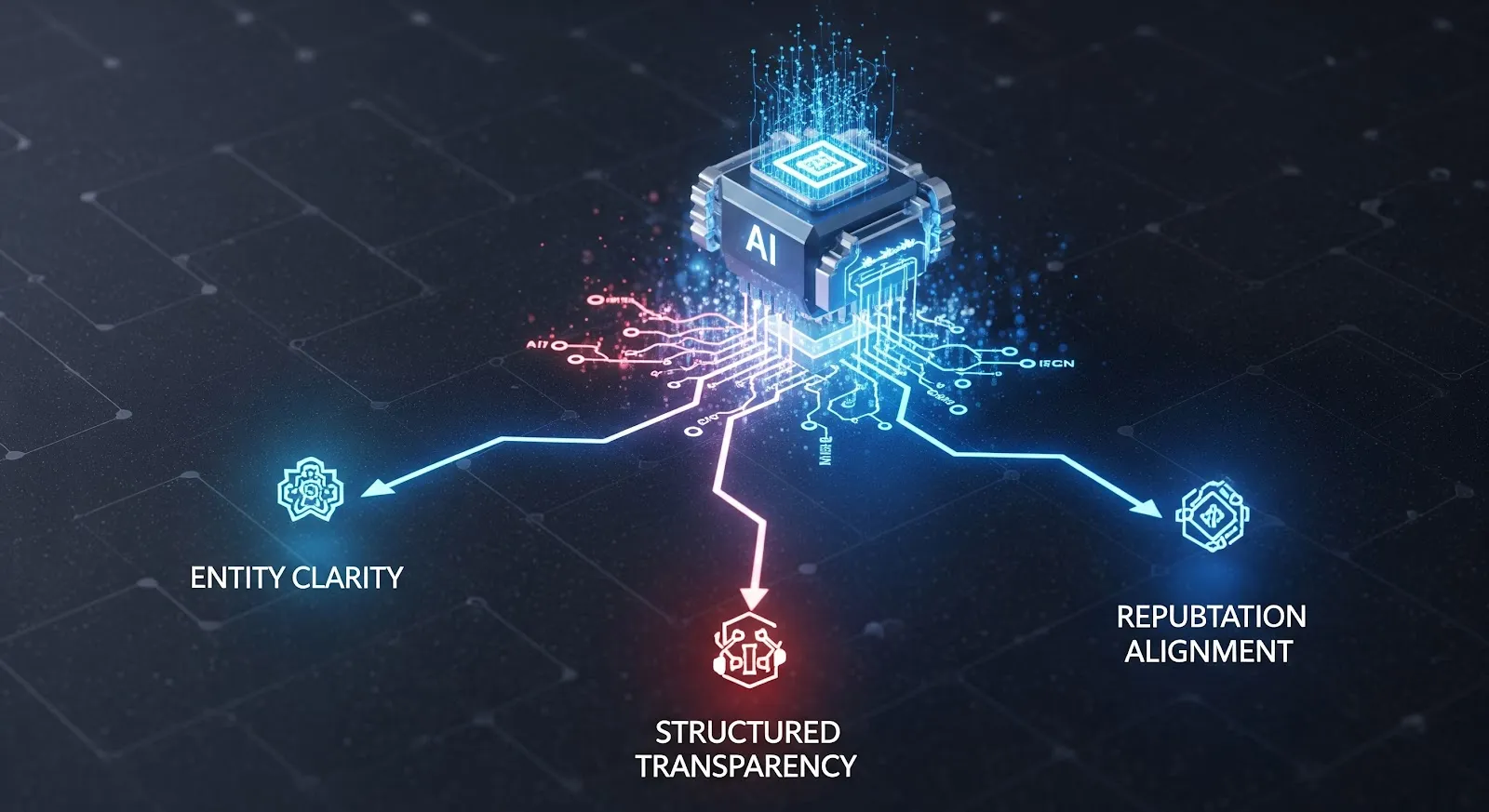
Engines like ChatGPT and Perplexity do not select sources at random. They rely on data quality, factual clarity and contextual authority, citing what they can understand, verify and trust. Their selection depends on three signals:
- Entity clarity: your brand, products and experts must be clearly defined and consistently described across the web.
- Structured transparency: schema markup, author profiles and source links make your content readable by machines.
- Reputation alignment: AI weighs credibility from reviews, backlinks, news coverage and references from authoritative sites.
In effect, AI engines behave like professional editors, prioritising sources that are clear, verifiable and consistently credible. They increasingly evaluate cross-source consensus, whether similar facts about your brand appear consistently across independent sources, and they favour content that minimises ambiguity, so brands with clear positioning and distinct terminology are retrieved and cited more accurately. This builds on becoming an authoritative entity for AI engines.
ChatGPT and Perplexity do not cite the same way, so getting cited is two jobs, not one.
- ChatGPT leans on reference sources: Wikipedia is its most-cited domain, about 7.8% of all citations and roughly 48% of its top-source share (Profound, 680 million citations, 2025).
- Perplexity leans on community: Reddit is about 6.6% of its citations and roughly 47% of its top-source share (Profound, 2025).
- Perplexity also cites far more per answer, about 22 sources against ChatGPT's 8 (Qwairy, 118,101 answers, 2025).
Earn reference-grade credibility for ChatGPT, and genuine community and review presence for Perplexity.
What content gets cited most often.
AI prefers content that directly answers questions. The more structured, factual and contextually complete your text, the more extractable it becomes. That includes concise explanations that answer a query in one paragraph, well-formatted sections with subheadings and logical flow, and supported claims with cited sources or original data. Blogs, FAQs, research reports and product explainers with clear headings are ideal. Keyword stuffing does not help; AI favours semantic relevance, the overall clarity and completeness of the idea. It typically extracts self-contained answer blocks that fully resolve a question, and it shows a growing preference for comparative and decision-support content such as best, versus and how to choose. For more, see what kind of content AI prefers to cite.
Both reward extractable substance.
- In a controlled study, adding citations, quotations or statistics each lifted a page's visibility in AI answers by about 30% to 40%, and up to 115% for pages that did not already rank well (Princeton GEO study, 10,000 queries, 2024).
- 44% of ChatGPT's citations come from the first third of a page, so put the answer near the top (Kevin Indig, 1.2 million responses, 2026).
- Among cited blog posts, 72% opened with a 40 to 60 word answer and 52% included original or owned data (Adam Gnuse, ~7,500 sessions, 2025).
How to start earning AI citations.
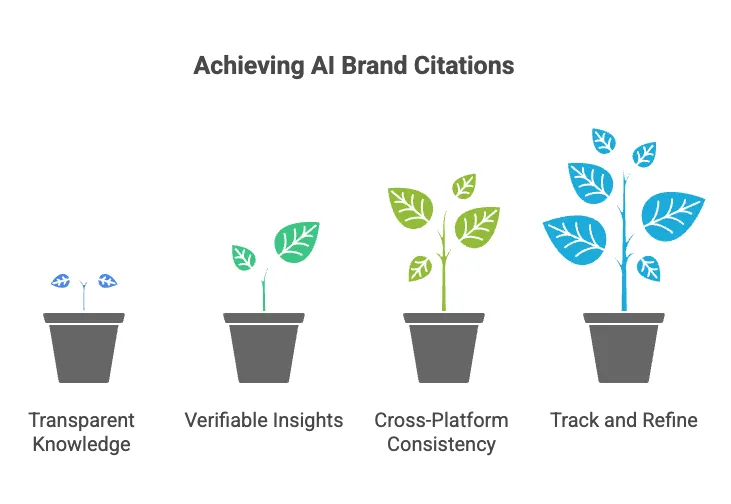
To have ChatGPT or Perplexity quote your site, optimise for machine comprehension and factual integrity:
- Create a transparent knowledge layer: add schema markup, FAQ sections and internal linking to your top content.
- Publish verifiable insights: include original research, statistics or case studies AI engines can confidently cite.
- Ensure cross-platform consistency: keep your brand name, tagline and descriptions uniform across profiles, encyclopaedias and company bios.
- Track and refine: identify which prompts already surface your brand and where new opportunities exist. See how to track AI citations and their impact.
Focus on prompt-level optimisation, aligning your content with how AI retrieves information, and develop topic clusters rather than isolated pages to reinforce authority across related queries. Incorporate fresh, verifiable data points where possible, since measurable insights improve confidence in the generated response.
Being on page one is not the entry ticket. About 62% of AI citations point to pages ranked below the top 10 (Ahrefs, 863,000 keywords, 2026). ChatGPT search retrieves candidates through Bing's index while Perplexity crawls with its own bot and weights freshness, so being indexed, fast and current matters as much as ranking.
Do it on the merits: since 15 May 2026 Google treats manufactured citations as spam (Search Engine Land, 2026), which is why Growth.pro's PAVA framework builds real Presence and Authority rather than gaming the answer.
Why brands should act now.
AI engines expand their data models continuously, learning which sources to trust, and early movers are already shaping that trust network. If your competitors are cited today, their advantage compounds with every model update, because AI systems show reinforcement behaviour: once a source is repeatedly cited it becomes a preferred reference, and displacing it later requires significantly stronger signals, which is the case for starting AEO and GEO sooner rather than later. To be cited by ChatGPT or Perplexity, your brand must speak the language of machines, structured data, consistent facts and credible expertise. In the new search era, the most readable brands become the most visible ones, and citation success is not about publishing more content but publishing more usable content, where clarity, structure and trust outweigh volume.
Questions about getting cited in ChatGPT and Perplexity.
Do I need to rank on Google's first page to get cited by ChatGPT or Perplexity?
No. About 62% of AI citations point to pages ranked below the top 10 (Ahrefs, 863,000 keywords, 2026). Being indexed, current and answer-first matters more than ranking first, since ChatGPT retrieves through Bing and Perplexity uses its own fresh index.
Why does Perplexity cite my site but ChatGPT never does, or the reverse?
How does ChatGPT actually choose which sources to cite?
ChatGPT search finds candidate pages through Bing's index, then favours clear, answer-first passages; about 44% of its citations come from the first third of a page (Kevin Indig, 1.2 million responses, 2026). Lead with the answer, backed by data.
Does Reddit or Wikipedia presence really help, and how do I earn it ethically?
Yes, both are heavily cited, but you earn them, not buy them. Contribute useful, accurate material and meet each platform's notability and community rules; manufactured presence now risks being treated as spam (Search Engine Land, 2026).
See where you are already cited, and where you are not.
Zicy tracks your mentions and citations across ChatGPT, Gemini, Perplexity, Google AI Overviews and Google AI Mode.
