What new KPIs replace traditional SEO metrics in the age of AI search?
In AI search, click-based SEO metrics no longer capture performance. The new KPIs measure influence at the answer level: AI citation volume, brand mention share, entity accuracy, positioning within answers, and citation-to-lead correlation. Zicy tracks these across ChatGPT, Gemini, Perplexity, Google AI Overviews and Google AI Mode, turning zero-click AI visibility into a measurable signal.
For years, marketers measured SEO success through rankings, traffic and conversions. But with Google AI Overviews, Google AI Mode, ChatGPT, Gemini and Perplexity shaping how users get answers, those metrics no longer tell the full story. Visibility is no longer about clicks. It is about citations, mentions and share of conversation, which calls for a new set of KPIs. This is the transition from performance visibility, what users click, to perception visibility, what users believe based on AI answers, a fundamentally different measurement paradigm. It builds directly on answer engine optimisation.
Why traditional SEO metrics are no longer enough.
Search results have evolved from lists of links to direct answers, which introduces three challenges:
- Zero-click behaviour: users often get what they need from AI answers without visiting your site.
- Opaque attribution: you may influence buyer decisions without seeing traffic spikes in analytics.
- AI-mediated discovery: visibility now depends on whether AI systems reference you, not whether Google ranks you.
Click-through rate and keyword rankings alone can no longer measure success. Traditional metrics operate at the page level, while AI visibility operates at the answer or snippet level, so high-ranking pages may still have low AI visibility. AI visibility needs metrics that measure influence, authority and representation even when clicks do not occur.
The old scoreboard is going dark.
- With an AI summary present, users click a result in only 8% of searches, against 15% without one, and just 1% click a link inside the summary (Pew Research Center, 900 US adults, 2025).
- Ranking is decoupling from citation: only 38% of AI Overview citations now come from the top 10 results, down from 76% a year earlier (Ahrefs, 863,000 keywords, 2026).
- Visibility is volatile: a brand can appear in 86% of tracked answers one period and 14% the next (Similarweb, 2025).
Rankings, clicks and impressions still exist, but they no longer describe how buyers find you.
The KPIs that define AEO and GEO performance.
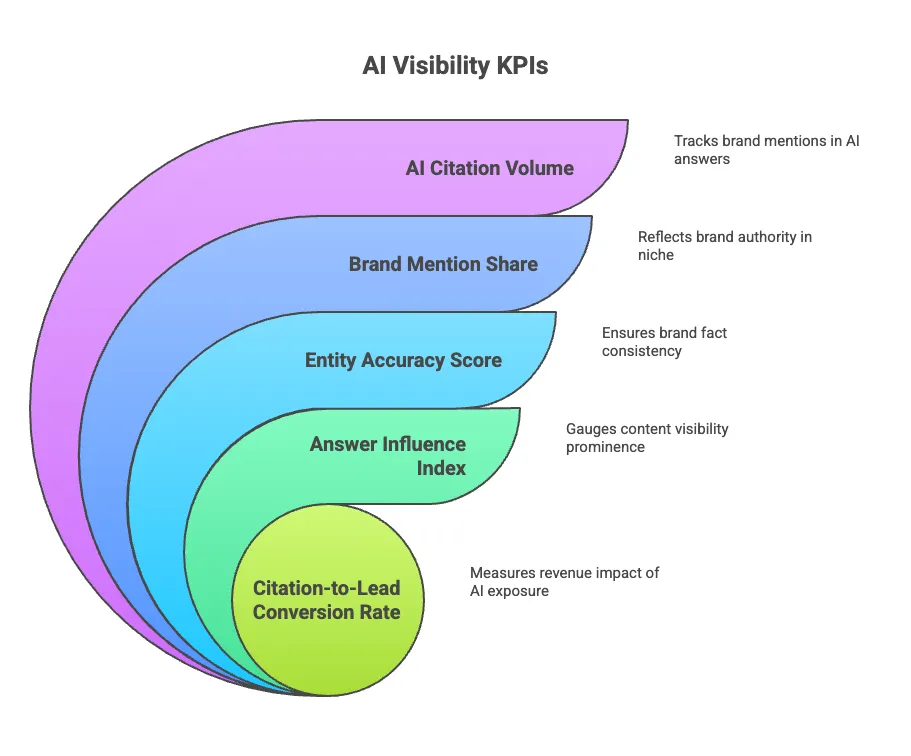
The next-generation measurement stack for AI-era visibility includes:
- AI citation volume: how often your domain or brand is cited in AI answers, the new organic impression. See how to track AI citations and their impact.
- Brand mention share, or share of voice: how often your brand appears in generative responses versus competitors, a proxy for authority in your niche.
- Entity accuracy: how consistently AI engines represent your brand facts, such as industry, services and location.
- Answer influence, weighted by prominence: your content's visibility in AI outputs, giving more weight to a top answer than a supporting mention.
- Citation-to-lead correlation: how AI-driven exposure aligns with inbound inquiries or signups, the bridge between awareness and revenue.
Many teams also add prompt coverage rate, average AI positioning within answers, and citation consistency across repeated prompts over time. Collectively these shift focus from traffic to trust-based influence, measuring how your brand shapes digital conversations rather than just appearing in them.
Measure presence in the answer, not position in a list. The metrics that matter now:
- Mention coverage: the share of tracked prompts that name you.
- Citation rate: the share that link you as a source.
- AI share of voice: your mentions against the competitor set.
- Average AI ranking: where you appear when named.
- AI-referred traffic and its conversion: the downstream signal.
Google is catching up: Search Console added generative AI performance reports in June 2026, though it still reports impressions more clearly than clicks (Google Search Console, 2026).
How to report AI visibility to leadership.
For executives and boards, the challenge is not data but clarity. To communicate AEO and GEO performance, combine qualitative and quantitative insights, pairing citation metrics with narrative context such as the specific summaries your brand is now referenced in. Visualise longitudinal growth to show how citations compound even when click volume plateaus, and align AI KPIs with the traditional funnel by mapping AI-driven awareness to trust to lead conversion. Many teams combine several KPIs into a single composite visibility index that is easy for executives to read. Reframing reports around influence and brand equity shows that AEO is not replacing SEO but evolving it. The guide on presenting AEO and GEO performance in C-suite reports goes further.
How these KPIs connect to business outcomes.
Unlike traditional SEO, which rewards visibility through position, AEO rewards visibility through credibility. When AI engines repeatedly mention or cite your brand, they effectively become advocates for your expertise, which over time improves lead trust and conversion efficiency, perceived market leadership, and lower dependency on paid reach. AI visibility also supports demand generation efficiency, since users exposed to trusted recommendations convert with less friction, and brands with strong AI presence tend to see higher-quality inbound leads that arrive with pre-established trust. Tracking these KPIs helps teams quantify intangible assets, reputation, recall and influence, that now drive commercial value. SEO used to measure visibility through clicks; AEO measures authority through citations, and the brands that track both see not just traffic but trust at scale.
These map to money because AI-referred visitors behave better. They stayed 41% longer, viewed 12% more pages and bounced 23% less than other visitors, and their conversion gap narrowed from 43% below other traffic to just 9% in seven months (Adobe Analytics, 2025).
Measure it continuously and honestly. Manufacturing mentions is now treated as spam (Search Engine Land, 2026), and citations shift day to day, so trends beat snapshots. This is the measurement layer of Growth.pro's PAVA framework.
Questions about AI search KPIs.
What metrics should replace keyword rankings for measuring AI search?
Track presence in the answer, not position in a list: mention coverage, citation rate, AI share of voice, average AI ranking, and AI-referred traffic with its conversion. These describe whether AI names, cites and recommends you, which rankings no longer predict (Ahrefs, 863,000 keywords, 2026).
Why does my brand appear in AI answers one day and vanish the next?
Because AI citations are volatile. A brand can appear in 86% of tracked answers one period and 14% the next (Similarweb, 2025). Measure continuously across a fixed prompt set and read the trend, not a single snapshot.
Does AI referral traffic actually convert?
Increasingly, yes. AI-referred visitors stayed 41% longer and viewed 12% more pages, and their conversion gap versus other traffic narrowed from 43% to just 9% in seven months (Adobe Analytics, 2025). Measure your own cohorts to confirm.
Can Google Search Console show my AI search performance?
Partly. Search Console added generative AI performance reports in June 2026, breaking out impressions for AI Overviews and AI Mode, though clicks are still bundled into the main report (Google Search Console, 2026).
Measure influence, not just clicks.
Zicy reports AI citations, mention share, positioning and entity accuracy across ChatGPT, Gemini, Perplexity, Google AI Overviews and Google AI Mode.
