The platform where a Malaysian aesthetic clinic has its lowest AI coverage is also the one that sent 13,225 sessions and 221 recorded purchases, and no blended visibility score would have told you that.
Every AEO conversation hits the same objection: does any of this sell anything? Mentions are easy to screenshot and hard to take to a finance director, so we tracked one clinic brand from the prompt to the purchase.
Rankings do not show who gets recommended
Search used to be measured in rankings, clicks and traffic. AI adds a second layer: whether you are mentioned and cited, how much of the answer you own, what sentiment surrounds you, and how all of it moves prompt by prompt.
A patient asking an AI engine which clinic to trust for a treatment gets a short list. A rankings report cannot tell you who is on it.
What we did
We tracked treatment queries, concern queries and clinic-selection queries across five AI platforms, to see where the clinic already led and where competitors still won.
We reworked treatment pages so AI engines could extract them more easily, with clearer direct answers and sharper entity signals on the pages that matter.
Prompts with weak coverage went to the top of the content queue, and prompts where the clinic already led got reinforced.
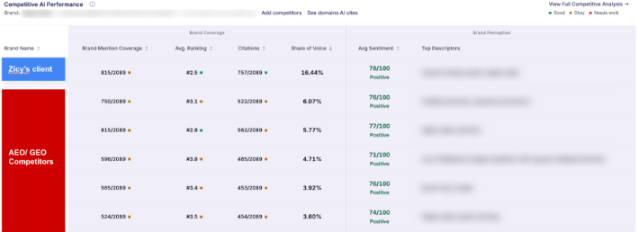
We benchmarked against the top five competing brands on mentions, citations, average ranking and share of voice, so a gain had to show up as market position.
Last, we followed the visibility into outcomes: referral sessions from ChatGPT, Gemini and Perplexity, then engagement, then purchases.
The numbers
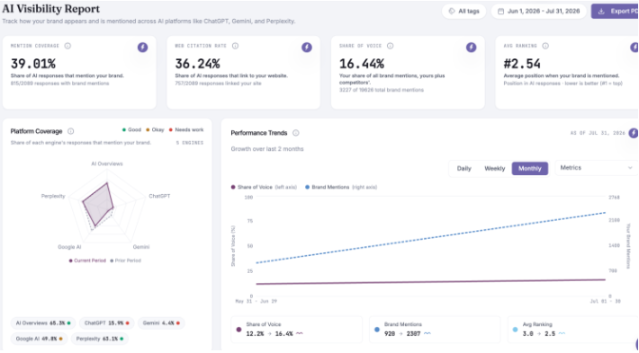
- 39.01% brand mention coverage
- 36.24% web citation rate
- 16.44% share of voice
- #2.54 average AI ranking
- 78/100 positive sentiment
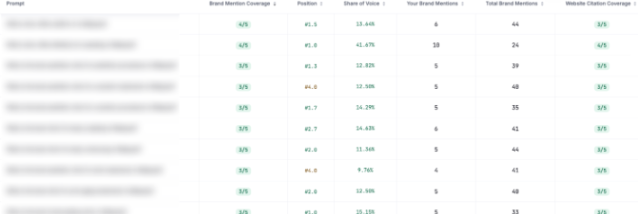
The gains were spread across prompts. Several important ones reached 3/5 or 4/5 platform coverage, the best hit 41.67% share of voice, and several averaged a position between #1 and #2.
Against the five competing brands in the same report, the clinic holds 16.44% share of voice and the next brand holds 6.07%, so the gap is roughly 2.7 times.
What moved in two months
Across the two-month window in the report, share of voice went from 12.2% to 16.4%, brand mentions from 920 to 2,307, and average position from 3.0 to 2.5. Share of voice alone can flatter you, so the useful part is that position improved while mentions more than doubled.
Purchases grew faster than traffic
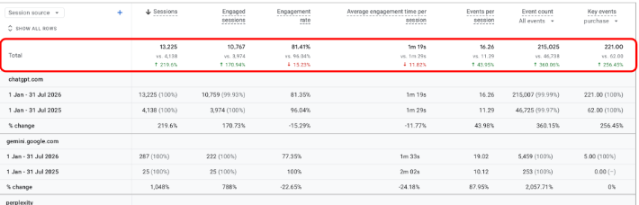
ChatGPT alone sent 13,225 sessions, up 219.6% year on year, with 10,767 engaged sessions, up 170.94%. Gemini went from 25 sessions to 287 and Perplexity from 48 to 120.
Purchases went from 62 to 221, up 256.45%, a faster rise than the sessions behind them. GA4 recorded those 221 on ChatGPT sessions, and for a B2C clinic that is a revenue line.
Engagement rate fell
Engagement rate on ChatGPT referrals fell from 96.04% a year ago to 81.35%. Volume more than tripled and the audience widened, which is the likely reason, though the data does not prove it. We would rather show you that row than crop it.
That makes engagement quality something to watch as AI referral volume continues to grow.
Coverage was lowest on the engine that sent the most sessions
ChatGPT is where this clinic has its weakest coverage, at 15.9%, against 65.3% on AI Overviews and 63.1% on Perplexity. It also sends the most sessions: 13,225 against 120 from Perplexity.
The engine with the weakest coverage is the one sending the customers. A blended score of 39% hides a platform at 16% that carries the commercial weight, and fixing the strongest numbers first would have pointed the budget the wrong way.
Two limits apply. AI Overviews and Google AI Mode cannot appear in a GA4 referral table because that traffic resolves to Google organic. Their low session counts say nothing about their value, so the clean comparison is ChatGPT against Perplexity. The visibility report covers 1 June to 31 July 2026, while the GA4 comparison runs 1 January to 31 July 2026 against the same dates in 2025. The two moved together, and that does not prove one caused the other.
Measure each engine separately
A blended AI visibility score would not have shown any of this. Tracking each platform down to the individual prompt did.
Which of your AI engines is sending you customers, and do you know how it describes you?
