Key Takeaways
- AEO reporting shifts from activity metrics to influence metrics.
- Executives care about brand presence, authority, and business impact.
- Prompt-level coverage reveals commercial relevance of visibility.
- AI Share of Voice reflects competitive positioning in generative search.
- Reports must connect visibility to real business outcomes.
- Visual storytelling improves executive understanding and buy-in.
- AEO dashboards position marketing as a strategic growth function.
Introduction
Marketing leaders have entered a new era of reporting.
Traditional SEO dashboards focused on rankings, impressions, and clicks. But in the AI visibility era, executives want to know something different: How often is our brand being mentioned by AI engines — and how does that translate to influence and revenue?
That’s the story AEO (Answer Engine Optimization) and GEO (Generative Engine Optimization) reporting needs to tell — one that connects visibility, credibility, and commercial impact.
At the executive level, this shift represents a move from activity-based reporting to influence-based reporting, where the focus is not on what users did, but on how your brand shapes decisions before they act.
Why C-suite audiences need a new reporting framework?
Boards and executive committees don’t speak in CTRs and bounce rates — they speak in ROI, brand equity, and competitive advantage. That’s why AEO reporting must focus on strategic translation rather than technical detail.
C-suites need to see:
- Brand Presence: How often AI systems mention or cite your organization.
- Brand Authority: Whether your content is recognized as credible by AI platforms.
- Business Impact: How that visibility supports lead generation, partnerships, or reputation growth.
This framework reframes marketing from “traffic generation” to brand representation in the intelligence economy.
Executives are increasingly interested in market influence signals or indicators that show whether the brand is shaping category narratives, not just participating in them.
AEO reporting also aligns closely with brand equity measurement, as repeated AI citations reinforce perception, trust, and top-of-mind awareness over time.
Read: What Does It Mean to Become an Authoritative Entity for AI Engines?
What metrics should your AEO/GEO report include?
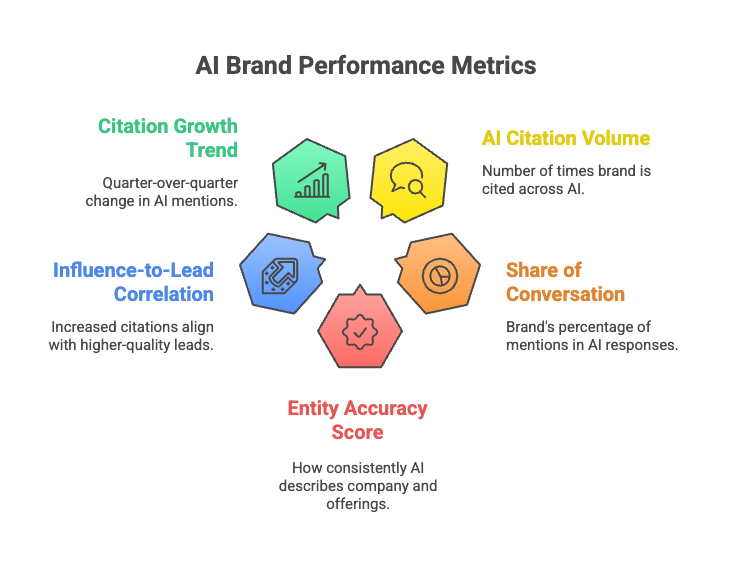
To resonate with executives, your dashboard should showcase influence over activity. Key metrics to include:
- AI Citation Volume – How many times your brand or domain is cited across ChatGPT, Gemini, and Perplexity. Learn: How to Track AI Citations and Measure Their Impact on Leads and Sales?
- Share of Conversation – Your brand’s percentage of mentions in AI responses within your category.
- Entity Accuracy Score – How consistently AI engines describe your company and offerings. Also read: What New KPIs Replace Traditional SEO Metrics in the Age of AI Search?
- Influence-to-Lead Correlation – Whether increased citations align with higher-quality leads or shorter sales cycles.
- Citation Growth Trend – Quarter-over-quarter change in AI mentions to demonstrate compounding visibility.
Each metric should connect to a tangible business outcome, not just a visibility indicator.
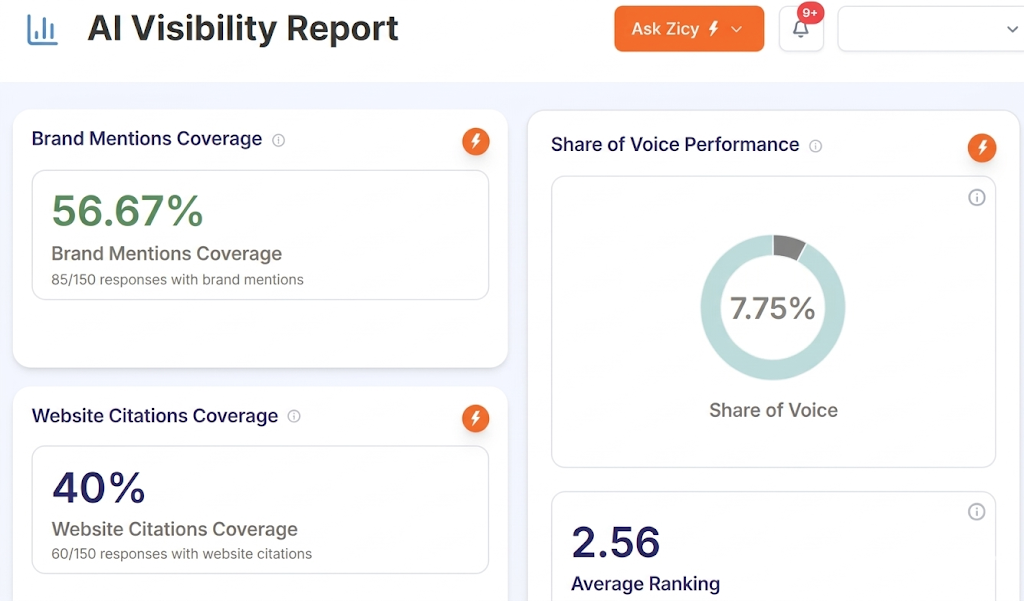
To deepen insights, include prompt-level coverage, showing which high-intent queries your brand appears in, as this directly reflects commercial relevance.
Another valuable metric is Average AI Positioning, indicating whether your brand is mentioned early or late within generated answers, which can influence user perception and recall.
Together, these metrics form a more complete view of AI Share of Voice, helping executives understand competitive positioning within generative ecosystems.

How to tell the AEO/GEO story effectively?
Data alone won’t move leadership — context will. Frame your report around a narrative arc executives can follow:
- Shift in Discovery: “Search is now answer-first. Our visibility depends on being cited by AI engines, not just ranked by Google.” Read about: How Will Google AI Overviews and ChatGPT Change SEO for My Business?
- Our Current Standing: “We’re currently mentioned X times per month in generative engines, appearing in Y% of relevant prompts.”
- Competitive Position: “Competitor A has a higher citation share, but our entity accuracy is stronger — showing better trust signals.” Learn: How to Benchmark Our AEO Readiness Against Competitors?
- Growth Plan: “We’ll expand structured data, improve authorship signals, and strengthen PR validation to increase AI recognition.” Read: Can PR, News Releases, and Wikidata Entries Improve AEO Visibility?
To strengthen impact, anchor the narrative in business outcomes, such as improved lead quality, shorter sales cycles, or increased brand recall, translating visibility into tangible value.
Including before-and-after snapshots (e.g., citation growth, improved entity accuracy) helps demonstrate progress and reinforces confidence in AEO investments.
This structure turns complex metrics into strategic insights, reinforcing marketing’s role as a business growth driver.
How to visualize AI performance in reports?
Executives absorb information best through simple, visual storytelling:
- Use line graphs to show citation growth over time.
- Compare AI visibility share vs. search traffic trends to highlight the paradigm shift.
- Add AI screenshots (e.g., ChatGPT or Gemini answers citing your brand) to humanize data.
- Include a “Brand Authority Index” summary — a single composite score combining citations, accuracy, and trust metrics.
Consider adding competitive comparison charts, showing your brand’s AI visibility alongside key competitors to highlight gains or gaps more clearly.
Another effective visual is a prompt coverage heatmap, indicating where your brand is strong or missing across different query types and funnel stages.
Over time, integrating these visuals into a single AEO dashboard view enables faster executive decision-making and clearer strategic alignment.
The goal is not just to show data, but to prove progress in perception.
Conclusion
The best C-suite reports don’t overwhelm — they persuade.
Ultimately, the goal of AEO reporting is not just to inform, but to influence strategic direction, positioning marketing as a driver of long-term competitive advantage in AI-led discovery.
Your AEO/GEO performance should tell a simple story: “Our brand isn’t just being found — it’s being trusted by the systems shaping tomorrow’s decisions.”