Key Takeaways
- PR acts as an external validation signal for AI systems.
- AI relies on cross-source consensus to confirm truth.
- Wikidata strengthens entity recognition and disambiguation.
- High-authority media mentions carry greater influence.
- Consistent external references reinforce entity identity.
- PR + structured data create compounding trust loops.
- Visibility in AI depends on being confirmed, not just published.
Introduction
In the traditional web, PR built reputation.
In the AI-driven web, PR builds recognition.
When your company appears in credible news sources or structured databases like Wikidata, it doesn’t just reach audiences — it signals to AI engines that your brand is verifiable and trustworthy.
That signal can dramatically improve your visibility in Answer Engine Optimization (AEO) and Generative Engine Optimization (GEO) results.
In many cases, external mentions act as independent validation signals, helping AI systems confirm that your brand’s claims are not self-published but widely acknowledged.
Why do AI engines rely on PR and external references?
AI systems like ChatGPT, Gemini, and Perplexity build their “worldview” from interconnected facts — and those facts come from trusted data sources.
While your website remains your primary authority, AI validates your claims by cross-referencing them with third-party mentions.
If multiple high-authority sites confirm the same information about your company, AI models reinforce it as the truth.
That’s why news coverage and credible references act as external validation loops.
A brand mentioned in reliable media is statistically more likely to be cited in AI answers because it already exists within the model’s verified data clusters.
This creates a consensus effect, where repeated confirmation across independent sources significantly increases AI confidence in your brand.
External references also help AI systems determine source hierarchy, prioritising information from domains with established authority and editorial standards.
Also read: What Does It Mean to Become an Authoritative Entity for AI Engines?
How do Wikidata entries strengthen AEO signals?
Wikidata — the structured database behind Wikipedia — plays a critical role in how AI engines interpret entities.
It’s one of the few open, machine-readable repositories of global facts.
When your brand has a verified Wikidata entry with accurate relationships (founder, headquarters, industry, website), AI can confidently identify your organization across different contexts.
That entry becomes a semantic anchor linking your brand to other recognized entities (partners, awards, products). For AEO, this helps prevent confusion and ensures that citations reference your brand — not a similarly named one.
Learn: Which Schemas and Entity Markups Are Most Critical for Brands?
Can traditional PR improve AEO visibility too?
Absolutely — but only when it’s digitally structured and verifiable.
Traditional press releases distributed via wire services still matter, but for AI visibility, the key is where and how they’re published:
- Focus on digital-first publications that are indexed by Google News and accessible to AI crawlers.
- Include structured data (NewsArticle schema) in your newsroom or blog posts.
- Link back to core brand and product pages to help AI connect topics to entities.
- Ensure consistent naming conventions (no variations of brand names, product titles, or company details).
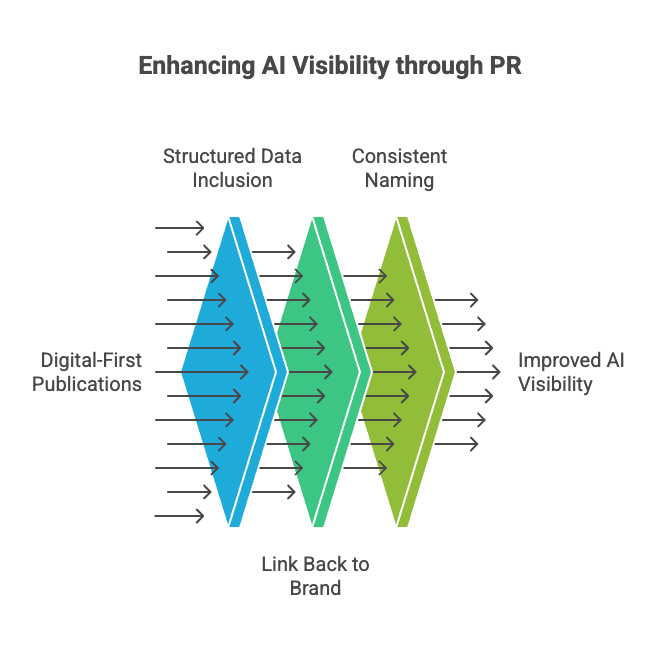
Each press mention essentially acts as a citation pathway that strengthens your brand’s data authority across AI systems.
The quality of publication also matters significantly, as mentions from high-trust editorial domains carry more weight than low-authority or syndicated content.
Consistency across press mentions reinforces entity signals, ensuring AI systems connect all references back to a single, unified brand identity.
How can brands combine PR, data, and AEO strategy effectively?
Think of PR and structured data as two sides of credibility:
- PR gives you visibility in trusted human media.
- Structured data gives you legibility in machine media.
When both align (verified news coverage linked to properly marked-up brand pages), you create a feedback loop that reinforces your authority in both human and AI search ecosystems.
This feedback loop strengthens what can be described as trust compounding, where each new validated mention increases the likelihood of future citations.
Over time, this alignment builds a stronger entity footprint, enabling your brand to appear across a wider range of queries and contexts.
This approach transforms publicity into permanence — AI doesn’t just see you; it remembers you.
Conclusion
PR builds awareness. Structured data builds proof. Together, they make your brand AI-recognizable, cite-worthy, and resilient across changing search landscapes.
Brands that integrate PR, structured data, and entity optimisation will create durable visibility advantages, as AI systems continue to prioritise validated, interconnected sources.
In the generative era, credibility isn’t claimed through keywords — it’s earned through confirmation.