What exactly is answer engine optimisation, and why does it matter for brands?
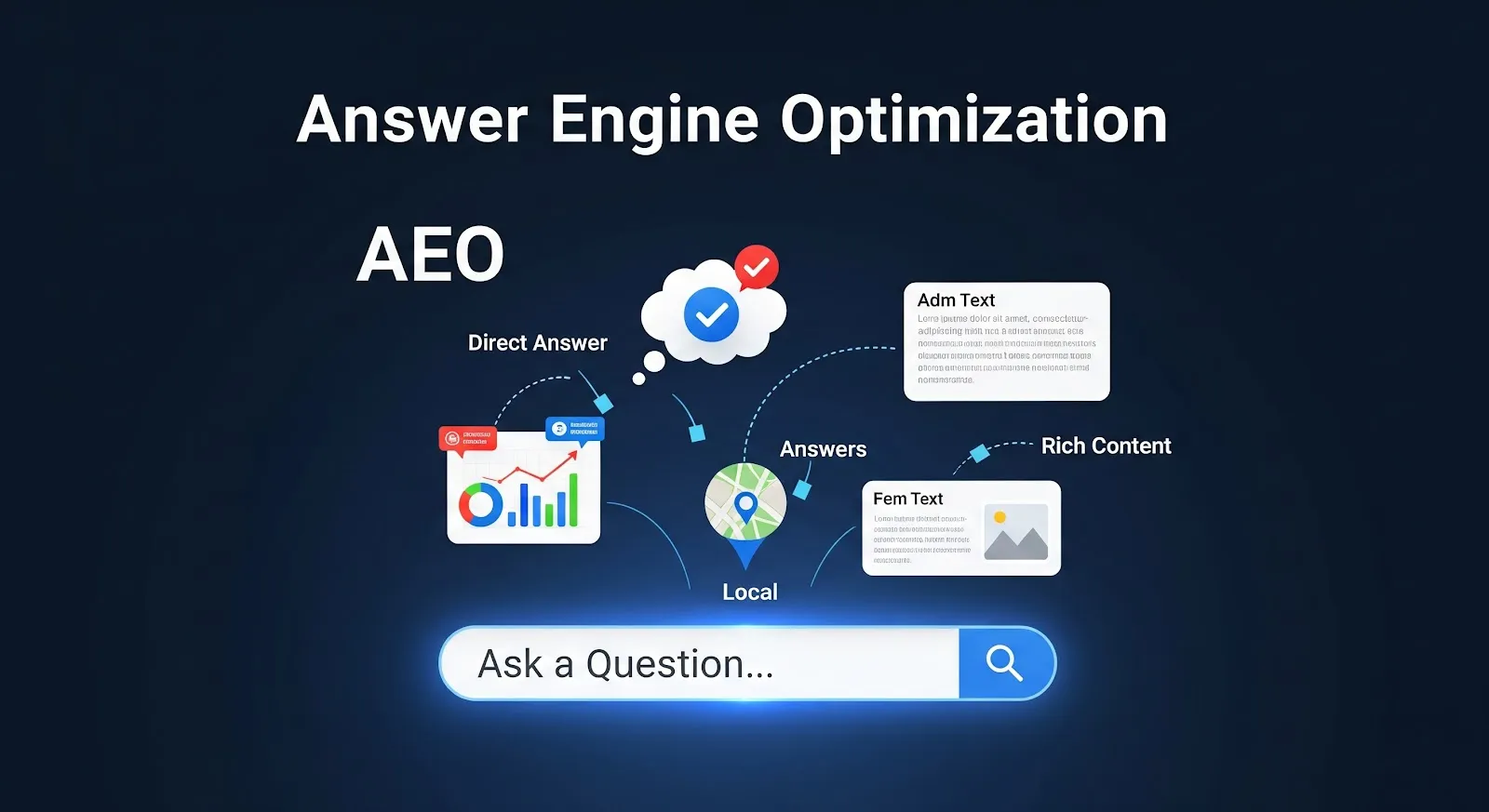
Answer engine optimisation (AEO) is the practice of structuring a brand's content, entity data and technical signals so AI systems can understand, extract and cite it when they answer questions. Where SEO earns rankings, AEO earns citations inside AI answers across ChatGPT, Gemini, Perplexity, Google AI Overviews and Google AI Mode. Zicy measures where a brand is cited.
The short version.
- AI answers are now often the first touchpoint, not just a search feature.
- Visibility is shifting from ranking pages to being cited in answers.
- AEO rewards snippet clarity, not just page authority.
- Content works best when designed for extraction, not just reading.
- Metrics are moving from traffic to AI mentions, coverage and share of voice.
- Zero-click visibility still carries real brand and revenue impact.
- AEO does not replace SEO. The two work together.
From ten blue links to answers.
Search is no longer only about ten blue links. From Google AI Overviews to ChatGPT and Perplexity, users now expect direct, summarised responses rather than lists of websites. That shift gave rise to answer engine optimisation: the discipline of helping AI systems understand, extract and cite your brand when they answer user questions. For CMOs and brand strategists, AEO is becoming as important as SEO once was. AI-generated responses are increasingly the first interaction layer rather than an assistive feature, and in many discovery journeys users form a brand perception before ever visiting a website. Visibility in AI answers now influences consideration, not just awareness.
What answer engine optimisation really means.
AEO focuses on optimising your content so AI models can easily interpret and quote it. Unlike traditional SEO, which targets keyword rankings, AEO makes a brand's information readable, factual and structured enough for AI systems to use in their generated responses. Engines like Gemini, ChatGPT and Perplexity rely on factual snippets from high-authority sources. They do not just index pages, they synthesise knowledge, so well-structured, verified and semantically clear content increases the chance of being mentioned or cited.
You can think of AEO as teaching machines how to talk about you correctly, which means embracing schema markup, rich entities and clear author credibility, the language AI engines use to connect information. In practical terms, AI systems break a query into many sub-questions, often ten to twenty variations, and retrieve short, high-confidence snippets across sources. Content that is dense, precise and contextually complete within small sections, typically 100 to 300 words, is significantly more likely to be extracted and cited.
The shift, in numbers.
The shift is already at scale, and it rewards citation over ranking.
- AI Overviews reached about 2 billion monthly users by mid 2025, and AI Mode passed 100 million (Google Q2 2025 earnings, via TechCrunch, 2025).
- Only 37.9% of AI Overview citations came from the top 10 organic results in early 2026, down from 76% six months earlier; roughly 62% now point to pages below position 10 (Ahrefs, 863,000 keyword SERPs, 2026).
- With an AI summary present, users click through to a site in only 8% of searches, against 15% without one, and just 1% click a link inside the summary (Pew Research Center, 68,879 US searches, 2025).
- A typical answer cites few sources: about three domains for AI Overviews, about seven for Google AI Mode (Semrush, 5,000 keywords, 2025).
A handful of sources shape the answer. Everyone else is invisible.
How AEO differs from traditional SEO.
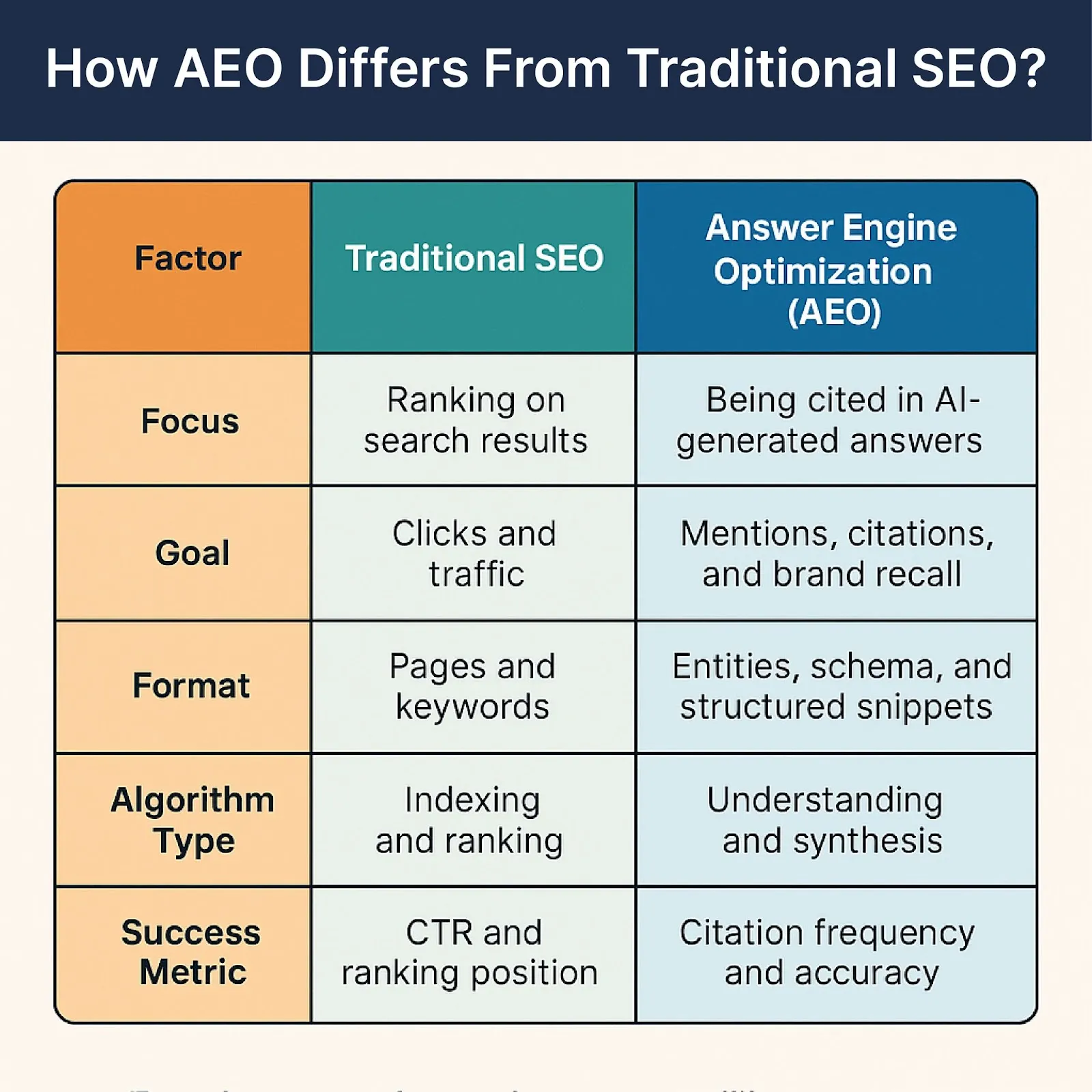
SEO and AEO share the same foundation of content quality, trust and authority, but they differ in intent and mechanics. SEO helps users find your site; AEO helps AI understand and explain it. The retrieval behaviour also differs: traditional SEO rewards page-level authority, while AEO rewards snippet-level clarity, so a single well-structured paragraph can outperform a whole high-ranking page if it answers a query more directly. In short, SEO earns traffic while AEO earns trusted visibility. You may not always get the click, but you can win the conversation.
A strong Google ranking no longer guarantees an AI citation. Overlap varies sharply by engine: AI Overviews share about 86% of cited domains with Google's top 10, but Google AI Mode overlaps on only about 54% of domains and 35% of exact URLs (Semrush, 5,000 keywords, 2025).
Ranking a page and getting it cited are related jobs, not the same job.
The core signals AI engines look for.
For content to earn citations, it generally needs to satisfy four signals:
- Clarity: each page answers a specific intent or question cleanly.
- Structure: schema, headings, FAQs and data markup make it extractable.
- Credibility: author names, sources and linked references prove reliability.
- Relevance: current stats and updated facts keep it fresh.
Two further implicit signals appear to influence citations: consistency across sources, since brands described similarly across multiple platforms are more likely to be trusted and cited, and entity disambiguation, since clear differentiation from similarly named entities improves citation accuracy. Engines like Gemini or Perplexity do not rank so much as reason, so the clearer and more factual your data, the more confidently they cite it.
How AEO success is measured.
In AEO, performance metrics move beyond traditional analytics. Teams have started tracking:
- AI mentions and citations: how often your brand appears in AI-generated answers.
- Entity accuracy: how correctly AI models describe your brand, products or services.
- Citation share against competitors: the proportion of visibility your brand holds in generative results.
- Zero-click brand lift: growth in brand searches after AI mentions.
- Answer conversion ratio: leads or inquiries correlated with AI-generated exposure.
- Average AI rank per prompt, prompt coverage across high-intent queries, and whether your brand appears in top summaries or only deeper explanations.
These metrics move AEO from a theoretical concept to a measurable performance discipline. The companion guides on tracking AI citations and their impact and the KPIs that matter in AI search go deeper.
Why this shift matters for modern brands.
The stakes are higher than visibility. They are about representation. AI answer engines shape what people believe, buy and trust. If competitors are cited by AI models and your brand is not, you effectively disappear from the discovery phase of the customer journey. Citations inside AI responses are the new organic reach, driving AI visibility even when potential customers never visit your site. For decision-makers this changes how ROI is measured, from rankings and traffic to mentions, citations and brand recall.
There is also a zero-click influence loop. Even without a click, repeated exposure to a brand within AI answers increases branded searches, direct visits and conversion intent over time. Being cited builds implicit trust, since users assume the brands named in AI answers are authoritative, and that halo can influence perception and partnerships beyond search. Brands are no longer competing only for rankings, but for inclusion in a limited answer set where only a handful of sources are referenced per response.
How organisations can adapt.
Start by treating your website not as content storage but as a machine-readable knowledge base, so your expertise and product data are instantly usable by AI engines. Three strategic pivots help: structure for comprehension with schema, clear headings and concise explanations machines can parse; prove authority with author bios, sources and cross-domain citations; and measure visibility differently by tracking when and where your brand is mentioned or cited, the modern equivalent of backlinks. It also helps to treat content as retrieval assets rather than pages, designing each section to answer one intent fully, to stand alone when extracted, and to depend less on long narrative flow for meaning.
What changed in 2026.
One change reset the rules. On 15 May 2026 Google extended its spam policies to cover attempts to manipulate generative AI responses in AI Overviews and AI Mode (Search Engine Land, 2026).
The durable move is to make your expertise clear, accurate and easy for AI to verify, not to game the answer. That is the brand-side logic behind Growth.pro's PAVA framework: Presence, Authority, Visibility, Amplification.
How AEO and SEO work together.
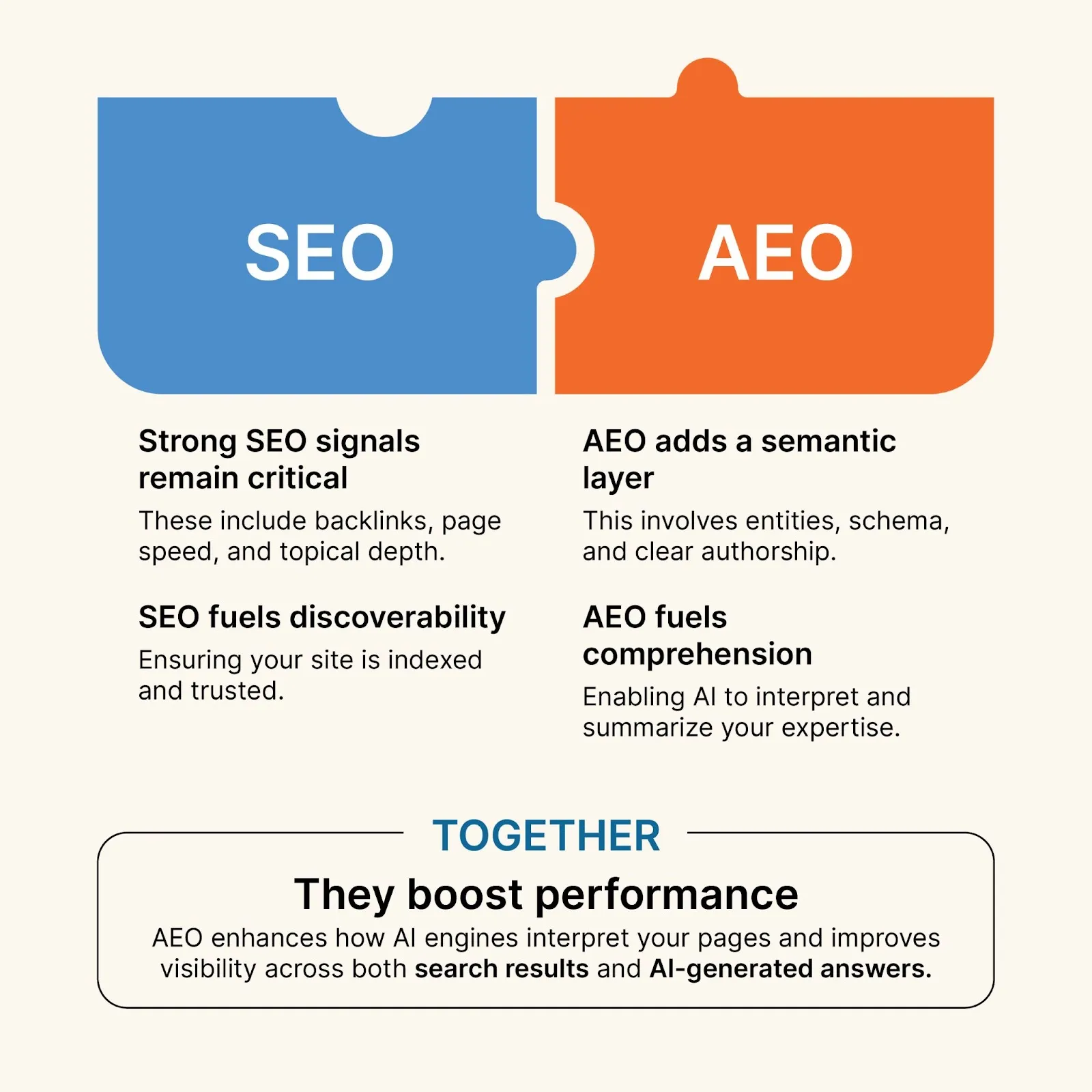
AEO does not replace SEO, it evolves it. Strong SEO signals such as backlinks, page speed and topical depth remain critical, but AEO adds a semantic layer that helps AI engines understand what your pages mean, not just what they say. SEO fuels discoverability, ensuring your site is indexed and trusted, while AEO fuels comprehension, enabling AI to interpret and summarise your expertise. Together they build answer-level authority, where your brand appears consistently across both search results and AI-generated content. AEO is, in essence, brand communication for machines: the more precisely your content speaks their language, the more confidently AI speaks about you.
Questions about answer engine optimisation.
Is answer engine optimisation the same as SEO?
No. SEO helps people find your site in a list of results; AEO helps AI systems understand, extract and cite your content inside a generated answer. They share foundations like content quality and trust, but AEO rewards snippet-level clarity and entity consistency rather than page-level ranking alone.
Do I need to rank on page one of Google to be cited by AI?
No. Roughly 62% of AI Overview citations point to pages ranked below the top 10, and only about 38% come from the top 10 (Ahrefs, 863,000 keyword SERPs, 2026). Clear, extractable, well-attributed content can be cited even when it does not rank first.
Which AI engines should I optimise for?
The five that decide most answers today are ChatGPT, Gemini, Perplexity, Google AI Overviews and Google AI Mode. Citation patterns differ across them, so track all five rather than optimising for one.
Can I be penalised for optimising for AI answers?
You can. Since 15 May 2026 Google treats manipulating generative AI responses as spam (Search Engine Land, 2026). Optimising through clarity, accuracy and demonstrable expertise is safe; manufacturing signals is not.
The rest of the AEO guide series.
- benchmark your AEO readiness against competitors
- track AI citations and measure their impact
- present AEO and GEO performance to stakeholders
- choose the KPIs that matter in AI search
- use PR and Wikidata to strengthen AI visibility
- optimise bilingual websites for AI citations
- prepare your website for Google AI Overviews
- become an authoritative entity for AI engines
- build the trust signals AI recognises
- understand the content AI prefers to cite
- get cited in ChatGPT and Perplexity
- add the schema and entity markup that matter most
- see examples of companies already succeeding with AEO and GEO
- find out whether AI engines can recommend your products
- weigh whether to invest in AEO and GEO now or wait
- understand how Google AI Overviews and ChatGPT change SEO
- find which industries generative search affects most
See where AI cites your brand, and where it does not.
Zicy measures your citations and mentions across ChatGPT, Gemini, Perplexity, Google AI Overviews and Google AI Mode.