Key Takeaways
- Measurement is shifting from clicks to perception and influence.
- Traditional metrics miss AI-driven, zero-click visibility.
- AEO KPIs operate at the answer level, not just the page level.
- New metrics include prompt coverage, positioning, and consistency.
- Composite indices simplify executive reporting and decision-making.
- AI visibility improves lead quality and conversion efficiency.
- The future of measurement is dual-layer: traffic + influence.
Introduction
For years, marketers measured SEO success through rankings, traffic, and conversions.
But with Google AI Overviews, ChatGPT, Gemini, and Perplexity shaping how users get answers, these metrics no longer tell the full story.
In the AI-driven landscape, visibility is not about clicks. It’s about citations, mentions, and the share of conversation. That calls for a new set of KPIs to understand true brand performance in the generative search era.
This shift marks the transition from performance visibility (what users click) to perception visibility (what users believe based on AI answers), which is a fundamentally different measurement paradigm.
Why traditional SEO metrics are no longer enough?
Search results have evolved from lists of links to direct answers. This has introduced three major challenges for marketers:
- Zero-click behavior: Users often get what they need from AI-generated answers without visiting your site.
- Opaque attribution: You may influence buyer decisions without seeing traffic spikes in analytics.
- AI-mediated discovery: Visibility now depends on whether AI systems reference you — not whether Google ranks you.
As a result, CTR and keyword rankings alone can’t measure success anymore.
Another limitation is that traditional metrics operate at the page level, while AI visibility operates at the answer or snippet level, requiring a more granular approach to measurement.
This creates a disconnect where high-ranking pages may still have low AI visibility, highlighting the need for separate but complementary KPI systems.
Instead, AI visibility requires metrics that measure influence, authority, and representation — even when clicks don’t occur.
Read: What Is the ROI of Being Cited by AI Engines Compared to Ranking on Google?
What new KPIs define AEO and GEO performance?
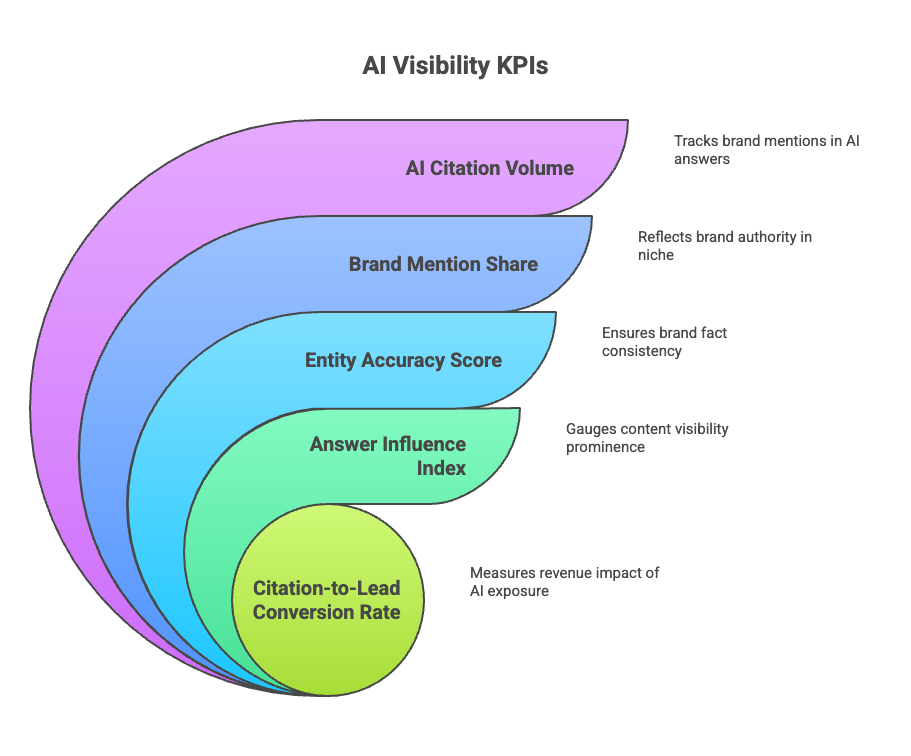
The next-generation measurement stack for AI-era visibility includes:
- AI Citation Volume: The number of times your domain or brand is cited in AI answers — the new “organic impression.” Also read: How to Track AI Citations and Measure Their Impact on Leads and Sales?
- Brand Mention Share (Share of Conversation): How often your brand appears in generative search responses versus competitors — a proxy for authority in your niche.
- Entity Accuracy Score: How consistently AI engines represent your brand facts (industry, services, location).
- Answer Influence Index: A measure of your content’s visibility in AI outputs weighted by prominence (top answer vs. supporting mention).
- Citation-to-Lead Conversion Rate: How AI-driven brand exposure correlates with inbound inquiries or signups — the new bridge between awareness and revenue.
To enhance this framework, many teams are introducing:
- Prompt Coverage Rate: Percentage of high-intent queries where your brand appears.
- Average AI Positioning: Placement of your brand within generated answers (early vs. late mention).
- Citation Consistency Score: Stability of your brand’s presence across repeated prompts over time.
Collectively, these KPIs shift focus from traffic to trust-based influence — measuring how your brand shapes digital conversations rather than just appearing in them.
How should businesses report on AI visibility to leadership?
For executives and boards, the challenge isn’t data — it’s clarity. To communicate AEO/GEO performance effectively:
- Combine qualitative and quantitative insights: Pair citation metrics with narrative context (e.g., “Our brand is now referenced in Gemini’s finance summaries”).
- Visualize longitudinal growth: Show how citations compound over time, even if click volume plateaus.
- Align AI KPIs with traditional funnels: Map AI-driven awareness → trust → lead conversion.
Leading organizations are also introducing composite indices (e.g., AEO Visibility Index) that combine multiple KPIs into a single, easy-to-understand score for executive reporting.
Also read about: How to Present AEO/GEO Performance in C-Suite Marketing Reports?
By reframing reports around influence and brand equity, you demonstrate that AEO isn’t replacing SEO — it’s evolving it.
How do these KPIs connect to business outcomes?
Unlike traditional SEO, which rewards visibility through position, AEO rewards visibility through credibility.
When AI engines repeatedly mention or cite your brand, they effectively become advocates for your expertise. Over time, this improves:
- Lead trust and conversion efficiency.
- Perceived market leadership.
- Lower dependency on paid reach.
AI visibility also contributes to demand generation efficiency, as users exposed to trusted recommendations are more likely to convert with less friction.
Over time, brands with strong AI presence may see higher quality inbound leads, as prospects arrive with pre-established trust and understanding.
Tracking these KPIs helps teams quantify intangible assets — reputation, recall, and influence — that now drive real commercial value.
Read: What Are Examples of Companies Already Succeeding with AEO/GEO?
Conclusion
SEO used to measure visibility through clicks.
AEO measures authority through citations.
The brands that track both will not only see traffic — they’ll see trust at scale.
In the long run, the most valuable brands will be those that can measure and optimise both visibility and influence simultaneously, bridging the gap between discovery and decision-making.