Key Takeaways
- AI visibility requires decoupling measurement from traffic.
- Not all citations are equal — position and prominence matter.
- Tracking should be based on prompt clusters, not single queries.
- Prompt libraries ensure consistent and reliable benchmarking.
- New metrics include coverage, position, and consistency.
- Stable visibility is more valuable than sporadic spikes.
- The goal is to measure influence across the buyer journey.
Introduction
In traditional SEO, tracking performance is straightforward: rankings, clicks, and conversions.
But in Answer Engine Optimization (AEO) and Generative Engine Optimization (GEO), visibility looks different.
Your brand may be mentioned or cited by ChatGPT, Google Gemini, or Perplexity — even when users never visit your site.
The challenge for marketing leaders is clear: how do we measure the ROI of visibility that doesn’t always generate clicks?
This introduces a new measurement challenge: decoupling visibility from traffic, where influence can occur without any measurable session or referral.
What exactly is an AI citation — and why does it matter?
An AI citation occurs when a generative engine references your brand, domain, or content as part of an answer. It might show as a hyperlink (e.g., “Source: yourdomain.com”) or as an unlinked brand mention embedded in a synthesized paragraph.
Both forms matter because they influence:
- Brand recall: users associate your name with trusted, fact-based answers.
- Reputation: being cited signals credibility to both users and search algorithms.
- Lead quality: cited brands attract higher-intent prospects who already trust them.
In short, AI citations are the new backlinks — not driving traffic directly, but building authority indirectly.
Not all citations are equal. Mentions that appear earlier in an answer or within primary summaries tend to carry more influence than those buried deeper in supporting text.
Over time, repeated citations across different queries contribute to entity reinforcement, strengthening how AI systems recognise and prioritise your brand.
Read more about: What Is the ROI of Being Cited by AI Engines Compared to Ranking on Google?
How can you track when AI engines mention your brand?
Unlike search rankings, AI citations aren’t indexed in public reports — so you’ll need a multi-layer monitoring approach:
- AI query monitoring: Run recurring prompts on ChatGPT, Perplexity, and Gemini using your target “money questions.” Track which brands appear in generated answers. Also read: How to Benchmark Your AEO Readiness Against Competitors?
- Custom dashboards: Use analytics tools that crawl AI-generated summaries and store responses over time.
- Brand alert systems: Set up tracking for your company name and domain mentions across AI-powered aggregators.
- Manual sampling: For niche queries, periodically test your most important search prompts to see if you appear in citations.
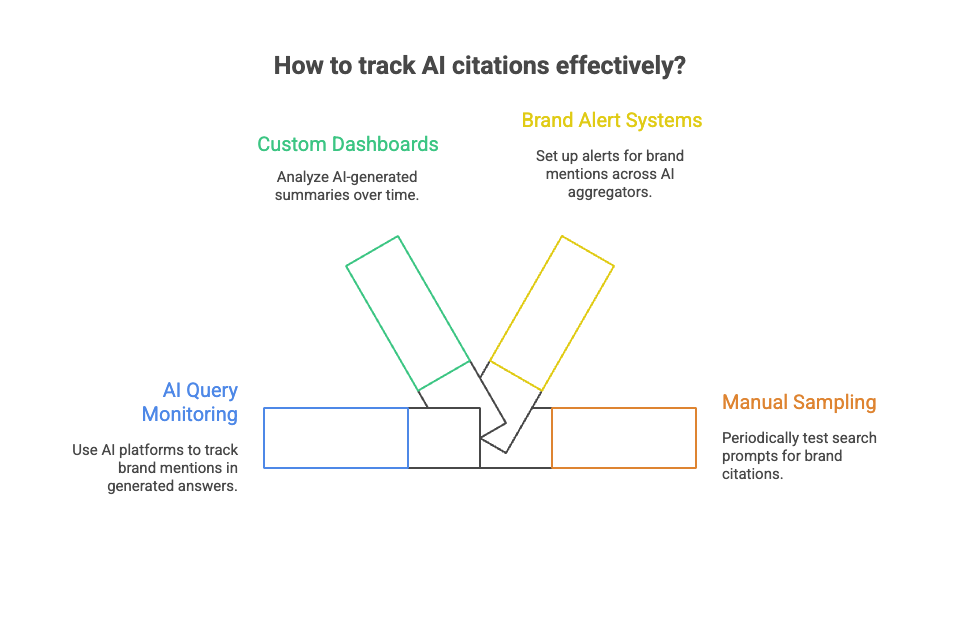
This hybrid method gives you a running baseline of where — and how often — AI models reference your brand.
To improve reliability, tracking should be conducted across clusters of related prompts, rather than isolated queries, as AI responses can vary based on phrasing and context.
Maintaining a standardised prompt library ensures consistency in measurement and allows for more accurate trend analysis over time.
Advanced teams also capture historical snapshots of AI responses, enabling comparison of citation trends and detection of gains or losses in visibility.
What metrics should you measure to gauge performance?
Tracking citations isn’t just about counting mentions; it’s about interpreting impact.
The three key metrics to focus on are:
- Brand Mention Frequency: How often your name appears across AI-generated results.
- Domain Citation Depth: How prominently your site is referenced — as a source, supporting example, or hyperlink.
- Lead Conversion Correlation: Whether cited visibility aligns with higher lead volume, lower acquisition cost, or improved close rates.
To deepen insights, include:
- Prompt Coverage Rate: Percentage of key queries where your brand appears
- Average Citation Position: Placement within AI responses
- Citation Consistency Score: Stability of mentions across repeated prompts
Also read: What New KPIs Replace Traditional SEO Metrics in the Age of AI Search?
By comparing these against your CRM and analytics data, you’ll start connecting AI visibility to real business outcomes.
How do you interpret ROI from AI visibility?
AI visibility produces compound influence, not linear traffic.
Here’s how to read the signals correctly:
- Short term: Expect more branded search queries and social mentions after AI citation spikes.
- Medium term: Notice improved lead-to-conversion ratios as brand trust increases.
- Long term: Track recurring appearances in AI summaries — this reflects sustained authority, not seasonal exposure.
A key interpretation principle is separating visibility spikes from visibility stability — consistent presence across queries is a stronger indicator of authority than occasional high-volume mentions.
Another important signal is cross-query expansion, where your brand begins appearing in adjacent topics, indicating growing topical authority within AI systems.
Over time, combining citation metrics with CRM data enables a shift toward influence-based attribution models, capturing how AI exposure contributes to revenue beyond last-click tracking.
By correlating these layers, you can calculate a Citation Impact Index — a composite score that shows how AI mentions translate into measurable business value.
Conclusion
You can’t optimize what you can’t measure — and AI visibility is no exception. Tracking citations turns abstract authority into actionable intelligence, bridging the gap between brand credibility and commercial performance.
Ultimately, the goal is not just to track mentions, but to understand how AI-driven visibility shapes buyer intent before measurable engagement occurs.