Language:

Is SEO Dead? The AI Search Shake Up

I started in SEO at a time when the rules were relatively stable. If you ranked well, you got traffic. And if you got traffic, you had a chance to convert.

That relationship was almost linear.

Today, it isn’t.

Users can get what they need without ever clicking through to a website. And when that happens, ranking becomes less important than something else entirely.

So the real question is no longer about rankings. It’s about whether you are part of the answer in the first place.

– Alvin Koay, Founder Zicy.com & Growth.pro


00:00


What we will discuss:

  • The shift in how search engines are evolving into answer engines [04:20]
  • Whether SEO is truly dying or simply evolving [04:56]
  • How answer engines retrieve and synthesise information [06:50]
  • Why being mentioned matters more than being ranked [08:55]
  • Why traditional traffic metrics are losing meaning [12:28]
  • What new KPIs like share of voice actually measure [18:20]
  • Why long-form content can become inefficient for AI retrieval [19:20]
  • The shift from keywords to entities in content understanding [21:33]
  • Why consistency across channels determines AI trust [26:18]
  • How AI recommendations influence user behaviour and conversions [28:27]
  • The mindset shift required for marketing leaders [29:50]

The shift from search engines to answer engines [04:20]

Search used to follow a very predictable pattern. You entered a keyword.  The search engine returned a list of results. And you navigated those results to find what you needed.

There was a process to it.

Now, that process is being compressed.

When you search, what appears first is no longer a list of links. It is an answer—generated directly within the interface.

Google itself is moving in this direction. The AI overview now sits above the traditional results, pushing the familiar search engine results page further down.

There’s an old joke in the industry: “If you’re on page two of Google, that’s where you can hide dead bodies.”

But today, even being on page one is no longer the defining advantage.

Because the user may never reach it.

Is Traditional SEO Dead? [04:56]

The question of whether SEO is dead depends on how you define it. If there were no search engines, would search engine optimisation even exist?

Google is still the largest search engine in the world. That hasn’t changed.

What’s changing is what Google is becoming.

Instead of returning a list of links, it is increasingly behaving like an answer engine by surfacing responses directly, often before users engage with any website.

So SEO is not disappearing. But its role is changing.

It becomes the foundation and the technical and structural layer that supports visibility.

What determines visibility now is something else entirely: whether your content is selected, interpreted, and included in the answer.

AI Search in China – Does it Affect LLMs? [06:50]

This shift is not limited to Google.

In China, platforms like Baidu operate within large, closed ecosystems, often referred to as walled gardens. They have their own large language models, such as ErnieBot.

The underlying behaviour, however, is similar. Traditionally, search required manual effort.

A user enters a query. Reviews multiple links. Visits different websites. And then decides where to transact.

Answer engines remove that process.

When a query is entered, the system breaks it down into multiple entities. Each entity generates a set of sub-queries, which is essentially a fan-out of possible questions.

The system then:

  • retrieves information from the open web.
  • cross-references it with its training data.
  • and compiles a single response.

What used to require multiple steps is now handled in one pass.

That is where the disruption comes from.

If AI Doesn’t Mention You, You’ve Lost [08:55]

This changes the nature of visibility. The question is no longer whether the answer engine sends you traffic.

The question is whether you are present in the answer at all.

If your brand or service is not mentioned, you are effectively invisible.

And if your competitors are being recommended instead, they are the ones capturing that opportunity.

This represents a shift in mindset.

Visibility is no longer about ranking. It is about being cited, mentioned, and recommended. In fact, this creates opportunities for smaller players.

A local car repair workshop in Klang, for example, can be recommended if its presence across its website, Google Business Profile, and social platforms is structured correctly.

Not because it ranks higher. But because it is contextually relevant to the query.

Why Traffic KPIs Are Losing Meaning [12:28]

For a long time, search behaviour was built around keywords. Users entered short phrases like “best life insurance Malaysia.” These queries contained very little context.

Search engines had to infer intent and match it with the most comprehensive and authoritative content available that demonstrated expertise, authority, trust, and a strong user experience.

That content would then rank highly, and users would click through to explore it. This model worked for decades.

But it relied on a limitation: the lack of context in the query.

That limitation no longer exists.

Users now ask complete questions. For example:  “I want to bring my family of five to Singapore in December, and I’m looking for a hotel near the zoo.”

This single query contains multiple entities:

  • family size
  • destination
  • time
  • specific location

Answer engines process this differently.

They break down each entity, generate sub-queries, retrieve relevant information, and construct a response. In this model, the need to click through multiple websites is reduced.

And as a result, click-through rates are declining significantly.

Even within Google’s AI environments, a large percentage of users do not click through to websites.

So traffic, as a primary metric, becomes less meaningful.

What KPIs are Important Now in AI Search [18:20]

If traffic is no longer the primary metric, the question becomes: what replaces it?

The answer is share of voice. Start with the most important queries related to your business.

Not just a handful, but potentially hundreds.

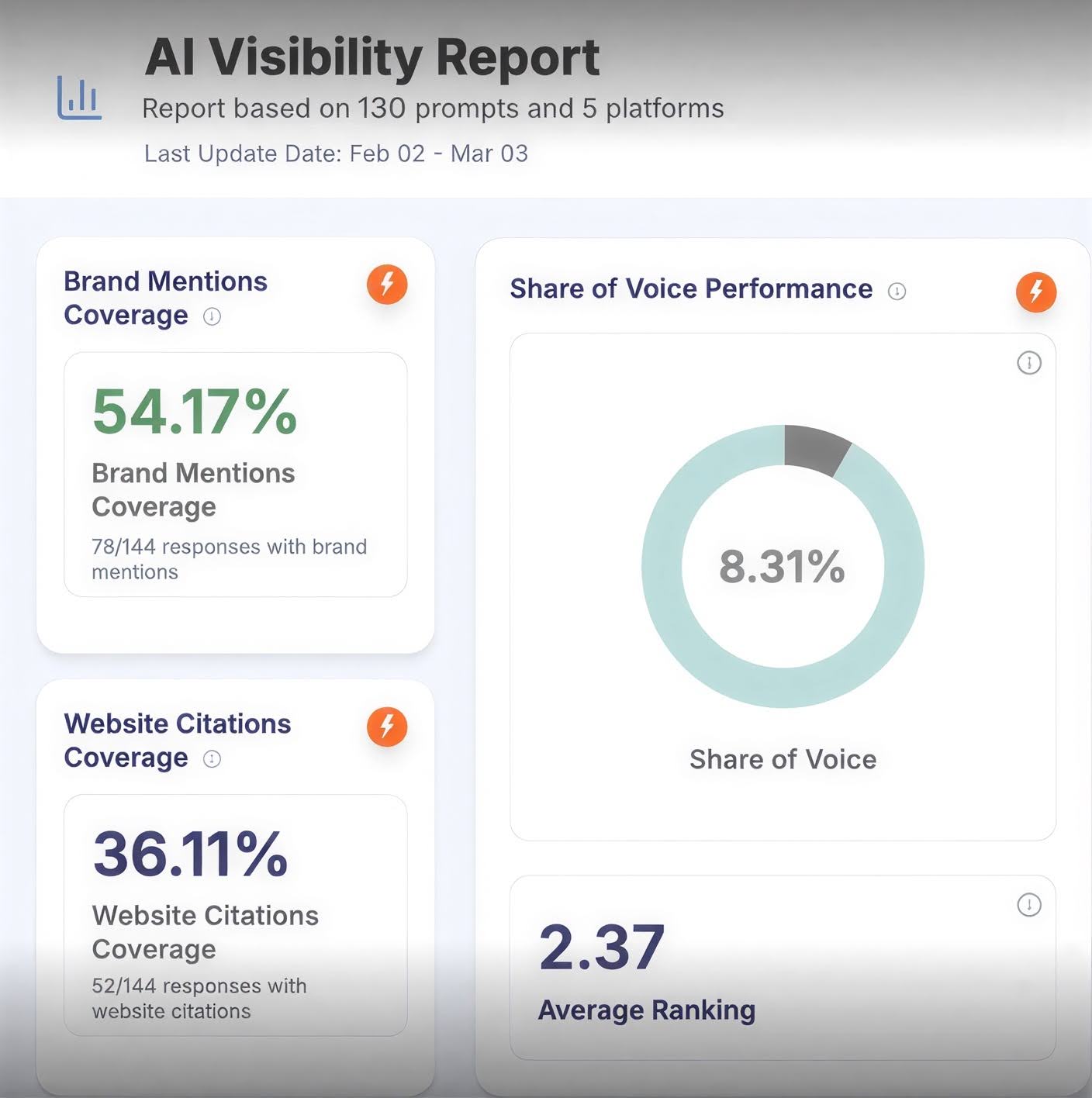
Let’s say there are 200 high-value queries that your customers are asking across platforms like ChatGPT, Gemini, Perplexity, and Google AI.

For each of these queries, you need to understand:

  • Are you being mentioned?
  • Are you being recommended?
  • How often are you appearing compared to competitors?

This becomes the new measurement framework. Visibility is no longer about how many users visit your website. It is about how often your brand is present in the answers they receive.

Long-Form Content Could Be a Liability [19:20]

There is also a structural issue with how content is consumed by AI systems.

When a user submits a query, the system first checks its training data, which may already be outdated by several months. It then retrieves additional information from the open web to construct a response.

During this retrieval process, efficiency matters. Content must be:

  • clear
  • relevant
  • and easy to extract

If a system needs to process 2,000 to 3,000 words to extract a small number of useful points, it may simply move on to another source.

This means that traditional long-form content (designed to be comprehensive) can become inefficient in this context.

Not because it lacks value. But because it is harder to retrieve.

Keywords vs Entities [21:33]

Traditional SEO focuses heavily on keywords. Content is often written to include specific phrases and their variations.

Answer engines do not rely on this approach. They operate based on entities and contextual relationships.

They can understand the meaning without exact keyword matches.

This changes how content should be structured.

Instead of writing for keyword coverage, content must be structured so that answers can be extracted directly, without requiring the system to interpret large amounts of text.

Clean Data Builds AI Trust [26:18]

Another factor is consistency. AI systems do not evaluate a single source in isolation.

They evaluate signals across multiple channels:

  • website
  • earned media
  • paid media
  • social platforms

If these sources present conflicting information, the system loses confidence. When that happens, it may:

  • ignore the content
  • or generate inaccurate outputs

This is often perceived as a hallucination. In reality, it is a reflection of inconsistent data.

To avoid this, organisations need to align messaging across all channels. Consistency becomes a prerequisite for trust.

Why ‘AI Mentions’ Drive Higher Conversions [28:27]

There is also a shift in how users make decisions.

If you ask a group of runners what shoes they use, and multiple people recommend the same brand, that recommendation carries weight.

AI systems function in a similar way.

When a user receives a recommendation from an answer engine, it is perceived as guidance rather than advertising. This leads to different behaviour.

Users who arrive through AI-driven recommendations:

  • already have intent.
  • already have context.
  • and often already know what they want.

They spend less time exploring. They require less support. And their lifetime value is often significantly higher.

Mindset Shifts For CMOs in the AI Search Era [29:50]

This leads to a broader shift in how marketing should be approached.

The traditional focus has been on driving traffic to websites. But the objective now is different.

It is to be mentioned and recommended by answer engines.

When this happens consistently:

  • branded search increases.
  • direct traffic increases.
  • lead quality improves.

This type of visibility cannot be bought in the same way as paid search.

It must be earned through relevance, clarity, and alignment.

Finally…

One final point.

Many assume that correcting an AI’s response directly will influence future outputs.

It doesn’t.

To influence how AI represents your brand, you need to influence the underlying data.

That means:

  • better content.
  • stronger contextual presence.
  • and consistent signals across platforms.

Because ultimately, AI reflects what it can retrieve.


Source: BFM 89.9


The article above highlights the key points from the episode. For readers who prefer to follow the full conversation or revisit specific details, the complete transcript is included below.

Full Podcast Transcript

Search is changing fast. With AI tools increasingly answering questions directly, brands can no longer rely on rankings, clicks, and traffic alone to stay visible.

In this episode of Marketing Mojo, Richard Bradbury from BFM 89.9 speaks with Alvin Koay, Founder and CEO of Growth.pro, about how AI is reshaping digital discovery, why traditional SEO metrics are losing relevance, and what Malaysian marketing teams must do now to remain credible, discoverable, and competitive in an AI-mediated world.


Richard, BFM:
For years, brands have fought for rankings, for clicks and traffic, but more so than before. Customers aren't just searching anymore. They're speaking to AI and when these tools generate answers directly, those rules of visibility and credibility and even measurement start to change. So what does that mean for Malaysian companies and their internal marketing teams? Is traditional SEO even still relevant in 2026 or are we looking at an entire

I'm speaking with Alvin Koay, founder and CEO of Growth Pro, a Penang-based AI-first SEO and digital marketing agency that helps brands to shift their focus from traditional to modern marketing strategies. Alvin, welcome to the show, my friend. How are you?

Alvin:
Good, thanks for the opportunity, Richard.

Richard, BFM:
Tell us about Growth Pro and what do you mean when you describe yourselves as an AI first SEO agency?

Alvin:
So we started about seven, eight years back as an SEO agency. ChatGPT started about three years back and that was when there was a lot of chatter about SEO being disrupted by ChatGPT. So incidentally, we have another partner who is a data strategist, and we were analyzing what can we do, what can the SEO company do if we were to be disrupted. We dig deep into how search is going and we found that we better get ourselves ready. We know a little bit about how ChatGPT works. So we started reverse engineering, the type of queries people put in and how these large language models get content from, how they get their training data from and all that. And we came up with a playbook. You can see that there's a huge drop in click through rates from Google search.

There's a joke that goes on in the SEO industry. If you are on the second page of Google, that's where you can hide dead bodies. Nobody finds them.

Richard, BFM:
Yes, I've heard that before.

Alvin:
So now, what comes up first is the AI overview and that's where it's powered by Gemini, which is a part of an answer engine. That's a major shift in Google.

Is Traditional SEO Dead?

Richard, BFM:
You're coming from a traditional SEO background. I suppose the million dollar question then is, are we talking about the death of traditional SEO or is it more of an evolution? What's the difference now then between AEO and SEO?

Alvin:
It depends on who you ask. If there was no search engine, will there be search engine optimization? Does it make sense? Google is still the largest search engine in the world.

Richard, BFM:
That's a good one.

Alvin:
So when you put in a keyword term, what comes out first is a chat conversation. The search engine result page gets pushed down way below the fold. So very soon you will see that Google is morphing into an answer engine. So yes, Google may still drive a lot of traffic, but will Google be a search engine or an answer engine? That's the question. So when there are no more search engine, eventually, will there be search engine optimization? So that's the question.

However, SEO is the very basis of AEO. So if the publishers optimizes their website - with a strong technical SEO, that will form a very strong basis for AEO.

AI Search in China - Does it Affect LLMs?

Richard, BFM:
Got it. Let me ask you a question regarding search engines elsewhere. How is stuff like AI affecting search engines in China, like Baidu, for example, China's biggest search engine by a long stretch. Are they adopting similar things to what Google is doing elsewhere?

Alvin:
So those are big platforms, big super apps and those are walled gardens. Baidu is a search engine. And Baidu has their own LLM which is powered by ErnieBot if I'm not mistaken. Traditionally for search, what happens is when you put in a keyword search term, the search engine will give you a search engine result page and that's where you have to manually click through from the links to the publisher and once you have gotten all the information that you want, then you identify I would like to transact with this company so then this person will go to that particular website and click through from the link and do a transaction or ask a question. So there's a lot of manual work involved but the answer engines work differently.

Answer engines will do all these things for you. When you put in a system, Gemini will break it down into different entities and each entity will do a fan out query of the most probable sub queries. And it goes up into the open web, grabs as much information as possible, comes back and looks at their training data, and compiles the best answer for you. That's why the search engine is disrupted.

If AI Doesn’t Mention You, You’ve Lost

Richard, BFM:
If we look at the future of this, how is it changing how we then interact with search engines? You know, if you want to get to page three and four, you can still do that. But how is it changing us fundamentally on a behavioral level?

Alvin:
It's a major shift. Even the smaller publishers will be able to get into the conversation. So the question now is no longer does the answer engine send me traffic? The biggest question right now is - is my brand or service getting cited or being recommended by the answer engines. So it's a total shift of mindset. So as long as you do the right optimization for answer engines, there is a very good chance of you being mentioned, recommended, and cited by the answer engines. In fact, it's easier if you are much more granular. For example, if you own a car repair workshop in Klang, and if you know how to optimize it properly using your Google business profile, your website and all the other socials, yes, the answer engine will be able to recommend you. It depends on how you optimize your content.

Why Traffic KPIs Are Losing Meaning

Richard, BFM:
The big ideas that you focus on with Growth Pro are traditional traffic KPIs, which are becoming arguably less meaningful today, some might say.

Why are those metrics losing relevance then when we are now living in this AI-mediated world? Is it because everybody's like, I just want to use my AI tool, and I don't need to use Google anymore?

Alvin:
I mentioned earlier that the seismic shift of the search behavior has changed. So Google was the 800-pound gorilla. Everyone used Google. And the way you use Google is by using keyword searches. It's a short two or three keywords for say, “Best life insurance Malaysia”. It's not even a question. It's just a keyword phrase. With very little context, Google needs to use its algorithm and look for the probable intent of the searcher and Google is a user-generated content monster. It doesn't have content. Because of the lack of context, it will look for the most comprehensive content that's published by a website which is aligned to the user's intent and has good expertise, authority, trust and also user experience. Then if that content has all those checked off, then it will be ranked highly.

So when a user searches a search term, it clicks on the first link because it's ranked highly, deemed very well presented by Google's algorithm. Then you cover the whole breadth of context for that limited search term.

Now, for the past few decades, this has been happening. But with ChatGPT, they don't put in keyword search terms. Usually they'll ask a long question with multiple entities. For example: “I want to bring my family of five to Singapore in December and I'm looking for a hotel near the zoo.” There are a few entities involved. Zoo is one entity. December is another entity. Family of five is one.

The answer engines like ChatGPT doesn't work based on keywords, it works based on entities. So now there are five or six entities and it breaks down the sub queries of each of the entities and fan out all the queries.

The AI will go out and grab all this content and the primary objective of a user or website is to get cited and mentioned by the answer engine. If you are not part of the conversation, you have lost. And if your competitors are being recommended by the AI engines, then you have lost the game.

Richard, BFM:
Previously, you could spend money with Google and that would raise your profile to the first page, or at least the first couple of search results. Whether or not you had all of those results, it doesn't matter, you've paid the money to get to where you are.

What you're saying then is with this new way of doing, that doesn't necessarily work the same way.

Alvin:
Paying money and getting right at the top of Google, that is pay per click. What I'm referring to is the organic search result which is not paid for. You need to engineer and optimize the metrics to measure the click through rate. How much time and traffic is being sent by the search engine to your website and how engaging is the traffic? Does traffic convert into sales or leads?

Whereas with the answer engine, the click-through rate has dropped probably about 60% over. And even in Google, if you are on AI mode, 93% of people do not even click through to websites. So in the past one or two years, you see that so much traffic is being dwindled.

So now we are not measuring traffic. What are we measuring? It's share of voice. How much of your brand is being mentioned in the conversation? Are you being cited by the answer engines? These are the very important new metrics because you cannot measure traffic anymore.

What KPIs is Important Now in AI Search

Richard, BFM:
If traffic is no longer the metric, then traditional traffic is no longer the primary scoreboard. So leaders should then be measuring how often or whether or not they're in these answer engines. So what does a successful measuring metric look like for marketeers?

Alvin:
It's what are the most important queries people are asking about your product or services. Let's say there are 200 very important queries. You want to know what all these queries are and whether the AI is mentioning your brand or not. We call it share of voice. You need to measure it in ChatGPT, Perplexity, Google Gemini, Google AI Mode and Google AI overview, these are all the different LLMs. So you want to know what's your share of voice across all the LLMs, and how much of share of voice you have against your competitors.

Long-Form Content Could Be a Liability

Richard, BFM:
So you were talking about how AI uses tokens and if there are too many tokens used, then the AI would then decide to potentially skip the content. Break it down a little bit.

Alvin:
When somebody puts in a query in ChatGPT, ChatGPT will check what kind of content they have in the training data. And usually training data is late by almost a year, and then goes up into the open web and looks for the latest content and then compiles everything and reviews the best response. So the part of where the AI goes out in the open web and scours high authority websites will preserve most of the tokens. The content needs to be very efficient to be retrieved. It has to make a lot of sense and answers to the query intent.

But if the traditional SEO content is very comprehensive and answer engines crawlers need to crawl through 2,000 - 3,000 word content just to get that two or three points, the crawler will say I'm gonna skip this, I'm gonna go to the next one and look for better content which is more targeted and more efficient. So when that happens, your long form article will be a liability.

Keywords vs Entities

Richard, BFM:
If you are writing efficiently for the answer engines to read your stuff, then it's almost like the stuff that you need to write on your website is the same way that you would query Google originally.

Alvin:
Yeah, in a way, but remember, I mentioned that the answer engines work based on entities and not based on keywords. Most people will write based on keywords. So they do a lot of keyword stuffing and put in some semantic keywords in their content. Whereas answer engines, they don't depend on keywords because it's based on entities.

That means that answer engines will know the semantic relevancy or contextual relevancy to some of those keywords. You need to restructure your long form content for answer engine to pick out the exact answers right off the bat and not scour through the whole three thousand words article.

Clean Data Builds AI Trust

Richard, BFM:
Where should typical Malaysian companies start if they want to realign their digital strategy for AI discovery without having to overhaul everything overnight?

Alvin:
The CMO needs to align all their agencies together and not let each of them work in silos because if your PR says one thing, the content from earned media says another, but your website says the opposite, the trust factor for ChatGPT would drop. And when that happens it either skips your content or hallucinates. You have to align across all your earned media, paid media, your socials and your owned media. That is very important to avoid hallucination and gain the trust factor from the large language models.

And the second thing is you need to know what are the most important queries that your customers are asking in ChatGPT, Gemini or any of those LLMs. Identify and track whether you are being mentioned or recommended favorably by the LLMs and how much share of voice do you have against your competitors.

Why AI Mentions Drive Higher Conversions

Richard, BFM:
How does being cited or referenced by these systems influence a brand's credibility and their customer trust compared to just following the rankings on page one of search results?

Alvin:
It’s a huge difference. So imagine you're a runner and you ask your runner friends ‘What brand of shoes are you wearing?’ And if your friend told you, this particular brand, there's a very high chance that you will buy it. It's based on recommendation. In the case of answer engines, if you put in a query what brand of shoes is best for female at this age etc. and you got a good recommendation for a particular brand, the trust factor is actually very high and if the answer engines mention your brand favorably, there's a very high chance that you'll buy that brand.

Being mentioned by the answer engine is very very important.

Mindset Shifts For CMOs in the AI Search Era

Richard, BFM:
Given all the ground that we've covered today, what do you think are maybe some of the mindset shifts marketing leaders, CMOs need to start making now to stay relevant? What do they need to be doing today?

Alvin:
They need to change their mindset from driving traffic to websites to being mentioned and recommended by the answer engines.

Generally, if you are being mentioned a lot by the LLMs, your branded search will go up very high, you'll see that your brand leads will increase and direct traffic to your website will also increase. You can track from your Google Analytics that it comes from these answer engines.

When this traffic comes to your website they stay there for a very short amount of time because they already know what they want to do on your website, they have much lower customer support demand. The economic lifetime value of that customer is so much higher than traditional search engine and there's data that shows that it's up to 4.4 times higher than your search engine traffic.

Richard, BFM:
If you are using one of these LLMs, let's say I'm searching for you, Alvin. And I keep saying, I'm searching for Alvin Koay and it's telling me, he's a guy who lives in Klang who sells cars. And I'm like, no, that's not the Alvin Koay that I'm looking for. And I'm correcting the LLM. Will that over time, influence the results of that LLM?

Alvin:
The search itself will not influence. So in order to influence LLM, you need to create more content with more contextual relevance. In multiple platforms and earned media and stuff like that.

Richard, BFM:
Alvin, it's been an absolute pleasure speaking with you today and an absolute eye-opener. Thank you so much for your time.

Alvin:
Thanks so much, Richard, for the opportunity.


Share the Post:

Related Posts