How to optimise bilingual websites for AI citations
Optimising a bilingual website for AI citations is about structure, not just translation. AI must decide which language version is canonical, so consistent entity names, correct hreflang, parallel schema and clearly segmented URLs let it connect both versions to one brand and cite either. Zicy tracks your citations across languages and across ChatGPT, Gemini, Perplexity, Google AI Overviews and Google AI Mode.
In multilingual regions and global markets, many brands run bilingual or multilingual websites, often balancing English with a local or regional language. In the age of answer engine optimisation, maintaining that balance is not just about translation; it is about how AI interprets and cites your content. If your website speaks to people in two languages, it must also speak clearly to machines in one universal language: structure. AI increasingly operates across languages, so a well-structured bilingual site can enable cross-language citation, where content in one language supports visibility in another.
Why bilingual sites pose a challenge for AI engines.
Engines like Gemini, ChatGPT and Perplexity read multilingual content differently from humans. When two or more languages appear on the same domain, AI must decide which version represents your canonical truth, and if your metadata, schema or URLs are not clearly segmented, the result can be confusion or citation errors. Common pitfalls include:
- Mixed-language metadata, such as English title tags on local-language pages.
- Duplicate URLs serving similar content in different languages.
- Inconsistent entity naming, where brand names are translated or localised inconsistently.
There is also a language dominance bias, where AI may favour one version, often English, if signals are unclear, reducing visibility for other variants. Ambiguity across languages weakens entity recognition, making it harder to connect versions to the same brand, and without clarity AI may skip your content entirely in favour of better-structured sources.
How to make bilingual content AI-readable and citation-ready.
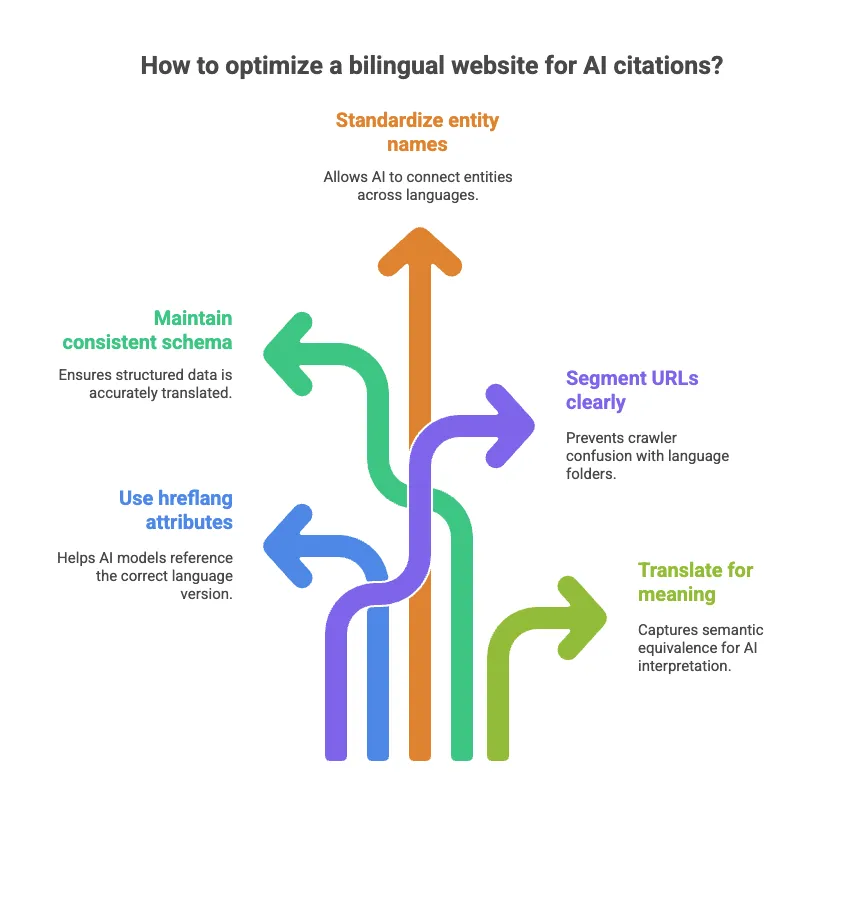
To earn citations across languages, treat each version of your site as a distinct yet connected source:
- Use hreflang correctly: indicate language and region, such as en-my and ms-my, so AI models and crawlers know which version to reference.
- Keep schema consistent across languages: replicate Organization, Article, Product and FAQ markup in both versions, translating key fields accurately. See which schema and entity markup matter most.
- Standardise entity names: keep company and product names identical across language pages, even where surrounding text changes.
- Segment URLs clearly: use language folders such as /en/ and /ms/ rather than automatic translation plugins that confuse crawlers.
- Translate for meaning, not keywords: capture semantic equivalence, explaining the same concepts naturally in each language.
Make sure key answer sections exist in both languages, since AI may prioritise the clearest and most complete version, and maintain structural parity so headings, FAQs and hierarchy mirror each other. Avoid relying solely on automated translation, which can introduce inconsistencies that reduce clarity and trust.
The trust and clarity factors to maintain.
Even in multilingual environments, AI prioritises credibility and consistency. To reinforce both versions as trustworthy:
- Add localised author bios and credentials where possible.
- Ensure contact information and company details match across every language.
- Keep last-updated dates aligned, since outdated translations signal neglect.
- Cross-link both versions for transparency, with visible language toggles.
Extend consistency to external platforms too, so multilingual brand profiles reinforce the same entity signals, and update all language versions regularly to keep trust parity. These small, strategic alignments make AI far more confident about citing your content, whichever language a user is viewing. The companion guide on building trust signals AI recognises goes deeper.
Why bilingual optimisation gives brands an edge.
Multilingual readiness amplifies your AI visibility footprint. A brand that is structured, semantically consistent and linguistically adaptive becomes eligible for citation in multiple language contexts, effectively doubling exposure without doubling effort. In cross-border markets such as Southeast Asia, that can mean being cited by AI systems serving different user bases, one English-speaking and one native-language, from a single optimised domain. Authority built in one language can support visibility in adjacent queries in another, and brands that optimise multilingual structure early establish cross-market authority that is harder to displace. AI does not care which language you publish in; it cares how clearly it can interpret, match and verify your information. A bilingual website that is structured, consistent and semantically aligned speaks fluently to both humans and machines, and earns citations in every language it serves.
Track your citations across every language you serve.
Zicy measures where AI cites your brand across ChatGPT, Gemini, Perplexity, Google AI Overviews and Google AI Mode, in every market.
