Key Takeaways
- AI answers are replacing search results as the primary discovery layer.
- Visibility is shifting from ranking to being cited in a limited answer set.
- Smaller, clearer content can outperform larger sites in AI citations
- Consistency across platforms is now a core AI trust signal.
- Traffic may decline, but influence and conversion quality can increase.
- SEO is evolving into semantic visibility and brand representation.
- The goal is no longer clicks, but being the source behind the answer
Introduction
The age of search as we know it is ending.
With Google’s AI Overviews and conversational tools like ChatGPT, Perplexity, and Copilot, users now receive synthesized answers instead of traditional search results.
For businesses, this marks a profound shift: SEO is no longer just about ranking — it’s about being referenced in AI-generated answers. Understanding how this change impacts your visibility, traffic, and conversions is essential for every brand leader planning their 2025 strategy.
Industry observations across 2025–2026 show that AI answer layers are increasingly becoming the default interface for informational queries, especially in research-heavy and B2B categories. This means brands are now competing not for page position, but for inclusion within a compressed answer set.
What’s really changing in how people find information?
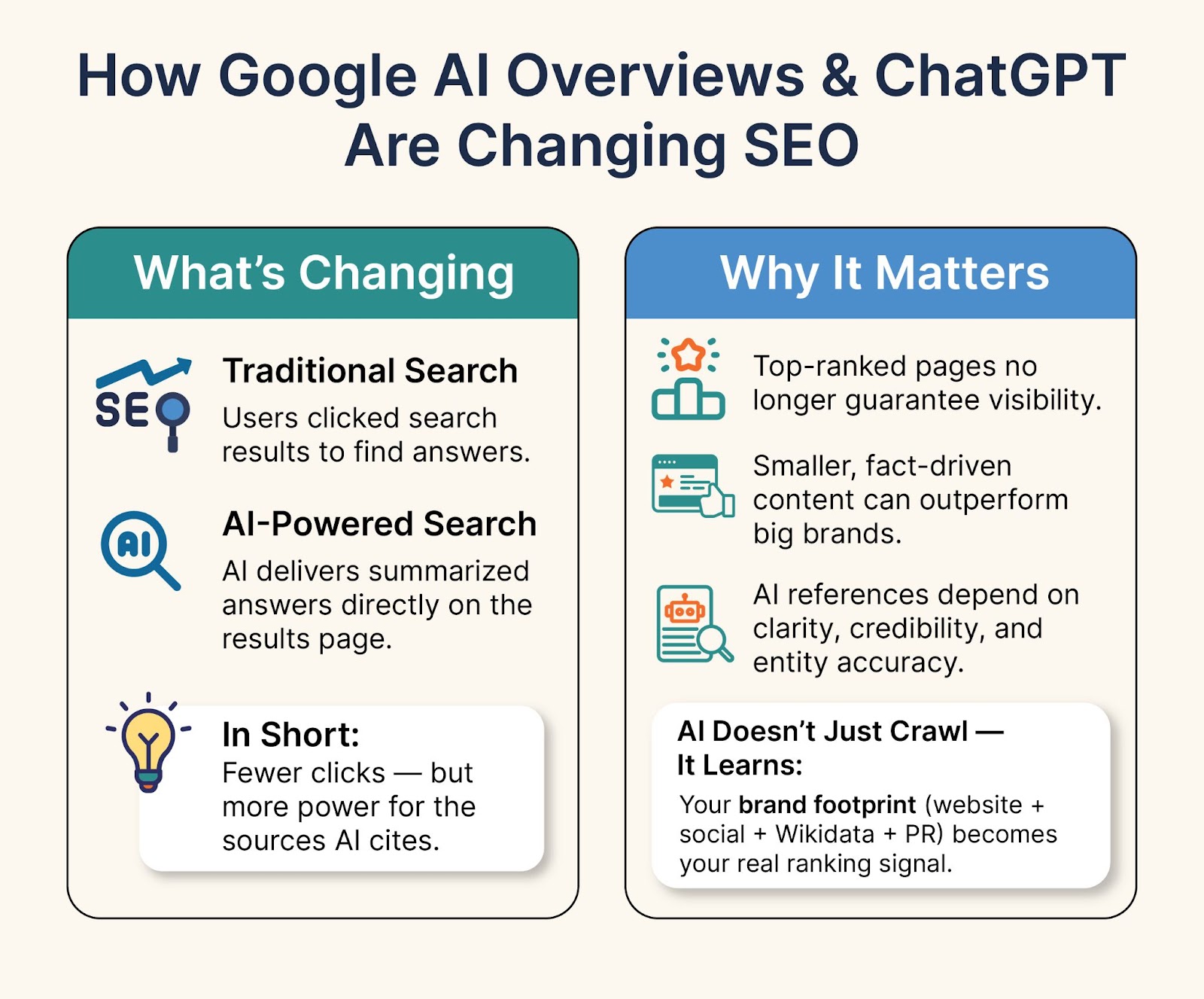
Traditional search relies on link lists; users click to learn more. But AI-powered search delivers answers directly on the results page, often summarizing insights from multiple trusted sources.
This means fewer clicks, but more influence concentrated within the limited set of sources that AI systems cite or reference.
In short, AI Overviews reduce the visibility gap between top-ranking and mid-ranking pages — what matters now is content clarity and credibility, not just keyword dominance.
ChatGPT, for example, may quote a smaller blog if it provides a cleaner, fact-based explanation that matches the user’s intent better than a top-ranked corporate page.
This introduces a critical shift in competition: ranking is no longer a proxy for visibility. AI systems prioritise extractability and confidence over domain size, meaning smaller but well-structured sources can outperform larger sites in answer inclusion.
AI engines also evolve dynamically. They don’t just crawl websites, but also learn from aggregated behavior, authority, and consistency across multiple contexts. As a result, your brand’s digital footprint, including articles, social bios, Wikidata entries, and structured facts, now acts as your true ranking signal.
Read: What kind of content does AI prefer to cite — blogs, FAQs, or structured data?
AI engines also evolve dynamically. They don’t just crawl websites — they learn from aggregated behavior, authority, and consistency across multiple contexts. As a result, your brand’s digital footprint — including articles, social bios, Wikidata entries, and structured facts — now acts as your true ranking signal.
Learn more about: Can PR, news releases, and Wikidata entries improve AEO visibility?
In many cases, AI systems validate information by cross-referencing multiple sources. When the same fact appears consistently across platforms, it increases the likelihood of citation, effectively making multi-platform consistency a ranking signal in the AI layer.
What does this mean for businesses already investing in SEO?
It doesn’t make SEO obsolete — it transforms it. Instead of optimizing for algorithms, you now optimize for interpretation. Businesses must focus on:
- Answerability: Can your pages directly and concisely answer high-intent questions?
- Entity Clarity: Are your products, services, and expertise recognized as distinct and authoritative by AI models?
- Consistency Across Channels: Do your brand facts match across your site, press mentions, and social profiles?
The new SEO is about teaching AI how to represent your brand — and that starts with AEO (Answer Engine Optimization) and GEO (Generative Engine Optimization).
Read: What Exactly Is Answer Engine Optimization and Why It Matters for Brands?
In practical terms, your analytics will also change.
Expect organic traffic to flatten or decline — not because your visibility dropped, but because more users are getting their answers before they click. This is where zero-click ROI becomes critical: being cited in AI answers still drives awareness and trust even without the visit.
This also shifts how attribution should be viewed. Instead of last-click models, brands need to measure pre-click influence, where AI mentions contribute to downstream actions such as branded searches, direct visits, and assisted conversions.
Another emerging pattern is that AI-driven discovery often shortens the consideration cycle. Users arrive more informed and closer to decision-making, which can improve conversion quality even if total traffic declines.
Explore: What is the ROI of being cited by AI engines compared to ranking on Google?
How should companies adapt their SEO strategies now?
Forward-thinking organizations are already shifting their priorities from “ranking pages” to “earning citations.” Here’s how:
- Audit for AI accessibility: Ensure your site’s robots.txt, sitemap, and schema markup are open and descriptive.
- Invest in brand authority assets: Author pages, expert credentials, verified data, and consistent tone all boost credibility.
- Track citation metrics: Monitor AI-generated responses that mention your domain or products — these are the new visibility indicators.
Explore: How to track AI citations and measure their impact on leads and sales?
In essence, SEO isn’t dead — it’s evolving into semantic visibility management. The next generation of optimization is about being the trusted source behind the answer, not just one of the links beneath it.
Companies should also rethink content design at the section level, not just page level. AI engines typically extract compact answer blocks, so each section should:
- Address a single intent clearly.
- Provide a complete, self-contained explanation.
- Avoid dependency on surrounding context for meaning.
Additionally, technical accessibility for AI crawlers is becoming critical. Blocking or limiting AI bots (intentionally or via infrastructure defaults) can significantly reduce your chances of being included in AI-generated responses.
Conclusion
AI Overviews and ChatGPT have redrawn the search map. Businesses that evolve from optimizing for rankings to optimizing for relevance, structure, and authority will own tomorrow’s digital attention.