Key Takeaways
- Schema improves AI interpretation, not just visibility.
- Structured data reduces ambiguity and misinterpretation risks.
- Core schemas include Organization, Article, Product, FAQ, and Author.
- Combining schemas creates multi-layered understanding.
- Entity optimization ensures consistent brand identity across sources.
- Regular audits prevent schema drift and data inconsistency.
- Structured clarity directly impacts AI citation and recommendation likelihood.
Introduction
AI engines like Google Gemini, ChatGPT, and Perplexity rely on structured data to understand context — not just keywords.
That’s where schema markup and entity tagging come in.
They tell machines who you are, what you offer, and why your content matters.
In the era of Answer Engine Optimization (AEO) and Generative Engine Optimization (GEO), schema is the connective tissue between your human message and AI comprehension.
Schema doesn’t just improve visibility. It improves interpretation accuracy, reducing ambiguity and increasing the likelihood that AI systems will correctly associate your brand with relevant topics.

What does schema markup actually do?
A schema is a standardized vocabulary that helps search engines interpret your web content. Instead of merely reading text, AI can now understand relationships between people, organizations, products, and ideas.

For example, if your “About Us” page lists your CEO’s name, schema ensures AI knows this person leads your company, not that they were mentioned on the page.
That clarity fuels visibility in AI Overviews, ChatGPT responses, and voice assistants.
Learn: How to Prepare Your Website for Google AI Overviews (Step by Step)?
Schema also enables relationship mapping, allowing AI systems to connect your brand with related entities such as industries, products, and partners within the broader knowledge graph.
Without structured data, AI must infer meaning from raw text, which increases the risk of misinterpretation or omission in generated answers.
Simply put, schema markup makes your brand’s digital identity machine-readable — and therefore, citable.
Which schema types are most essential for modern brands?
While there are hundreds of schema types, a few are foundational for establishing entity-level authority:
- Organization / LocalBusiness Schema: Defines your company’s identity, contact details, and service area. Use these for every brand site, regardless of industry.
- Article / BlogPosting Schema: Communicates what your thought-leadership content covers, who authored it, and when it was updated. It strengthens topical authority and recency signals.
- Product / Service Schema: Details specifications, pricing, reviews, and availability — vital for brands with product lines or offerings. Learn: Can AI Engines Like Copilot or Gemini Recommend My Products to Users?
- FAQ Page Schema: Converts Q&A content into structured responses that AI can quote directly.
- Person / Author Schema: Establishes credibility through verified expert authorship — a cornerstone of digital trust. Read: How Can You Build Digital Trust Signals That AI Engines Recognize?
Priority should be given to schema types that directly support AI extraction and validation, particularly FAQ, Article, and Organization schemas.
Combining multiple schema types on a single page (e.g., Article + Author + FAQ) creates a multi-layered understanding, improving both context and credibility signals.
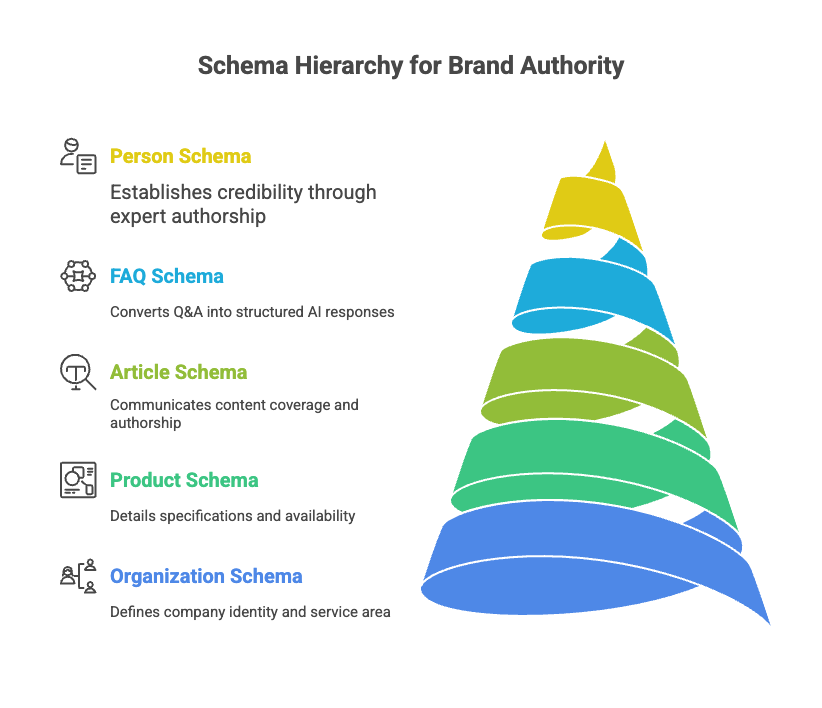
By integrating these, your site becomes a knowledge graph node — something AI models can map and reference reliably.
What’s the difference between schema markup and entity optimization?
Schema describes your content’s structure; entity optimization defines your brand’s identity.
An entity is a concept that AI can recognize, categorize, and associate with other entities (like “Tesla” → “Electric Vehicles” → “Sustainability”).
When your schema, metadata, and external profiles all reinforce the same facts — name, the result is entity consolidation, where AI systems form a single, stable representation of your brand across different data sources.
Schema acts as the technical layer, while entity optimization acts as the strategic layer, both must align to achieve consistent AI recognition.
Strong entity alignment also improves disambiguation, ensuring your brand is correctly identified even when similar names exist in the market.
How can brands maintain healthy schema and entity hygiene?
Treat structured data like your company’s digital DNA — it needs regular checkups.
- Audit quarterly: Ensure all schema types remain valid and error-free.
- Update promptly: Reflect new products, leadership changes, or awards.
- Cross-verify data: Keep consistency between website schema, Wikidata, and social profiles.
- Test frequently: Use Google’s Rich Results Test and Schema.org validator to confirm accuracy.
Learn: How to Benchmark Your AEO Readiness Against Competitors in Malaysia?
Ongoing maintenance keeps your brand’s semantic identity strong, clear, and AI-visible.
Brands should also maintain schema consistency across templates, ensuring similar page types follow the same structured data patterns.
Monitor for schema drift, where updates to content are not reflected in structured data — a common issue that can reduce AI confidence.
Over time, consistent schema implementation contributes to a stronger entity footprint, increasing the likelihood of being cited across multiple queries.
Conclusion
Schema markup is the new metadata of trust. The more precisely you define your brand’s entities, the more confidently AI engines can quote, recommend, and rank your content.
In the generative era, structured clarity is authority.