What if product discovery no longer begins with Google… but with ChatGPT?
Today’s consumers are skipping search engines and going straight to conversational platforms—asking questions like “Which is the best product for X?” or “What’s a good alternative to Y?”
That shift opened a new frontier for an eCommerce brand. We realised that to win online, they had to become the answer itself—not just appear near it.
And so they did.
Through a focused AI visibility strategy, we went beyond traditional SEO. We restructured content to be cited by platforms like ChatGPT, Perplexity, and Gemini—and saw a measurable lift in both visibility and conversions.
This is what results looked like..
Within 4 months, this is what we managed to achieve:

AI Platform Citations Skyrocketed
Their brand began appearing as a go-to recommendation across multiple generative AI tools:
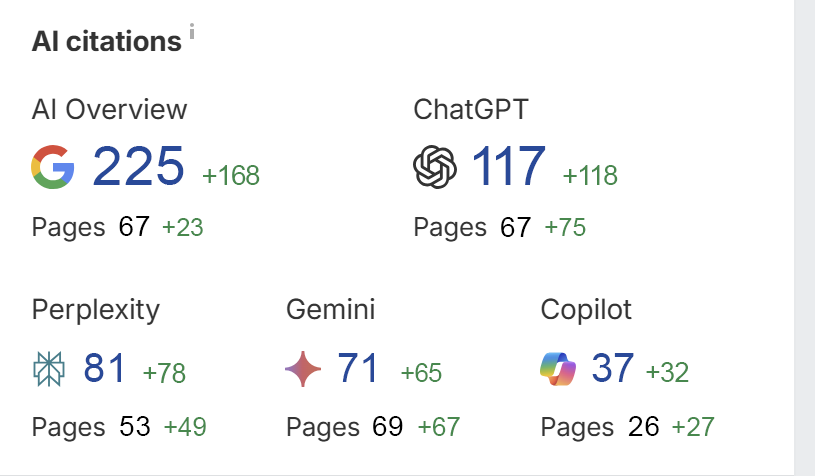
- Google AI Overview: 225 citations (↑168), spread over 67 pages
- ChatGPT: 117 citations (↑118), across 67 pages
- Perplexity: 81 citations (↑78), across 53 pages
- Gemini: 71 citations (↑65), across 69 pages
- Copilot (Microsoft): 37 citations (↑32), across 27 pages
Share of Voice: Beating the Competition on ChatGPT
Brand visibility wasn’t just rising—it was dominating:
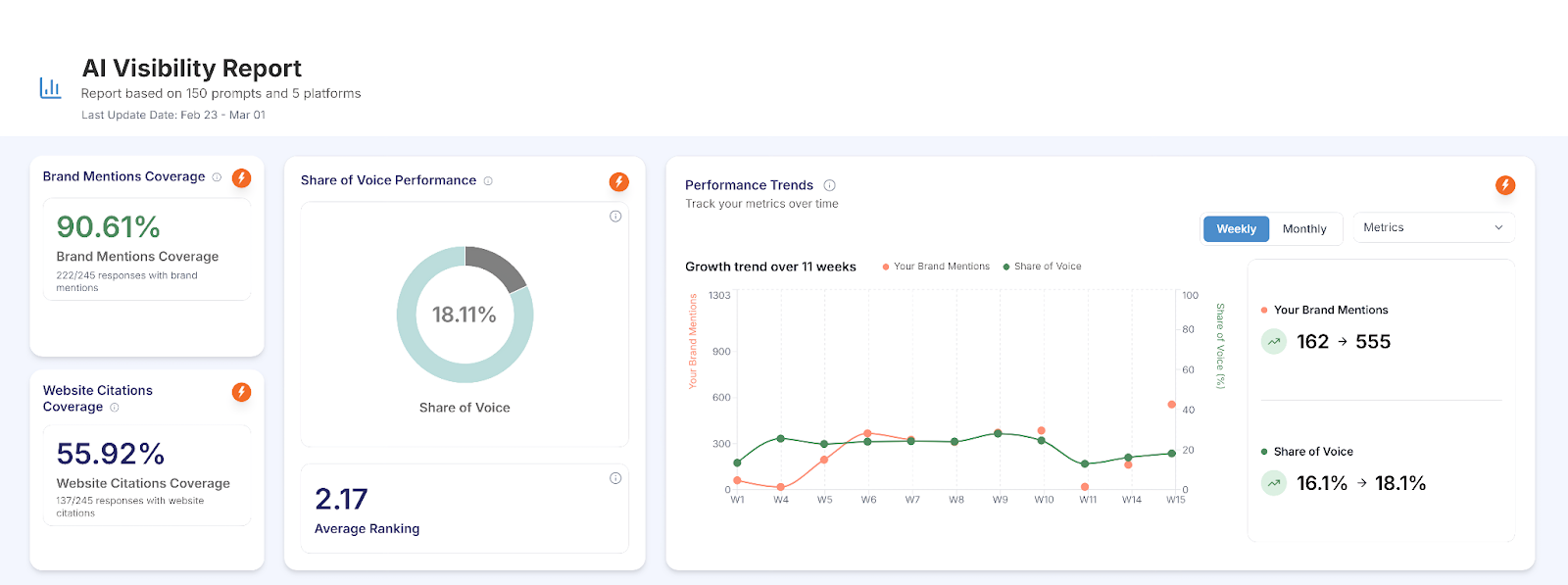
- Their brand secured 53.6% of ChatGPT brand mentions
- Top competitor trailed with only 24.2% share
Strategy Breakdown..
- AI Citation Engineering
Instead of chasing backlinks, the team engineered content that AI models want to cite:
- Structured brand anchors using entity-based markup.
- Answer-driven paragraphs with clear contextual framing.
- External linking styled for AI interpretation and traceability.
- Multimodal Content Upgrades
They went beyond text:
- Product pages enhanced with image alt text and visual schema.
- Infographics and short-form videos to support AI’s multimodal outputs.
- AEO + Intent-First Content Structure
Rather than focusing on keywords, they wrote content that answers questions:
- Sections answering “which is best for…”, “should I choose…”, “difference between…”
- Long-tail semantic triggers and layered FAQ schemas.
- Headers crafted for maximum contextual clarity.
- AI Traffic Monitoring Across Platforms
Referrer tracking and analytics integration allowed them to track:
- ChatGPT user flow via chat.openai.com.
- Perplexity and Gemini origin traffic.
And the takeaway?
While others are still optimising for search rankings, this brand bet on a different game:
→ Be the source AI platforms trust and recommend.
→ Make your product the answer.
And that shift in strategy paid off—in both visibility and bottom-line growth.