Why brand audits matter in the AI search era
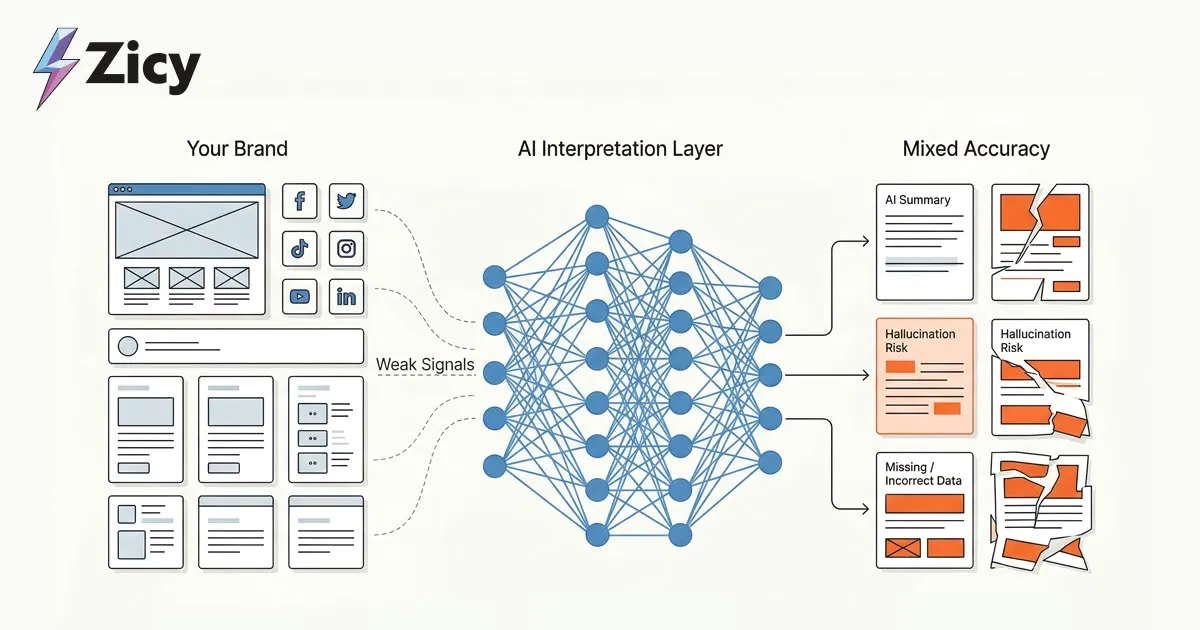
A brand audit in the AI search era measures how AI systems interpret and restate a brand: whether it appears in AI answers, what facts AI attaches to it, the sentiment, and where AI is confidently wrong. Zicy audits that AI footprint across ChatGPT, Gemini, Perplexity, Google AI Overviews and Google AI Mode, surfacing hallucinations before they shape buyer perception.
For years, brand audits were mostly about consistency: whether messaging was aligned across channels, whether positioning was clear, whether branded search results were clean, and whether the website, social profiles, media coverage and reviews reflected the same identity. Those questions still matter, but they are no longer enough. In the AI search era, brands are no longer judged only by what they publish or rank for. They are increasingly judged by how AI systems interpret, summarise and restate them.
A modern brand audit is no longer just about reviewing your digital presence across search, website and social. It is about understanding your AI footprint: how AI-powered search engines and large language models represent your brand when users ask questions about it. That includes whether your brand appears in AI-generated answers, what facts AI associates with your business, whether the summary is positive, neutral or negative, whether your core narrative is intact, and whether AI is confidently getting important details wrong. This matters because AI is becoming a new decision layer between your brand and your buyer. If your brand is missing, misrepresented or misunderstood there, the impact is not theoretical. It affects trust, perception and ultimately revenue, which is why AI visibility now belongs in the audit.
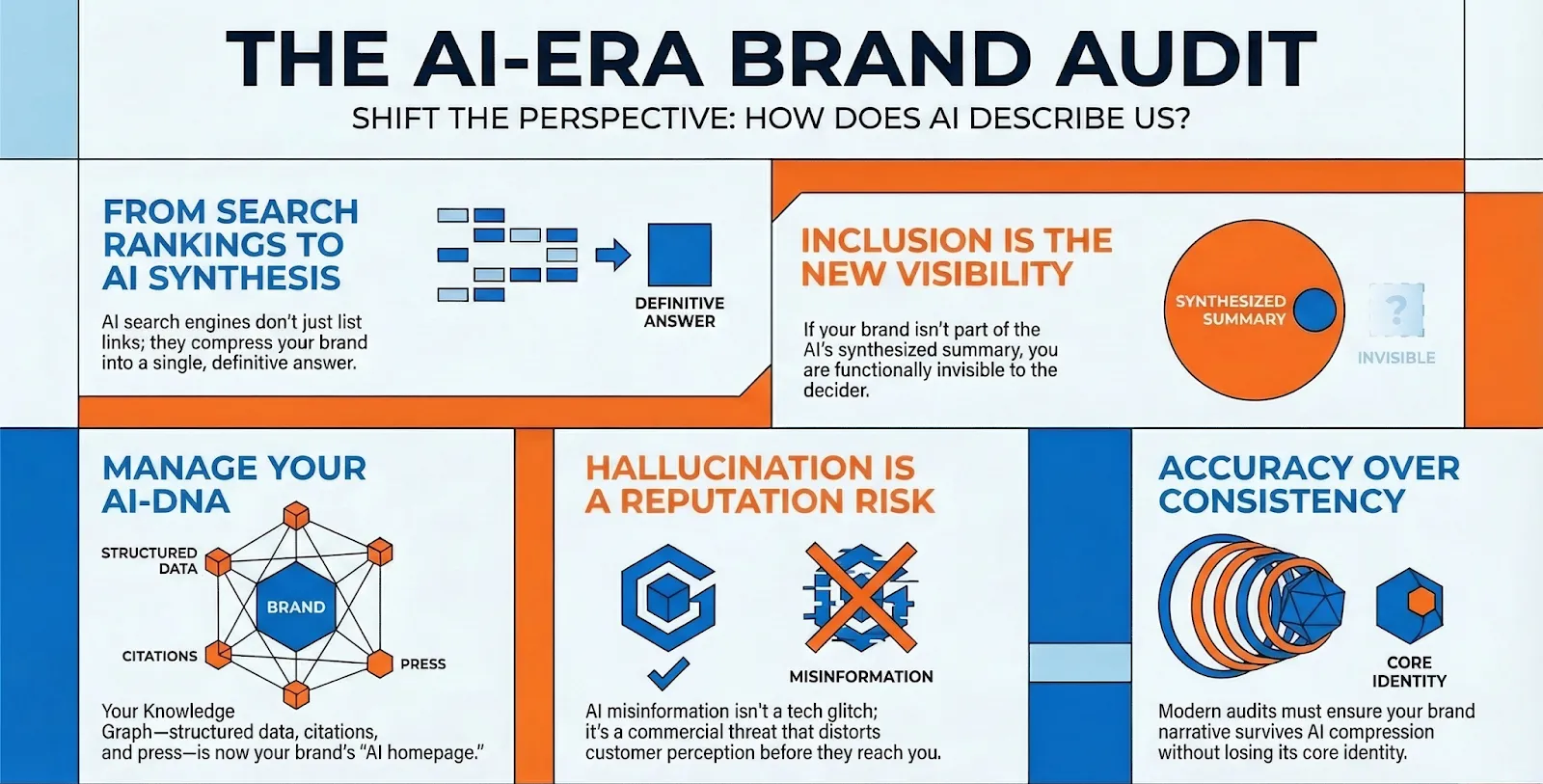
From search to synthesis.
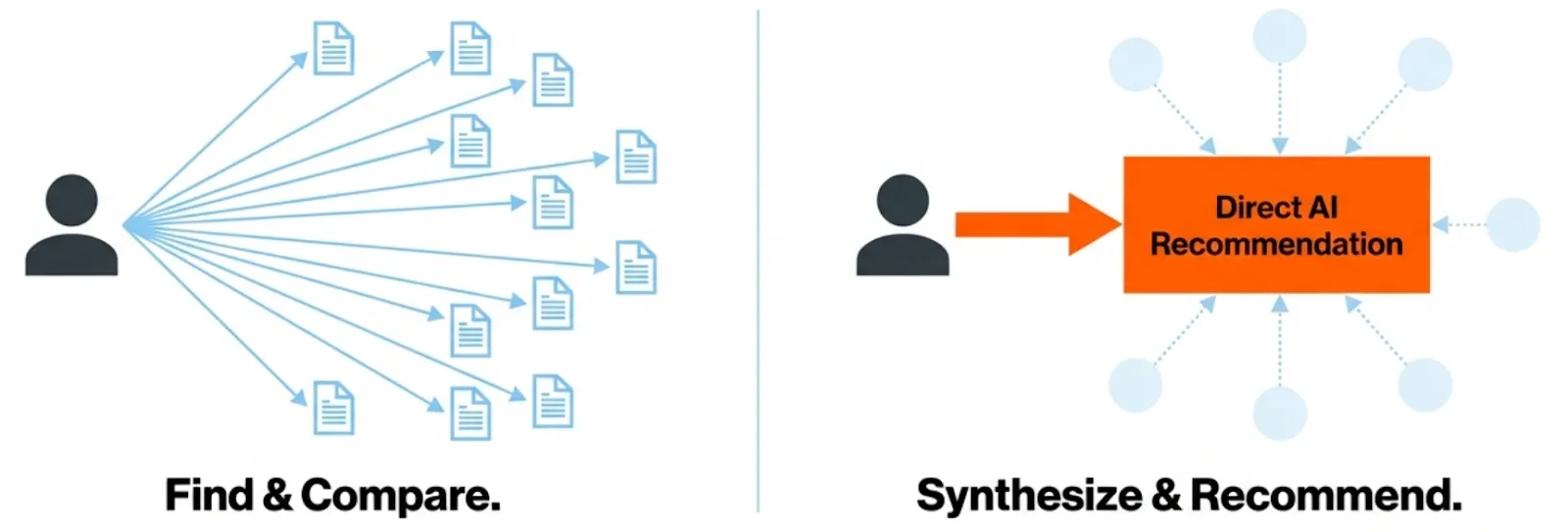
Traditional SEO was built around rankings. A user typed a query, search engines returned a list of links, and the job was to appear prominently for the right terms. That model is being disrupted. AI-powered search and answer engines do not simply retrieve links. They synthesise information, interpret multiple sources, compress them into a summary, and often present a direct answer. The battle is no longer only about ranking on a results page. It is increasingly about whether your brand becomes part of the AI's synthesised answer at all.
Traditional search helped users explore; AI search often helps users decide. When someone asks what the best brand for something is, which company is known for a capability, whether a company is trustworthy, or which brands offer a service, an AI engine may not offer ten links to compare. It may produce one streamlined answer or a shortlist. If your brand is not included in that synthesis, you are not just ranking lower. You may be functionally invisible at the moment preference is being formed. So a brand audit now has to answer a new question: how does AI describe us when no one from our company is in the room to correct it? The output is more fluid, the source signals are distributed, and the final description can be hard to trace to a single page. That makes auditing more important, not less, because if you do not know how AI systems represent your brand, you do not really know how part of the market now sees you.
The new brand audit looks at interpretation, not channels.
A conventional audit might check website messaging, search results, review sentiment, social profiles, brand consistency and competitor positioning. A modern AI-era audit needs to go further and evaluate brand presence in AI-generated responses, sentiment in AI summaries, knowledge graph integrity and factual consistency, competitive inclusion in AI comparisons, and the gap between your intended brand narrative and AI's version of it. That gap is where risk starts to build.
The hallucination hazard is a brand risk, not just a tech problem.
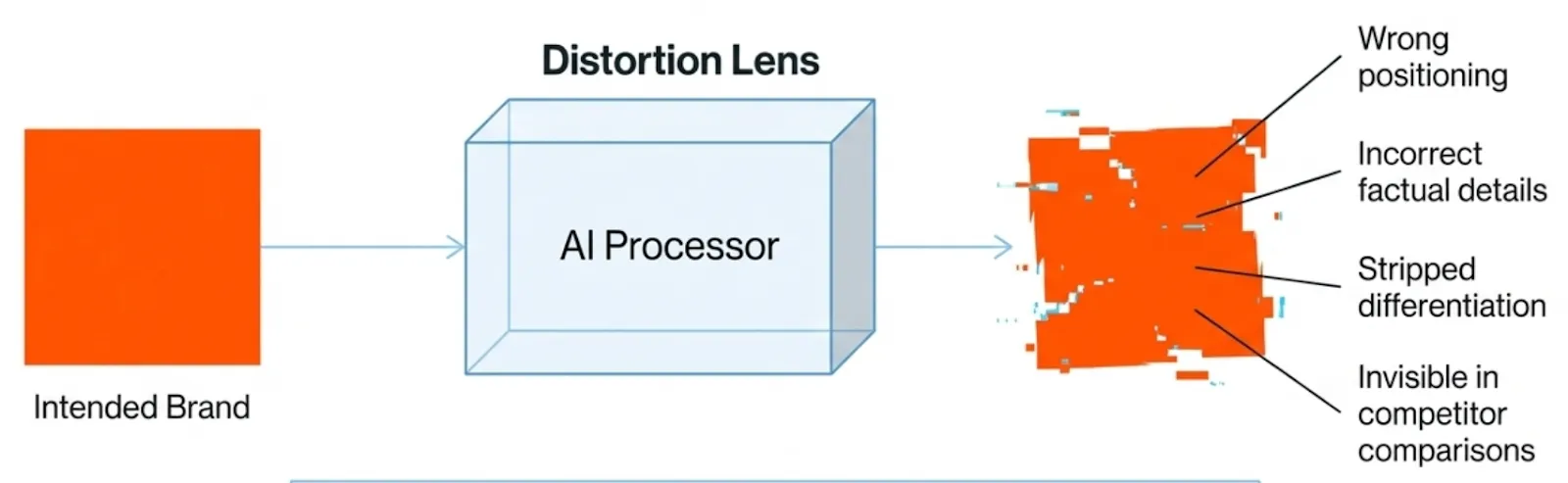
Many marketers still talk about hallucinations as if they are just an AI product flaw. For brands, they are a reputation risk. Large language models are probabilistic systems. They do not know your brand the way a person inside your business does; they predict and assemble likely answers from the information ecosystem around them, which means they can state incorrect things with confidence. They may get your product offering, leadership details, service coverage, pricing model, positioning, brand relationships, or market category wrong. The real problem is not just that these errors can happen, but that they may happen convincingly.
That creates one of the biggest blind spots in modern brand management: many companies do not know when AI is misrepresenting them until the misinformation has already influenced perception. That is why brand audits in the AI era should be treated as preventive reputation management. A proper audit surfaces hallucinations before they become repeated assumptions in customer conversations, sales objections, or internal confusion among prospects comparing vendors. It is the difference between reacting to misinformation after it affects trust and identifying it early enough to strengthen the source signals feeding the AI ecosystem. In that sense, an AI brand audit is not just diagnostic. It is protective.
The risk becomes more serious in high-intent moments. If a user asks whether a brand offers enterprise support, whether a company is available in a given market, what makes a platform different, who its founders are, or whether it is credible, and the answer is wrong or skewed, the brand may lose trust before the buyer ever reaches the website. That is what makes hallucinations different from a minor inconsistency on a forgotten page: they can affect perception at the exact moment a user is trying to make sense of your brand quickly. That is a commercial problem, not a technical inconvenience.
The risk is neither hypothetical nor rare.
- Eight AI search engines answered sourcing questions incorrectly in more than 60% of tests (Tow Center, Columbia, 1,600 queries, 2025).
- Hallucination rates run from about 1.8% on the best models to over 24% on the worst (Vectara Hallucination Leaderboard, 7,700+ articles, 2026).
- The engines disagree: Google AI Overviews were about 44% more likely than ChatGPT to surface negative brand sentiment, and the two flagged different brands about 73% of the time (BrightEdge, 2026).
An audit that checks only one engine misses most of the picture.
Courts and headlines are catching up. In 2024 a tribunal held Air Canada liable after its chatbot invented a refund policy (Forbes, 2024). In 2025 a US radio host sued OpenAI after ChatGPT fabricated an embezzlement claim about him (Walters v. OpenAI, 2025).
The exposure of an AI stating something false about your brand is now a board-level question.
The knowledge graph is becoming the new brand homepage.
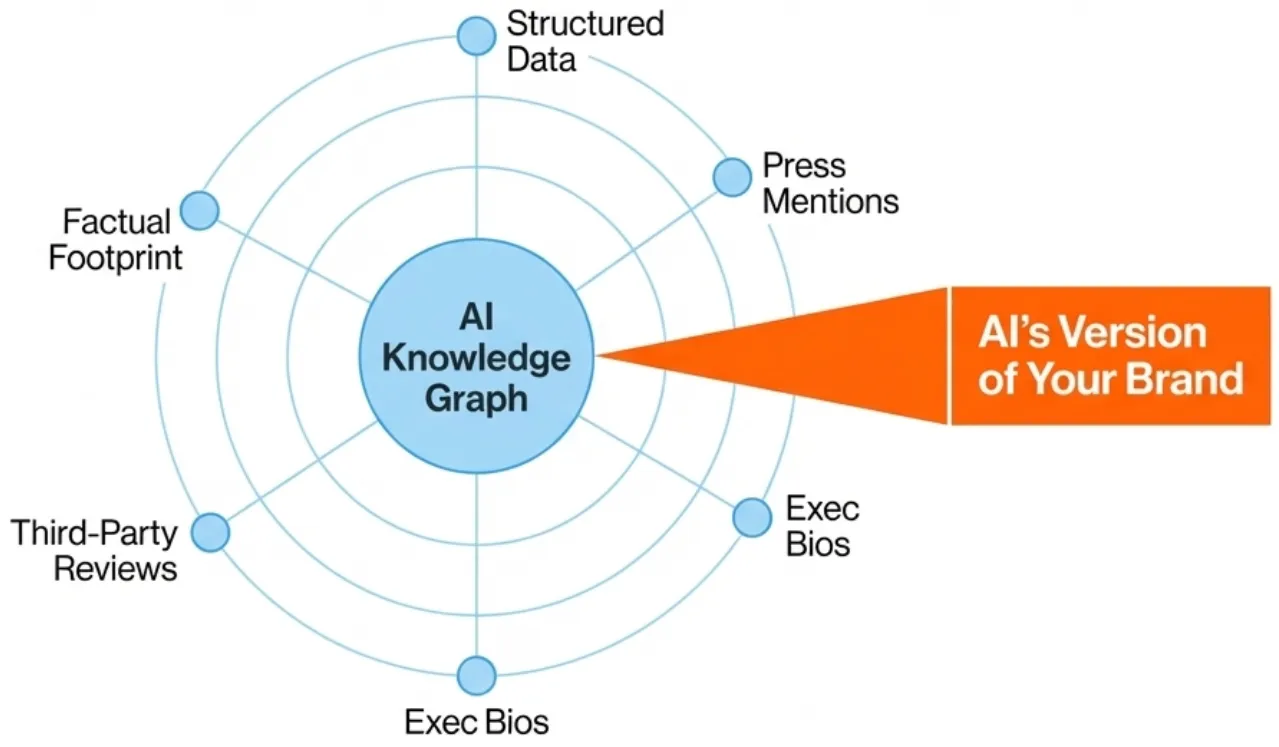
For years we treated the brand website as the main digital home of the business, the place where people got the official story. That is still important, but in the AI search era your website is no longer the only, or even the first, place where people form their understanding. Increasingly, users ask AI first, and what AI returns is shaped by a kind of externalised brand memory: your structured data, press mentions, executive bios, category associations, content footprint, factual consistency, and the overall information ecosystem around your brand. The AI representation of your brand is becoming a new kind of digital homepage. Not one you fully own or directly design, but one that may shape first impressions just as powerfully.
This is where knowledge graph integrity becomes critical. If the facts AI systems hold about your brand are incomplete, outdated, contradictory or overly dependent on weak sources, your digital identity becomes unstable. You may think your brand story is clear because it is accurate on your website, while AI is summarising a very different version. Brands now need to pay closer attention to their AI-DNA: structured data, factual content, press releases, leadership bios, product and service descriptions, company milestones, citations across authoritative sources, and the overall consistency of their digital identity signals. A brand audit in this environment is not just a communications exercise. It is a diagnostic process for the new reputation infrastructure your brand depends on.
It also shows where the fixes live. AI answers lean on independent sources: earned and third-party media account for roughly 82% of AI citations, while brand-owned sites supply only about 5% to 10% (Muck Rack, 1M+ citations, 2025).
So a real audit checks two things: your own entity data, and the third-party sources AI reads. That split is why Growth.pro's PAVA framework separates entity integrity (Presence) from independent authority (Authority).
Why modern brand audits matter for three audiences.
Brand owners need to understand that AI visibility is no longer experimental. It is a business perception issue. If AI systems describe a company incorrectly, omit it from relevant comparisons, or summarise it in ways that weaken trust, that can affect customer acquisition without showing up clearly in traditional performance reports. A modern audit helps answer whether the brand is represented accurately, whether the narrative is reflected clearly, and whether there are misinformation risks the team does not yet see.
In-house marketing teams are now asked to protect the clarity of the brand across an increasingly fragmented discovery environment, not just manage channels and campaigns. A brand audit becomes part of performance, reputation and demand generation strategy, helping uncover whether brand messaging is being translated properly by AI systems, where factual gaps are causing confusion, and which assets need stronger public signal consistency.
Digital marketing agencies should note that the reporting standard is changing. Treating brand audits as mostly visual, messaging and search-result consistency checks misses one of the fastest-growing layers of digital perception. Clients increasingly need help understanding how their brand is being reconstructed by AI, which gives agencies a larger strategic role: auditing narrative accuracy, identifying hallucination risks, evaluating AI brand presence, benchmarking AI representation against competitors, and strengthening the source ecosystem shaping that output.
What an AI-era brand audit should answer.
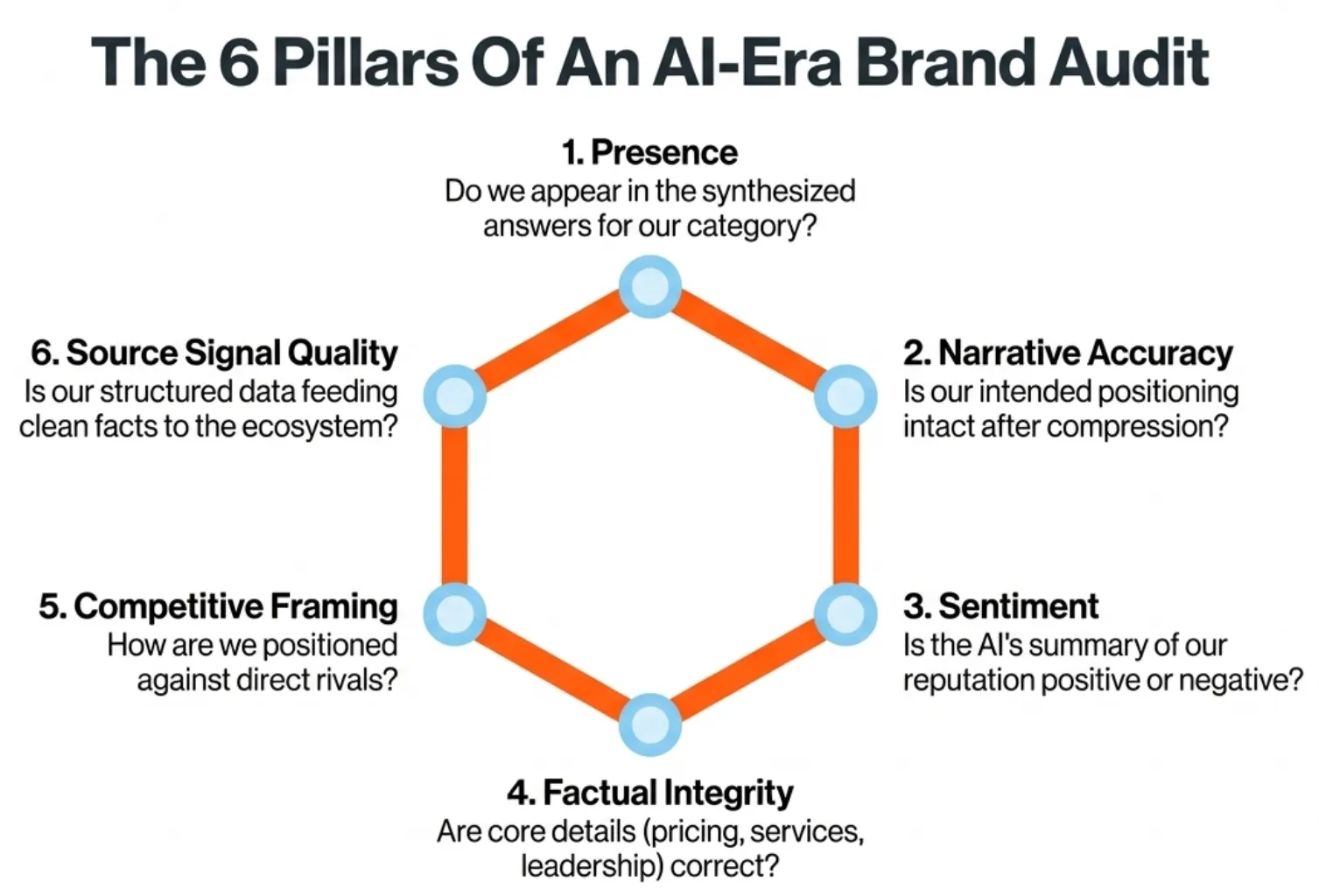
- Brand presence. When people ask AI about our category, problem or competitors, does our brand appear at all?
- Narrative accuracy. When AI describes our company, does it reflect our intended positioning, value proposition and identity?
- Sentiment. Is the tone around our brand generally positive, neutral or negative in AI-generated summaries?
- Factual integrity. Are core details about our products, services, leadership or mission represented accurately?
- Competitive framing. How does AI compare us against competitors, and are we positioned as credible, differentiated and relevant?
- Source signal quality. Are our public digital assets strong enough to support accurate AI interpretation, or do gaps and inconsistencies leave room for distortion?
Why this matters for revenue, not just reputation.
It is a mistake to treat brand audit work as purely defensive. In the AI era it is also offensive. A strong audit can uncover opportunities to improve inclusion in AI-generated answers, strengthen branded trust signals, reduce misinformation before it affects conversions, align public-facing content more tightly with strategic positioning, and make the brand easier for AI systems to understand and summarise correctly. This matters because AI search is not just influencing awareness. It is influencing shortlisting. If buyers rely on AI summaries to narrow options and compare providers, being accurately represented becomes part of conversion readiness.
The brands most exposed to AI perception risk are not always the small ones. Even established brands can be vulnerable if their digital footprint is fragmented, public information is outdated, structured data is weak, brand architecture is unclear, product messaging is inconsistent, or third-party signals dominate the narrative. In some cases larger brands are more exposed, because they have more moving parts, more sub-brands, more legacy content, and more opportunities for contradictory information to surface. A good audit does not just point out problems. It helps brands move from passive exposure to active management: identifying misinformation risk, understanding how AI interprets the brand today, finding narrative gaps, benchmarking against competitors, prioritising which assets need strengthening, and improving the factual consistency feeding the wider AI ecosystem.
This moves real decisions. When AI and a brand's own messaging conflict, only 29% of consumers trust the brand outright and 54% seek outside validation. 47% had already acted on AI brand information: 17% switched brands, 19% avoided a purchase (Skyword and Dynata, 1,000 US adults, 2026).
Wrong facts are not cosmetic. They move revenue.
Final thoughts.
The role of a brand audit is changing because the nature of brand discovery is changing. We are moving from a search environment built around links to one increasingly shaped by synthesis, summarisation and AI-mediated interpretation. Brands can no longer afford to ask only whether they are ranking, whether messaging is consistent, and whether channels look aligned. They also need to ask how AI is representing them, what facts AI thinks are true about them, whether they are being included, misrepresented or overlooked, and what is shaping their AI-era reputation when customers ask about them. That is why brand audits matter more now, not less. In the AI search era, the goal is not just to publish your brand story. It is to make sure the digital ecosystem understands it well enough to repeat it accurately.
Brand audits in the AI search era.
What is a brand audit in the AI search era?
A brand audit in the AI search era evaluates how AI-powered search engines and large language models represent your brand. It looks at brand presence, sentiment, factual accuracy, narrative alignment, and competitive positioning in AI-generated responses.
Why is a traditional brand audit no longer enough?
Traditional brand audits focus on website messaging, search results, and channel consistency. That is no longer enough because AI systems now synthesise and summarise brand information, which can influence how users perceive your business before they ever visit your website.
Why do brands need to monitor AI-generated answers?
Brands need to monitor AI-generated answers because AI can shape perception, trust, and purchase decisions. If a brand is missing, misrepresented, or described inaccurately, that can affect reputation and revenue.
What are AI hallucinations in a brand context?
AI hallucinations are false or inaccurate claims generated by AI systems about a brand. These may involve products, leadership, services, pricing, or company background, and they can damage trust if left unaddressed.
What is knowledge graph integrity?
Knowledge graph integrity refers to how accurate, consistent, and complete the facts associated with your brand are across the digital ecosystem. Strong knowledge graph integrity helps AI systems describe your brand more accurately.
Who should care about AI-era brand audits?
Brand owners, in-house marketing teams, and agencies should all care. Anyone responsible for reputation, demand generation, digital visibility, or brand strategy now needs to understand how AI systems interpret and present the brand.
How do I fix wrong information that ChatGPT or Gemini shows about my brand?
Start by finding every claim and where it comes from, then correct the sources AI reads: your own entity data and schema first, then the third-party pages that supply most citations. Because about 82% of AI citations are earned or third-party (Muck Rack, 1M+ citations, 2025), fixing only your website usually is not enough.
Why does AI cite competitors or third-party sites instead of my own website?
Because AI systems trust agreement across independent sources. Owned sites supply only a small share of AI citations, so if the wider web is quiet or inconsistent about you, AI leans on whoever it does find, including competitors.
Can my company be held liable for what our AI chatbot tells customers?
It can. In 2024 a tribunal held Air Canada responsible for a refund policy its chatbot invented (Forbes, 2024). Treating your AI's public statements as your own is the safer assumption.
How often do AI search engines get brand facts wrong?
Often enough to audit for it. Eight AI search engines answered sourcing questions incorrectly in more than 60% of tests in one study (Tow Center, 1,600 queries, 2025), and hallucination rates still reach double digits on some models (Vectara, 2026).
See how AI describes your brand when you are not in the room.
Zicy audits your AI footprint across ChatGPT, Gemini, Perplexity, Google AI Overviews and Google AI Mode, flagging inaccurate claims before they reach a buyer.
