Most brands publish more content when they want more traffic.
But what if the real growth lever isn’t quantity—it’s precision?
For our client, an eCommerce brand, the turning point came when we shifted the focus from producing endless blogs to restructuring and enriching existing pages. By aligning with how AI tools and Google interpret user intent, we uncovered hidden opportunities sitting in plain sight.
The outcome? Not incremental change, but a step-level jump in performance.
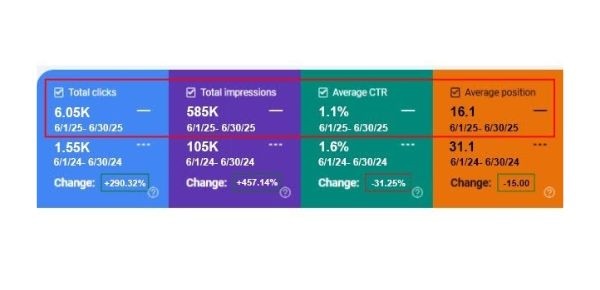
The results (June 1 – June 30, 2025 vs June 1 – June 30, 2024)
Here’s the change we saw in a YOY comparison:

- Monthly clicks surged 290.32%, climbing from 1.55K to 6.05K
- Monthly impressions grew 457.14%, from 105K to 585K
- Average search position improved by 15 spots, from 31.1 to 16.1
What we did differently
- Intent-Led Keyword Clustering
We used AI-driven clustering to spotlight product and category pages with untapped ranking potential, matching them directly with transaction-focused queries.
- Layered Content Enhancements
Instead of adding volume, we enriched key pages with:
- FAQs tuned for buyer questions
- Short trust-building snippets
- Contextual details that improved semantic depth
- Intelligent Internal Linking
AI-guided mapping connected product pages, parent categories, and blogs into a logical content web, amplifying crawl efficiency and signalling stronger relevance to search engines.
- Continuous Optimisation Loop
Every 30 days, we applied micro-adjustments informed by weekly AI performance tracking—ensuring content evolved with user behaviour and SERP shifts.
- Entity-Level Authority Signals
We embedded structured metadata and NLP-driven entity optimisation so that search engines could better associate the brand with topical authority in its product niches.
The big lesson..
This case study wasn’t about writing more. It was about writing smarter.
AI became the lens through which we refined strategy: surfacing content gaps, aligning with buyer intent, and structuring pages so they were easy for both users and algorithms to understand.
The takeaway? Brands that combine human strategy with AI precision don’t just compete in search—they leap ahead.
If your pages aren’t yet AI-optimised, your competitors may already be one step closer to capturing your audience.