Key Takeaways
- AEO/GEO is already creating early-mover advantage in AI visibility.
- AI citation patterns are stickier than traditional rankings.
- Early brands become default references in AI-generated answers.
- Competition is shifting from ranking to being included in a limited source pool.
- Visibility compounds over time through AI memory and citation graphs.
- Waiting reduces your ability to shape category perception in AI systems.
- The biggest risk is not late entry, but complete exclusion from AI discovery.
Introduction
Every major shift in digital marketing starts quietly — until it doesn’t. That’s what’s happening right now with Answer Engine Optimization (AEO) and Generative Engine Optimization (GEO).
As AI systems like Google Gemini, ChatGPT, and Perplexity begin to dictate how brands are discovered, many marketing teams are asking the same question: Should we invest now, or wait until it’s more established?
The short answer? Waiting could cost more than acting early. Here’s why.
Across industries, a clear pattern is emerging: early AEO adopters are already capturing disproportionate visibility in AI-generated answers, particularly for high-intent queries. As AI systems refine their preferred sources, this advantage compounds rather than resets.
What happens if you wait to adopt AEO and GEO?
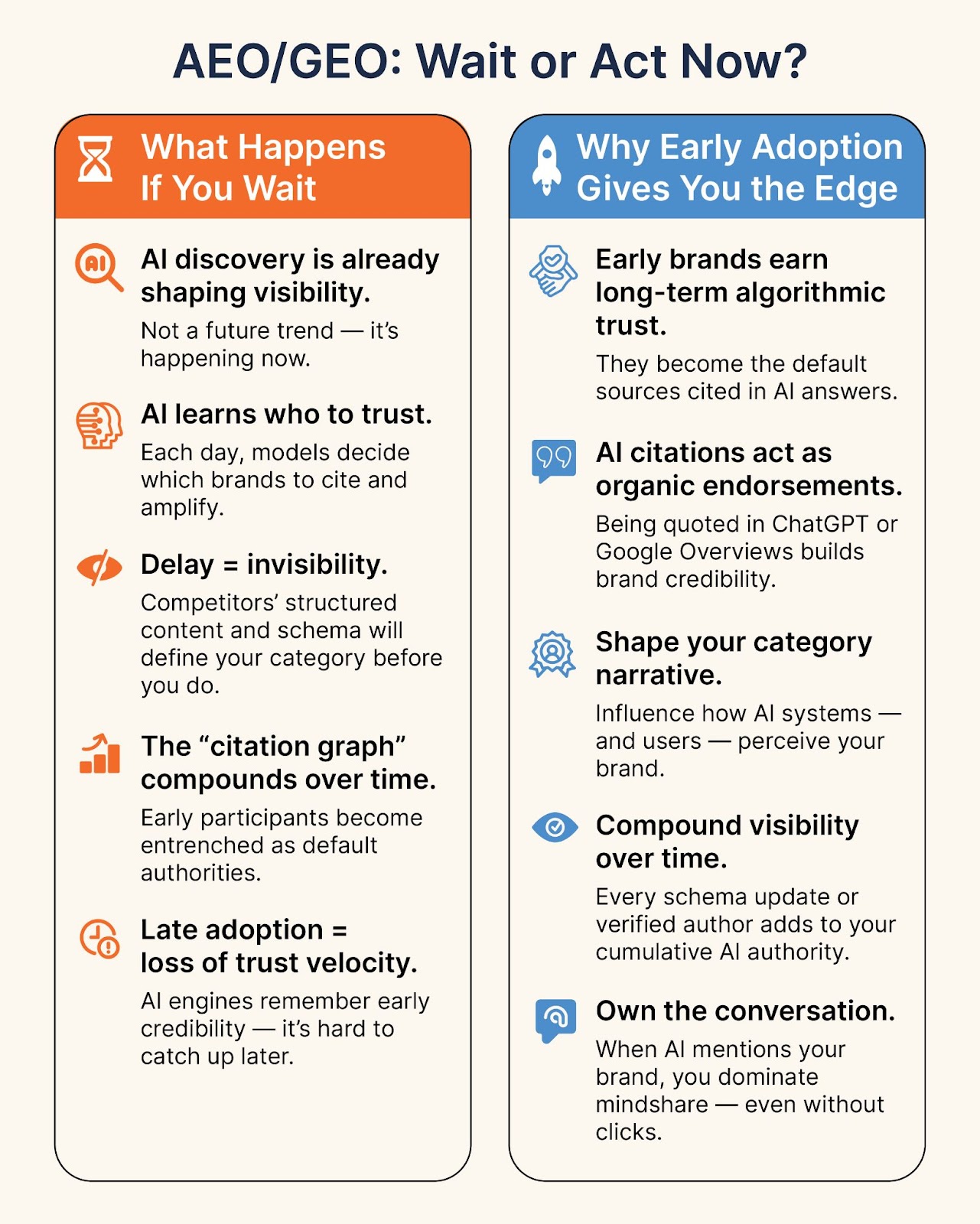
AI discovery isn’t a future scenario — it’s already shaping user behavior. Every day, AI engines are learning which brands to trust, which pages to cite, and which voices to amplify. If your brand isn’t yet visible in these datasets, you’re missing early-mover advantages that are difficult to reclaim later.
The “citation graph” that AI models build — a network of brands and verified facts — becomes more entrenched over time. Early participants are rewarded with long-term authority. Think of it like SEO in 2008: those who started optimizing early now own decades of compounding visibility.
Unlike traditional SEO, where rankings can shift relatively quickly, AI citation patterns tend to be stickier. Once a model consistently retrieves and cites certain sources for a topic, it continues to reinforce those choices unless significantly better alternatives emerge.
Delaying AEO or GEO implementation means your competitors’ structured content, author pages, and entity markups will define your category before you do. In the world of AI-driven discovery, the gap between being late and being invisible is often just a few quarters.
This creates a “default source bias,” where early-cited brands become the baseline references for future answers, making it increasingly difficult for new entrants to displace them without significantly stronger signals.
Why early AEO/GEO adoption gives brands a strategic edge?
The first brands that establish their digital identity as authoritative entities become the default references in AI outputs. These citations — in ChatGPT answers, Google AI Overviews, or Perplexity responses — act as organic endorsements from the world’s most trusted systems.
For marketing teams, this isn’t just about traffic. It’s about shaping brand narrative and market perception. When an AI mentions your company as a source, users implicitly trust you. When it doesn’t, you simply don’t exist in the conversation.
AI-generated answers typically rely on a limited set of sources per response, which means the competition is not for ranking position but for inclusion within a small, high-trust pool. Early adoption increases your chances of entering and staying within this pool.
Read: What Does It Mean to Become an Authoritative Entity for AI Engines?
Moreover, AEO data is cumulative. Every schema update, verified author profile, or well-structured FAQ adds to your long-term visibility index. Just like compounding returns, the earlier you begin, the more exponential your brand’s AI presence becomes.
Over time, this accumulation builds what can be described as AI memory footprint — the extent to which your brand is recognised, retrieved, and reused across different queries and contexts.
How to know if your business is ready to begin now?
You don’t need to overhaul your entire content operation. Start with strategic readiness:
- Audit what AI sees: Check if your robots.txt, sitemap, and metadata allow AI crawlers to access your best pages. Explore: How to Prepare Your Website for Google AI Overviews (Step by Step)?
- Assess your citation potential: Review whether your pages are well-structured, cite credible sources, and have clear authorship signals.
- Benchmark your current visibility: See if your brand or domain already appears in AI responses. Learn: How to Benchmark Your AEO Readiness Against Competitors?
Once you understand your current standing, you can prioritize what to fix first — structure, authority, or content clarity.
A practical starting point is identifying high-intent prompts relevant to your category (e.g., comparison, “best”, “how to choose”) and checking whether your brand appears in AI-generated responses for these queries. This helps prioritise efforts where visibility has the highest commercial impact.
Additionally, businesses should evaluate whether their content is structured into independent answer blocks, as AI systems are more likely to extract sections that fully resolve a single query without requiring additional context.
Conclusion
In the AI era, waiting for “certainty” means waiting until the advantage is gone. Brands that invest in AEO and GEO early won’t just adapt — they’ll define the new standards of visibility and trust.
The real risk is not just falling behind competitors, but becoming structurally excluded from the AI discovery layer altogether, where decisions are increasingly shaped before users ever visit a website.