My name is Richard Bradbury and you're listening to Open for Business. It's the show that dives into the journeys and the ventures of entrepreneurs and of business leaders. Now, this morning on the show, I'll be speaking with Alvin Koay. He is the founder and CEO of Growth Pro, a Penang-based SEO and digital marketing agency. That's using AI to help brands transition from traditional search strategies to AI-driven visibilities. Now, with AI-powered interfaces changing how consumers search for products and services, conventional keyword-based SEO is starting to lose that elusive touch. Founded in 2019, Growth Pro's approach comes from what they call AI citation engineering. That focuses on helping brands become the direct source for AI system references, rather than simply competing for rankings. We kind of had a bit of a conversation not too long ago. But in this conversation, we'll be discussing how they built the platform, the business model, and revenue mechanics behind performance-first marketing, as well as what it takes to grow and stay relevant in a rapidly evolving digital economy. Alvin, welcome back to the show. Thank you for coming in.
Alvin:
Thanks for having me.
0:08 Richard, BFM:
Nice that you're in town this time as well. Let's start off with, you know, you've built and scaled businesses before. And even won a global startup competition uh hosted by the Guardian.
Seven years in now then, what made you decide to stick with this venture at this stage of your career?
1:46 Alvin:
So, at that venture when I won the Guardian competition, it was sadly disrupted. So Google and Facebook ate up our lunches and we lost all the money and I had nothing to do. I was flat broke and I had to go to my mom. My mom is a retired teacher with a little bit of savings and I said, 'Hey mom, I need help. I've got three growing children to feed and I'm broke. My wife is not working.' And I was about close to 50 at that time. And then I said, 'Okay, I need to do something, what do I have? Okay, I've been a digital native for many decades. And I thought, okay, I think I will start something which is SEO. So with just a few tens of thousands of a loan from my mom, I started an SEO company. So what we did was with that little bit of money, I started buying courses from all the world's best SEO gurus and I studied all of them and I just literally modeled what they did and and tried to hustle and look for my first client.
Richard, BFM:
Okay, I want to stick with that for a little bit then. Because this might alter the narrative of my conversation with you. You are hitting 50 at that point. You know, you've lost everything financially. Having gone from being an award-winning, you know, business. That must have been a humbling experience to have to go through at that stage of your career.
3:30 Alvin:
Oh that that's part of entrepreneurship and even before that I have crashed and burned many times. So the life of an entrepreneur is always this roller coaster.
Richard, BFM:
Right. What is it that keeps bringing you back then? You know from, is it an addiction to the hustle? Is it the I need to prove myself? Is it I don't want to belong in a normal corporate kind of situation, you know?
3:55 Alvin:
Well, it's a little bit of age, right? First thing is, I did not manage to go to university. Right. So I don't have a degree and I don't think many people will hire me. So like they say, innovation, ah sorry, desperation is the mother of all innovation. Right. So when you are desperate, you need to hustle and look for stuff to stay afloat. That's what I did.
Richard, BFM:
What was it about SEO then at that time that drew you to it? Why did you think that this is a space I want to sit in for a while?
4:33 Alvin:
So many years back when I was about early 20s, I started an e-commerce company. And at that time Google, I think it was in 1998, Google was just in beta. And those search engines were like AltaVista, Yahoo, and Excite and all that. So when I started those that particular e-commerce company, I knew I needed to get business off the ground. So what I did was um there's this thing called SEO how to hack or rather how to get ranked highly in AltaVista and all that and at those times SEO was very easy. Right, it's to an extent that you just need to be, if your domain name is early in the alphabetical order, then you are placed highly in the directory. Yeah. At that time the directory was Yahoo and DMOZ and all that stuff. So I registered a domain name called CoolVCD. So it started off with C and we were ranked very highly and we got a lot of traffic from there. Right, so at that time that uh e-commerce business was selling original video CDs all over the world. Right, and we were one of the earliest pioneers of e-commerce. So from there, I learned a little bit about how to rank, and we got so much business from the search engines. At that time I thought, 'Oh, this works.' During those days, the internet population was only 200 million, as compared to today's 3 billion. So I had my early taste of success through search engine optimization. So 30 years later, when I failed at everything, I said, 'Okay, let's go back to my roots and let´s do this.' But Google, more than 30 years later, is a different engine, or rather animal altogether. So you need to rework all your strategies. And that's what we did.
6: 30 Richard, BFM:
I just remember those days of the early internet, you know, Ask Jeeves, AltaVista. My gosh, what a world that was living in.
So along this journey then, and where we are now, when did you realize that traditional SEO was no longer enough in this AI-driven discovery, and that AI-driven discovery would fundamentally change the rules of digital marketing? When did you realize that?
Alvin:
Probably one year after ChatGPT started, there was a lot of chatter in the market that SEO is dead. But then again, there has always been the narrative that SEO is dead for at least more than a decade now. But this time, when ChatGPT came about, I really felt threatened because I could not afford to fail again at that age. The company, Growth Pro, was already growing. We had about 30 over full-timers, and I knew that I cannot fail this time. So when ChatGPT came about, I was very worried and had to think of ways to prevent the disruptions. Incidentally, I have a very close friend who we failed in business with. He was my business partner, Peter Kua. He is one of the top data science strategists in the country, or rather in the region potentially. I knew I had leverage, because with him being a data strategist and knowing the tech about algorithms, we had the advantage to try to reverse engineer the algorithms of the large language models. We started playing with OpenAI, with the LLMs, and building up knowledge bases, and it just clicked, because all the while when we were trying to optimize for Google, we realized that what we learned on these embeddings and LLMs, it has some similarity with the Google that we have been optimizing for.
8:50 Alvin:
So we thought, 'Hey, I spotted a pattern. We can do this.' So what we did was we really dug in deep and hard on how Google functions. And because we are also hands-on building out solutions with the LLMs, then we are able to spot these algorithms and we know how to optimize for it. We tried it with our own digital assets, and it worked.
9:20 Richard, BFM:
Right. Before we jump into a break then, you and I spoke on Marketing Mojo not too long ago, and we kind of spoke a little bit about this. But just to refresh our memory, when we look at 'AI first', what does that actually mean in operational terms for your business? And why does it matter today in modern marketing strategies?
Alvin:
AI first, yeah? So basically, AI is a force multiplier. If you are very smart, you can multiply your intelligence by a huge percentage. So how do you leverage on this technology? One of our key strategies to execute for our clients is actually to build SEO-structured content. But when AI comes about, we know that AI is a totally different animal. The algorithms work differently. It has to be very efficient to grab content for the answer engines. Now, we spotted a certain structure of how to optimize for AI. But how do you do it at scale? We started using AI to do it at scale, and we said, 'Okay, let's do this for all our clients so that when the AI engines come in and grab content from your website, it can do it so efficiently and love it so much that it will float up all your content in the answer engines. Because of our leverage on building out knowledge bases and using LLM technologies, why don't we leverage this and win it for our clients?
11:55 Richard, BFM:
Let's talk a little bit about AI citation engineering and its business logic. Let's talk about your focus, which is AI citations rather than just rankings. Commercially speaking, how does citation visibility translate into a measurable ROI for your clients?
Alvin:
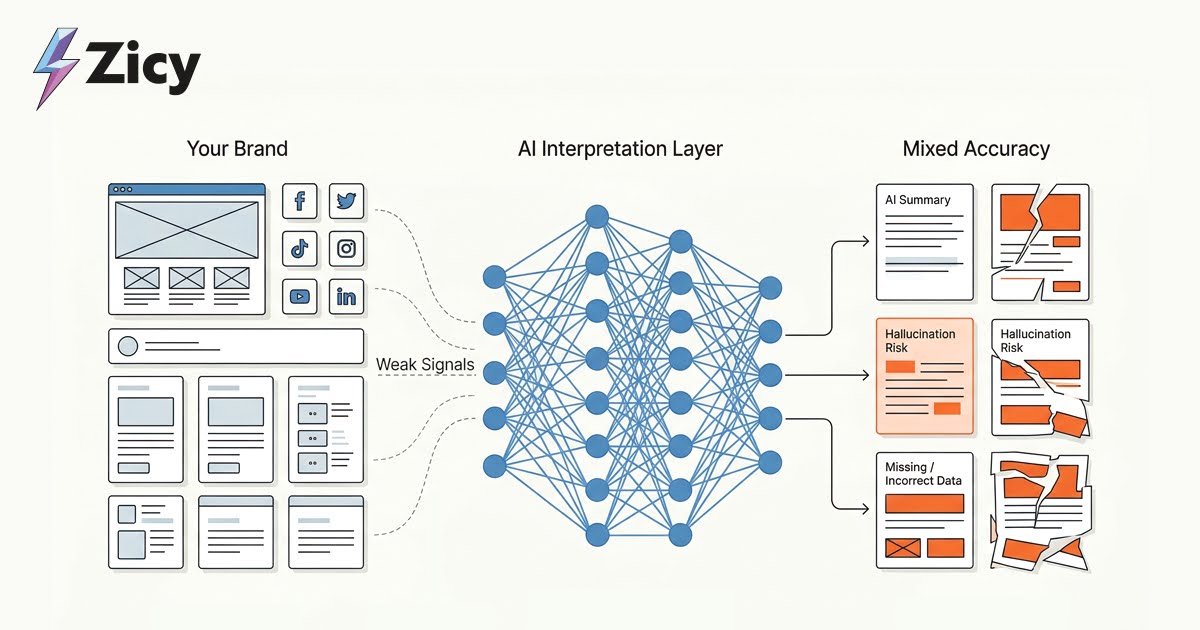
That's a good question. So transitioning from SEO to the search behavior in AI search, you got to understand how SEO works. SEO is based on ranking algorithms. Someone puts in a search term, and because it's a short two or three phrases, Google does not have much context. So it has got to grab as much as possible, use an algorithm, look for content from publishers, and rank them accordingly based on the comprehensive content that can cover the contextual relevancy of those few keywords. You rank it, and it's based on expertise, authority, and trust. Those kind of content will be very comprehensive and long. But now, with the answer engines, you don't put in two or three keywords; you actually ask a long-form, multi-part query, and sometimes even the query can be a paragraph long. Because of that, the answer engines will fan out its queries based on the multiple entities within that query. It will fan out dozens of sub-queries and grab content from its training data and the latest information from the open web. Right, so when that happens, it uses a lot of credits, or rather, tokens. If it's not efficient to grab all this content, it's going to cost the LLMs a lot of money. So you need to structure it differently to lay down the red carpet for the bots to grab content efficiently. Now, back to the SEO piece of content which is very comprehensive. If you are not structuring those content properly for the AI, it costs a lot of tokens. So traditional legacy SEO content potentially can be a liability to answer engines. Now, you need to go back to your SEO content, chunk it down, structure it with proper schemas and ways to tell the bots how to treat those content. Then it will be efficient, and the bots will love it. What does it mean? Some companies that have been doing SEO for ages with long-form comprehensive content, they may be sitting on a liability where the answer engines find it difficult to grab content from them, and then they are not cited. So what we do is we help our clients to restructure their legacy SEO content and improve and enrich it so that the answer engines love it.
15:20 Richard, BFM:
And how do you monetize it then? Do you charge them like, 'come in, we'll take a look at your website, we'll do an audit, and we can give you a fee for doing your website and everything'? Is that how it works?
Alvin:
More or less, yes. So it is a managed service where the strategy and the consulting, and at the same time the execution. Not only the strategies, consulting, and execution part of it; we create content, we enrich or layer new content for them, or we come out with a content clustering strategy and do it for them. Of course, we'll take care of the technicalities of the websites. At the same time, the biggest portion is the monitoring. The monitoring of the most important queries for their products or services in certain geographic locations. We monitor all of them, and what are the new KPIs for marketers, or rather, brands or companies? How much are you being mentioned and cited by the answer engines? Whether the citations or the mentions are favorable? Are you even in the conversation when the answer engines give out the responses? And if yes, how much of it as compared to your competitors?
16:42 Richard, BFM:
Okay. I want to ask you a question about trust and transparency, in a way. I read an article just fairly recently about a journalist who had managed to get himself into the high rankings of the answer engines by telling them he essentially created his own website, created a story on that website how he was a world champion hot dog eater. And he just kept searching for this world champion hot dog eater or whatever, and gradually over time, he started appearing in the answer engines as this world champion hot dog-eating journalist, even though it was completely fake. None of it was real; it was just a social experiment. Is there a danger of brands kind of taking advantage of this, and who are aware of the know-how, to play the game, if you like? Is there a danger of this happening if we're not careful and cautious?
Alvin:
Potentially, yes. Because the LLMs grab content from the open web, they don't know if it's true or false, and you can do certain engineering work to come out with a narrative. But the danger may not be that huge in the sense that you can win in the answer engines for very novel, small portions of the conversation. Not the generic, universal stuff. So if you are talking about a person who is very good, who has won a lot of hot dog competitions, that is not a general, universal thing. It is a very niche market. Because of its highly niched portion, a small market, it won't cause a big problem. But if you know how to engineer it on certain angles that can cause problems, yes, then it can potentially be manipulated.
18:55 Richard, BFM:
Because it could manipulate news items, it could manipulate all kinds of things over time. I find this area fascinating. Without getting into too much confidential detail, and you don't need to give me names, can you share maybe some examples of your clients who have successfully shifted from legacy SEO strategies to AI visibility? What kind of clients are we looking at?
Alvin:
I want to change the paradigm on this. It's not a matter of moving from SEO to AEO (Answer Engine Optimization) or GEO (Generative Engine Optimization). Generally, SEO is a subset of AEO and GEO. You absolutely need to have the baseline technical SEO in order to be successful in AEO and GEO. Once you have that baseline of SEO, then it's much easier to work on AEO and GEO because it's a bigger scope; you are just doing more things and tracking more stuff.
19:50 Richard, BFM:
Okay, that makes sense. Before we go into a break, what feedback have your clients given you then to show you an improvement in some of their performance metrics?
Alvin:
Of course, so often times, when you are being mentioned very often in the answer engines, then you can see that, if you are using Google Analytics tracking, you can see direct attributions from the answer engines. But when your brand is being mentioned, sometimes there is no link to the citation. It's just your brand, and then you will see brand lift. People are searching more about your brand in Google, or sometimes it's a direct type-in traffic to your website. You'll see the lift and improvement in those numbers.
21:10 Richard, BFM:
Now, digital marketing is becoming, let's say, saturated. Or getting saturated.
It's always been like that, right? Everybody's fighting in that space. But for you, what do you think is that defensible edge that you have compared to other agencies, marketing agencies, companies? What's your single strength you think for this company?
Alvin:
Well, it's the authenticity, that's one. Authenticity of doing great work for your client. Not just, 'these are my deliverables, I'm just going to deliver this, and that's it, and I want my fee.' No, at the end of the day, you want results for your clients. And we have this integrity principle that if we cannot deliver for you, we don't want to take your money. So we don't lock you down in a 6-month or 12-month contract so that we are safe for six months and get the fees for six months even though we don't deliver. So one of the principles is, okay, if in the first month we don't deliver enough, and if you think that we don't deliver enough as we promised, just fire us anytime. No questions asked. So not many agencies can live up to this. And we de-risk the client, and we put the onus back to our strategists or our team to deliver. So they will absolutely need to find ways to deliver. So it's not just a cookie-cutter, 'okay, we do this and that, and this and that.' No, if the result is not there, we have got to really move the needle and shake the tree and go back and layer more stuff and think of other strategies just to move the needle. Right, so that's the authenticity that we have.
23:02 Richard, BFM:
And that's what you feel is your DNA as well.
Alvin:
That's our DNA, our culture. Another culture is that we hire the very, very best and very smart people, and we let them do what they want as long as they deliver the results. We have been working from home, we do not even have an office. We have been working from home for the past 18 years, everyone has been working from home. Growth Pro, we started about seven, eight years back, and everyone has been working from home since then until today. So, and the very interesting thing is we don't do on-site client visits. So when you charge hundreds of thousands of dollars per year to a client, most of the clients I have not even met them.
23:50 Richard, BFM:
I want your job.
Alvin:
So a lot of agencies find it kind of unbelievable. Even on the pitching stage and all that, we don't go on-site visits. Everything was on Zoom calls and WhatsApp and we have been doing that for the past seven or eight years. Some of the clients who have been with us for many years, we have not even met them.
23:18 Richard, BFM:
Your clients, are they Malaysian based? Are they regional, international?
Alvin:
Mostly Malaysia, but we have a lot of clients from China because those manufacturers, we have a publicly listed company from China, they do PCB boards, and we help them expand globally. A lot of clients in Malaysia, which are corporates, big companies, insurance companies, and all that, yeah. So, and of course, e-commerce companies from the UK, from the US, SaaS companies from the US, and all that.
24:48 Richard, BFM:
Let me just ask you about the kind of logistics of that, because when I imagine insurance companies coming to talk to you about helping their website, they don't strike me as being the most, I'd imagine they'd want to get you in a room to have a meeting. How do you kind of say, 'No, this is our principle, this is how we work. Take it or leave it.' Is that the kind of... in a polite way, obviously?
Alvin:
So, you have got to absolutely show your subject matter expertise. And you got to show that you can do stuff so much better than anyone else, and there's not many competition in the market who can do what you do. And when you are able to show that, then we don't have to do all the swag and all the fluff and dine and wine the clients and all that. At the end of the day, they know that they cannot find anyone that can do a better job than you. They will come to us.
25:45 Richard, BFM:
What is it that you kind of show them about, 'How this is what we can do for you'? What kind of visuals, metrics do you give them to say, 'Hey, you know, this is how we can get you from this to this'?
Alvin:
So basically, it's content marketing. So we started off with a small entrepreneur's group in Malaysia. So we started posting up case studies. And our case studies is not just like, 'Hey, buy my stuff, buy my service, we are good.' No, what we did was we took a lot of real screenshots, of course we anonymized the information, real actual screenshots, and then we go into very detail on before and after, the exact numbers backed up with screenshots, and almost every strategic execution or tactical execution in point form. So basically, we are giving away the whole playbook.
26:45 Richard, BFM:
Your secret sauce.
Alvin:
Yeah, the secret sauce. And we do it almost every week for the past many years. If you went to our website, you can see that we have more than 100 case studies of these kind of case studies, and I believe we are one of the most number of case studies in the world in terms of SEO with actual screenshots and whatnot. So with that, of course the confidence level is there because it's just consistency, consistency, and consistency.
27:10 Richard, BFM:
We started this conversation with you telling me about how you had lost everything. I want to bring it back around then, and look at where we are now. Let's talk about revenue. When we talk about money, where is the business today in terms of revenue scale and revenue mix? Did you bootstrap, did you raise capital to get here? And where are you... final question of where are you in terms of revenue?
Alvin:
So in terms of revenue, of course we are not more than 10 million dollars a year, not more. And we are trying to move towards there and better that. Right, so of course it's a service-based industry, but at the same time we have also built out a tech portion. We have built out what we call an AI clone of our agency. The very heart and soul, and the strategies, and the tactics, and all baked into an AI agent, and that's where we have built out. That's where we think that we can serve the global market at scale using technology. So with that, we have just launched it, we are using it for all our clients, and it's localized in all the local languages regionally. Well, with that, if all the stars align, then that can be a major revenue generator. Because basically, you cannot scale with human resources. You cannot scale globally with human resources. You can scale with tech, and that's where the next chapter of the company is.
28:48 Richard, BFM:
And that's what I was going to ask you, you know, to keep up with the kind of rapid adoption of marketing technology, what's the biggest operational challenge that you're facing? To keep the business in line with these AI search shifts, because we don't know what happens from one week to the next, often.
Alvin:
So the biggest challenge will be the flexibility and the improvisational moving with the fast-paced disruption that's happening every day. So in the tech startup world, there's this... someone used to say, 'Okay, building a company for a tech startup is like jumping off a cliff and try to assemble the parachute before you hit the ground along the way.' So we adopt the same principle, even though we are a managed service for Growth Pro, we are more human resource-centric, but we move at the tech pace, right? Building out the AI clone of our agency, then we are basically a true blue tech company, and we got to move at that pace.
29:59 Richard, BFM:
My last question for you then, Alvin, before I let you go today. After almost seven years since you started this particular journey with this, what does growth look for you going forward? And when do you think, 'I've achieved what I need to achieve with this'?
Alvin:
Okay, there is no end game for me. Basically, what I'm trying to do is build an ecosystem where amazing people get to thrive in the garden that we've built, and it's such a wonderful thing because we bring good people in, give them a balanced work life, and do stuff with meaning and purpose, right? And we treat them well. So everything is very humanized, and back to the reason why we don't have a contract with clients is because we don't want toxic clients to dictate how our team works, so most of the time there have been many, many cases, even though when there's a contract of 100 or 200,000 on the table for the year, we will just reject that contract because the client is toxic to our environment, to our culture. So we want to build a company for good people to thrive in, so it is like a very humanized kind of culture and company.
31:20 Richard, BFM:
Brilliant. Alvin, thank you so much for talking with me today.
Alvin:
Thank you so much for the opportunity.