I started in SEO at a time when the rules were relatively stable. If you ranked well, you got traffic. And if you got traffic, you had a chance to convert.
That relationship was almost linear.
Today, it isn’t.
Users can get what they need without ever clicking through to a website. And when that happens, ranking becomes less important than something else entirely.
So the real question is no longer about rankings. It’s about whether you are part of the answer in the first place.
– Alvin Koay, Founder Zicy.com & Growth.pro
What we will discuss:
- The shift in how search engines are evolving into answer engines [04:20]
- Whether SEO is truly dying or simply evolving [04:56]
- How answer engines retrieve and synthesise information [06:50]
- Why being mentioned matters more than being ranked [08:55]
- Why traditional traffic metrics are losing meaning [12:28]
- What new KPIs like share of voice actually measure [18:20]
- Why long-form content can become inefficient for AI retrieval [19:20]
- The shift from keywords to entities in content understanding [21:33]
- Why consistency across channels determines AI trust [26:18]
- How AI recommendations influence user behaviour and conversions [28:27]
- The mindset shift required for marketing leaders [29:50]
The shift from search engines to answer engines [04:20]
Search used to follow a very predictable pattern. You entered a keyword. The search engine returned a list of results. And you navigated those results to find what you needed.
There was a process to it.
Now, that process is being compressed.
When you search, what appears first is no longer a list of links. It is an answer—generated directly within the interface.
Google itself is moving in this direction. The AI overview now sits above the traditional results, pushing the familiar search engine results page further down.
There’s an old joke in the industry: “If you’re on page two of Google, that’s where you can hide dead bodies.”
But today, even being on page one is no longer the defining advantage.
Because the user may never reach it.
Is Traditional SEO Dead? [04:56]
The question of whether SEO is dead depends on how you define it. If there were no search engines, would search engine optimisation even exist?
Google is still the largest search engine in the world. That hasn’t changed.
What’s changing is what Google is becoming.
Instead of returning a list of links, it is increasingly behaving like an answer engine by surfacing responses directly, often before users engage with any website.
So SEO is not disappearing. But its role is changing.
It becomes the foundation and the technical and structural layer that supports visibility.
What determines visibility now is something else entirely: whether your content is selected, interpreted, and included in the answer.
AI Search in China – Does it Affect LLMs? [06:50]
This shift is not limited to Google.
In China, platforms like Baidu operate within large, closed ecosystems, often referred to as walled gardens. They have their own large language models, such as ErnieBot.
The underlying behaviour, however, is similar. Traditionally, search required manual effort.
A user enters a query. Reviews multiple links. Visits different websites. And then decides where to transact.
Answer engines remove that process.
When a query is entered, the system breaks it down into multiple entities. Each entity generates a set of sub-queries, which is essentially a fan-out of possible questions.
The system then:
- retrieves information from the open web.
- cross-references it with its training data.
- and compiles a single response.
What used to require multiple steps is now handled in one pass.
That is where the disruption comes from.
If AI Doesn’t Mention You, You’ve Lost [08:55]
This changes the nature of visibility. The question is no longer whether the answer engine sends you traffic.
The question is whether you are present in the answer at all.
If your brand or service is not mentioned, you are effectively invisible.
And if your competitors are being recommended instead, they are the ones capturing that opportunity.
This represents a shift in mindset.
Visibility is no longer about ranking. It is about being cited, mentioned, and recommended. In fact, this creates opportunities for smaller players.
A local car repair workshop in Klang, for example, can be recommended if its presence across its website, Google Business Profile, and social platforms is structured correctly.
Not because it ranks higher. But because it is contextually relevant to the query.
Why Traffic KPIs Are Losing Meaning [12:28]
For a long time, search behaviour was built around keywords. Users entered short phrases like “best life insurance Malaysia.” These queries contained very little context.
Search engines had to infer intent and match it with the most comprehensive and authoritative content available that demonstrated expertise, authority, trust, and a strong user experience.
That content would then rank highly, and users would click through to explore it. This model worked for decades.
But it relied on a limitation: the lack of context in the query.
That limitation no longer exists.
Users now ask complete questions. For example: “I want to bring my family of five to Singapore in December, and I’m looking for a hotel near the zoo.”
This single query contains multiple entities:
- family size
- destination
- time
- specific location
Answer engines process this differently.
They break down each entity, generate sub-queries, retrieve relevant information, and construct a response. In this model, the need to click through multiple websites is reduced.
And as a result, click-through rates are declining significantly.
Even within Google’s AI environments, a large percentage of users do not click through to websites.
So traffic, as a primary metric, becomes less meaningful.
What KPIs are Important Now in AI Search [18:20]
If traffic is no longer the primary metric, the question becomes: what replaces it?
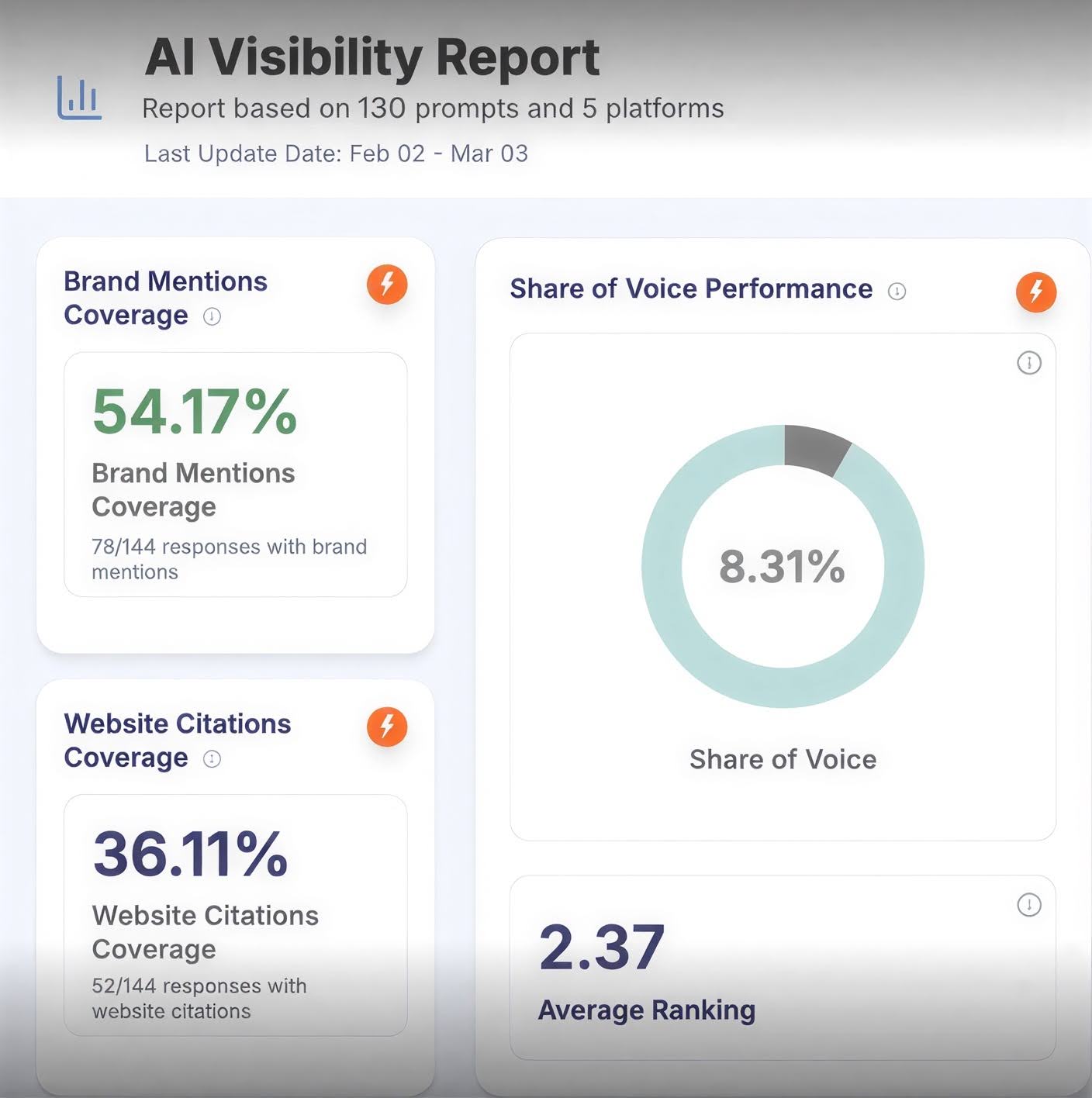
The answer is share of voice. Start with the most important queries related to your business.
Not just a handful, but potentially hundreds.
Let’s say there are 200 high-value queries that your customers are asking across platforms like ChatGPT, Gemini, Perplexity, and Google AI.
For each of these queries, you need to understand:
- Are you being mentioned?
- Are you being recommended?
- How often are you appearing compared to competitors?
This becomes the new measurement framework. Visibility is no longer about how many users visit your website. It is about how often your brand is present in the answers they receive.
Long-Form Content Could Be a Liability [19:20]
There is also a structural issue with how content is consumed by AI systems.
When a user submits a query, the system first checks its training data, which may already be outdated by several months. It then retrieves additional information from the open web to construct a response.
During this retrieval process, efficiency matters. Content must be:
- clear
- relevant
- and easy to extract
If a system needs to process 2,000 to 3,000 words to extract a small number of useful points, it may simply move on to another source.
This means that traditional long-form content (designed to be comprehensive) can become inefficient in this context.
Not because it lacks value. But because it is harder to retrieve.
Keywords vs Entities [21:33]
Traditional SEO focuses heavily on keywords. Content is often written to include specific phrases and their variations.
Answer engines do not rely on this approach. They operate based on entities and contextual relationships.
They can understand the meaning without exact keyword matches.
This changes how content should be structured.
Instead of writing for keyword coverage, content must be structured so that answers can be extracted directly, without requiring the system to interpret large amounts of text.
Clean Data Builds AI Trust [26:18]
Another factor is consistency. AI systems do not evaluate a single source in isolation.
They evaluate signals across multiple channels:
- website
- earned media
- paid media
- social platforms
If these sources present conflicting information, the system loses confidence. When that happens, it may:
- ignore the content
- or generate inaccurate outputs
This is often perceived as a hallucination. In reality, it is a reflection of inconsistent data.
To avoid this, organisations need to align messaging across all channels. Consistency becomes a prerequisite for trust.
Why ‘AI Mentions’ Drive Higher Conversions [28:27]
There is also a shift in how users make decisions.
If you ask a group of runners what shoes they use, and multiple people recommend the same brand, that recommendation carries weight.
AI systems function in a similar way.
When a user receives a recommendation from an answer engine, it is perceived as guidance rather than advertising. This leads to different behaviour.
Users who arrive through AI-driven recommendations:
- already have intent.
- already have context.
- and often already know what they want.
They spend less time exploring. They require less support. And their lifetime value is often significantly higher.
Mindset Shifts For CMOs in the AI Search Era [29:50]
This leads to a broader shift in how marketing should be approached.
The traditional focus has been on driving traffic to websites. But the objective now is different.
It is to be mentioned and recommended by answer engines.
When this happens consistently:
- branded search increases.
- direct traffic increases.
- lead quality improves.
This type of visibility cannot be bought in the same way as paid search.
It must be earned through relevance, clarity, and alignment.
Finally…
One final point.
Many assume that correcting an AI’s response directly will influence future outputs.
It doesn’t.
To influence how AI represents your brand, you need to influence the underlying data.
That means:
- better content.
- stronger contextual presence.
- and consistent signals across platforms.
Because ultimately, AI reflects what it can retrieve.
Source: BFM 89.9
The article above highlights the key points from the episode. For readers who prefer to follow the full conversation or revisit specific details, the complete transcript is included below.